
Your Desk Deserves Green Too — Even Without a Window
The best office desk plants no sunlight conditions can support include Snake Plant, ZZ Plant, Pothos, Peace Lily, and Spider Plant — all of which thrive under artificial office lighting with minimal care.
Quick picks at a glance:
| Plant | Light Need | Watering Frequency |
|---|---|---|
| Snake Plant | Very low | Every 2-3 weeks |
| ZZ Plant | Very low | Every 2-3 weeks |
| Pothos | Low | Every 1-2 weeks |
| Peace Lily | Low | Weekly |
| Spider Plant | Low | Weekly |
| Cast Iron Plant | Very low | Every 2-3 weeks |
| Lucky Bamboo | Low | Weekly (water-grown) |
You spend a huge chunk of your waking hours at a desk. If that desk sits in a dim corner — or a room with no windows at all — it can feel pretty lifeless.
But here’s the thing: a lack of sunlight doesn’t mean a lack of greenery.
Many plants have evolved on the floors of dense rainforests, where almost no direct light reaches them. They’re built for exactly the kind of low-light environment your office creates.
And it’s worth doing something about it. A well-known study found that adding plants to office spaces boosted worker productivity by 15%. NASA research also confirmed that indoor plants filter harmful pollutants — like benzene and formaldehyde — that commonly off-gas from office furniture and equipment.
That stagnant, stuffy feeling in a windowless room? Plants can actually help with that.
Below, we’ve rounded up 15 of the best low-light plants that will genuinely survive — and thrive — on your office desk, no sunlight required.

Why Low-Light Plants are Essential for Windowless Workspaces
When we talk about the best office desk plants no sunlight can reach, we aren’t just talking about decoration. We are talking about a fundamental shift in your work environment. If you work in a windowless office, you likely deal with “stale” air and a lack of connection to the outside world. This isn’t just a vibe; it’s a biological drain.
According to a UK study, bringing greenery into the office environment enhanced productivity by 15%. When we see green, our brains relax slightly, allowing for better focus and creative problem-solving. Furthermore, natural light conditions have a huge impact on mental health and our ability to perform at work. In windowless spaces, plants act as a surrogate for nature, mitigating the negative psychological effects of being “boxed in.”
Beyond the brain, there is the air. Modern office furniture, carpets, and printers release VOCs (Volatile Organic Compounds) like benzene, trichloroethylene, and formaldehyde. A NASA study proved that indoor plants act as natural air filters, absorbing these pollutants and releasing pure oxygen. This results in fewer headaches and less respiratory irritation for employees. If you are looking for more ways to optimize your space, check out these tips on indoor air quality and productivity.
15 Best Office Desk Plants No Sunlight
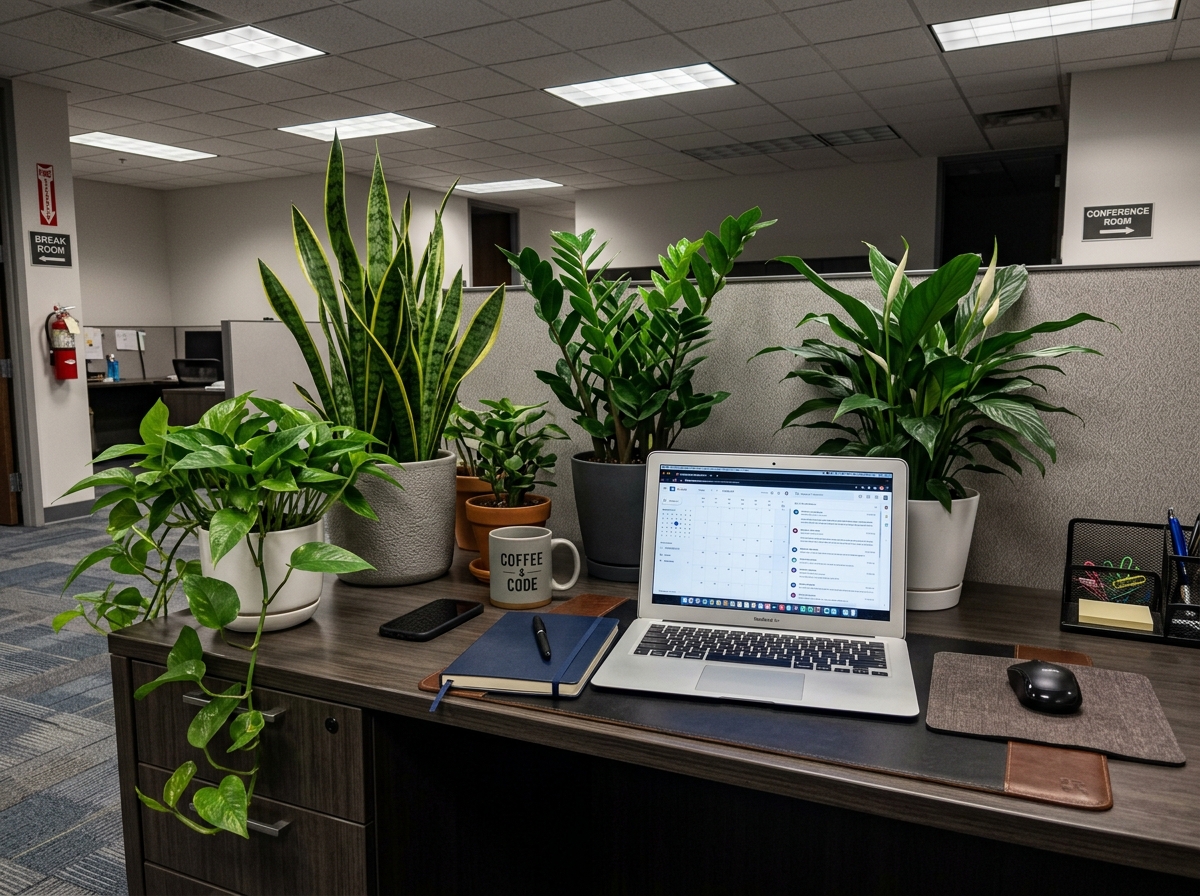
Selecting the best office desk plants no sunlight requires looking for “low-light” specialists. These are plants that have adapted to live under the dense canopy of tropical jungles. In an office setting, they perceive fluorescent or LED overhead lights as their “sun.”
| Plant Name | Max Desk Height | Water Needs | Best Feature |
|---|---|---|---|
| Snake Plant | 1-3 feet | Low (Dry out) | Nighttime Oxygen |
| ZZ Plant | 2 feet | Very Low | Glossy leaves |
| Peace Lily | 1-2 feet | Medium (Moist) | White blooms |
| Pothos | Trailing | Medium | Fast growth |
| Chinese Evergreen | 1 foot | Medium | Patterned foliage |
1. Snake Plant (Dracaena trifasciata)
Often called Mother-in-Law’s Tongue, the Snake Plant is arguably the king of windowless offices. It is a “photosynthesis minimalist.” While most plants release CO2 at night, the Snake Plant continues to produce oxygen, making the air around your desk fresher even after the lights go out. It is incredibly hardy and can survive weeks of neglect if you get caught up in a big project.
2. ZZ Plant (Zamioculcas zamiifolia)
The ZZ Plant is practically made for the modern cubicle. Its waxy, deep green leaves actually reflect light, helping to brighten up dark corners. It grows from thick, potato-like rhizomes under the soil that store water, meaning it only needs a drink about once a month in low-light conditions. It thrives under standard office fluorescent bulbs.
3. Peace Lily (Spathiphyllum)
If you want a plant that talks to you, the Peace Lily is it. It is a dramatic communicator; when it’s thirsty, the leaves will droop significantly, only to perk back up within hours of watering. It is one of the few low-light plants that can actually produce flowers (white spathes) without direct sun, though it may need a bit more ambient light to bloom consistently.
4. Pothos (Epipremnum aureum)
Pothos is the ultimate trailing plant. It’s often called “Devil’s Ivy” because it is nearly impossible to kill. For a desk, we recommend the Jade Pothos variety, as solid green leaves handle low light better than variegated ones. You can let the vines cascade over the edge of your desk or train them to climb up a small trellis for vertical interest.
5. Lucky Bamboo (Dracaena sanderiana)
Not actually bamboo, this member of the Dracaena family is a staple of office feng shui. It can grow entirely in a vase of water with pebbles, making it a “mess-free” desk companion. It prefers filtered water, so let your tap water sit out overnight to allow the chlorine to evaporate before giving it a top-off.
6. Spider Plant (Chlorophytum comosum)
Spider plants are famous for their “spiderettes”—tiny baby plants that hang down from the mother plant. They are world-class air purifiers. NASA rated them highly for removing formaldehyde from the air. They are also incredibly resilient; if the tips turn brown, it’s usually just a sign of fluoride in the water, not that the plant is dying.
7. Cast Iron Plant (Aspidistra elatior)
The name says it all. This plant earned its reputation in Victorian England for surviving in dark, drafty hallways filled with coal smoke. It grows slowly, which is actually a benefit for a desk plant because it won’t outgrow its space quickly. It handles “office neglect” better than almost any other species.
8. Chinese Evergreen (Aglaonema)
If you want color without sun, look for the Chinese Evergreen. While many colorful plants need sun to maintain their hues, the darker green varieties of Aglaonema thrive in shadows. They have beautiful, large, patterned leaves that add a “jungle” feel to a sterile office environment.
9. Philodendron Brasil
With its heart-shaped leaves featuring a splash of lime green down the center, the Philodendron Brasil is a showstopper. It is similar to Pothos in care but offers a more sophisticated color palette. It’s a great choice for indoor plants for office spaces where you want a bit of “cascading green” without the maintenance of a finicky fern.
10. Parlor Palm (Chamaedorea elegans)
Want to feel like you’re working in a tropical resort? The Parlor Palm is a miniature palm tree that rarely grows taller than two feet indoors. It is slow-growing and handles the dry air of air-conditioned offices remarkably well. Most importantly, it is completely non-toxic to pets if you happen to bring your dog to work.
11. Monstera Adansonii
While its big brother (Monstera Deliciosa) might be too large for a desk, the Adansonii (Swiss Cheese Vine) is perfect. Its leaves are full of natural holes, an evolutionary trait designed to let light pass through to lower leaves in the jungle. This makes it highly efficient at capturing the “specks of light” available in a windowless room.
12. Prayer Plant (Maranta leuconeura)
The Prayer Plant is a “living” desk accessory. At night, its leaves fold upward like hands in prayer, and they lower again during the day. It features stunning red veins and intricate patterns. It does prefer a bit more humidity, so it’s a great excuse to keep a small mister at your desk for a 2-minute “refresh” break.
13. Bromeliads
Most people think of Bromeliads as high-light tropicals, but many varieties actually grow as “epiphytes” (air plants) on trees under the forest canopy. They provide a pop of neon color that can last for months. They absorb water through a central “cup” formed by their leaves—just keep that cup filled with a little fresh water.
14. Air Plants (Tillandsia)
If you have zero floor or desk space for a pot, Air Plants are your solution. They don’t need soil at all. You can set them in a decorative glass globe or a piece of driftwood. To keep them alive, simply take them to the office breakroom sink and soak them in water for about 30 minutes once a week.
15. Peperomia
Peperomias are often called “radiator plants” because they are so sturdy. They have thick, succulent-like leaves that hold onto moisture, making them very forgiving if you forget to water them. They come in dozens of shapes and colors, making them the ultimate indoor plants for low-light rooms.
Expert Care Tips for Best Office Desk Plants No Sunlight
Caring for plants in a windowless room is slightly different than caring for them on a sunny windowsill. Without sun, the plant’s metabolism slows down. Here is how to ensure they don’t just survive, but thrive:
- Master the Light: Even the best office desk plants no sunlight can survive need some light for photosynthesis. Standard office fluorescent lights usually provide enough “fuel” if they are on for at least 8 to 10 hours a day. If your office is truly dark, consider a small LED grow light that clips onto your monitor or desk.
- The Finger Test: The #1 killer of office plants is overwatering. Because there is no sun to evaporate the water, the soil stays wet longer. Always stick your finger an inch into the soil; if it feels damp, walk away. Only water when the top inch is dry.
- Dust the Leaves: In an office, dust accumulates quickly. Dust on leaves blocks what little light the plant is getting. Every few weeks, wipe the leaves with a damp cloth. This helps the plant “breathe” and stay vibrant.
- Drainage is Non-Negotiable: Never let your plant sit in a pool of water in its saucer. This leads to root rot. If you want a stylish look, use a “cachepot”—keep the plant in its plastic nursery pot (which has holes) and set that inside a decorative planter. For more ideas, see our guide on low-maintenance air-purifying plants.
Choosing the Right Desk Plant: Size, Style, and Safety
When selecting your greenery, consider the “footprint.” A large Monstera might look great, but if it blocks your second monitor, it’s going to become a nuisance.
- Compact Varieties: For small desks, stick to Peperomia, Air Plants, or small Snake Plants.
- Safety First: If your office allows pets or has visiting children, safety is key. Spider Plants and Parlor Palms are safe, but Peace Lilies and ZZ Plants can be toxic if ingested. Always place toxic plants toward the back of the desk out of easy reach.
- Style: Fiberstone or ceramic planters add a professional touch. Avoid “self-watering” pots for low-light plants; they often keep the soil too wet for windowless environments where evaporation is slow.
- Air Quality: If your main goal is health, prioritize the Snake Plant or Spider Plant. These are essentially workplace comfort mini air purifiers that happen to look beautiful. You can also find more easy-care plants for home air quality to bridge the gap between your work and home life.
Common Mistakes to Avoid with Office Greenery
- Overwatering: We can’t say it enough. In low light, plants need significantly less water.
- Fertilizer Overload: Low-light plants grow slowly. They don’t need much “food.” Fertilizing a plant that isn’t actively growing can lead to root burn. Skip the fertilizer in the winter months entirely.
- Temperature Shocks: Don’t place your plant directly under an A/C vent or next to a space heater. Extreme temperature fluctuations will cause leaves to yellow and drop.
- Ignoring the “Leggy” Look: If your plant starts growing long, thin stems with very few leaves, it’s “stretching” for light. This is a sign you need to move it closer to an overhead light or add a small LED lamp.
Frequently Asked Questions about Best Office Desk Plants No Sunlight
Can these plants survive on LED office lights alone?
Yes! Most modern LED office lights emit a broad enough spectrum for low-light plants to perform photosynthesis. The key is duration. If the lights are on for 8-12 hours a day, hardy plants like the ZZ Plant and Snake Plant will do just fine.
Which best office desk plants no sunlight are safest for pets?
The Spider Plant, Parlor Palm, and Prayer Plant are all non-toxic. While we don’t recommend letting “Fido” snack on your desk garden, these won’t cause serious harm if a leaf is nibbled.
How do I know if my low-light plant needs water?
The “Finger Test” is most reliable. However, you can also look for physical cues: Peace Lilies will droop, and Snake Plant leaves will start to look slightly wrinkled or “shriveled” when they are truly parched.
Conclusion
At Mount Pilchuck, we believe that your workspace should support your health, not drain it. Transitioning to a windowless office doesn’t have to mean losing your connection to nature. By choosing the best office desk plants no sunlight can support, you are investing in your own productivity, air quality, and mental clarity.
Whether you start with a nearly indestructible Cast Iron Plant or a vibrant Philodendron Brasil, adding even one plant can transform a sterile cubicle into a living, breathing sanctuary. Ready to go green? Explore more indoor plants for your workspace and start breathing easier today.
