
Your Air Is More Polluted Than You Think — Here’s the Natural Fix
Air refreshing plants are one of the simplest, most affordable ways to improve the air quality in your home or office. Here are the top options to get started:
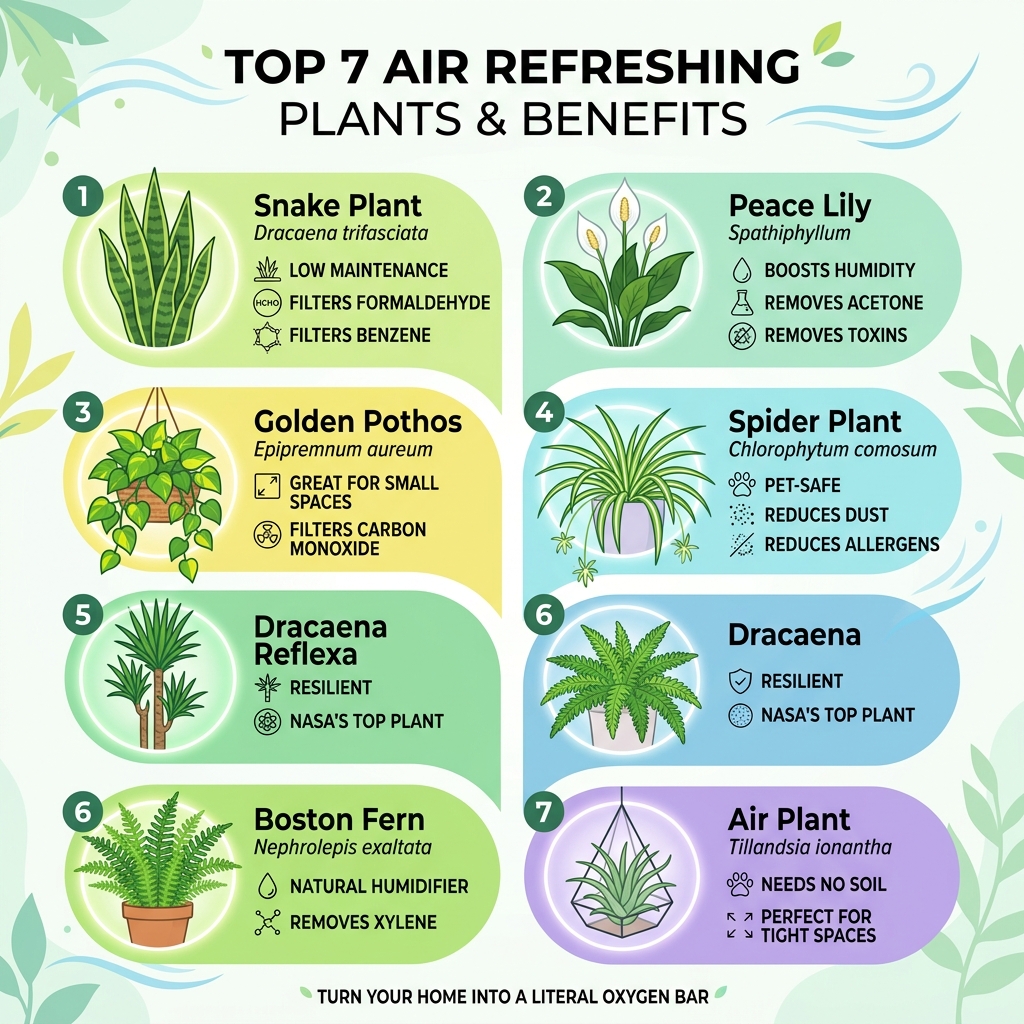
Best air refreshing plants for your home:
- Snake Plant (Dracaena trifasciata) — low maintenance, filters formaldehyde and benzene
- Peace Lily (Spathiphyllum) — boosts humidity, removes acetone and other toxins
- Golden Pothos (Epipremnum aureum) — great for small spaces, filters carbon monoxide
- Spider Plant (Chlorophytum comosum) — pet-safe, reduces dust and allergens
- Dracaena Reflexa — resilient, ranks in NASA’s top air-purifying plants
- Boston Fern (Nephrolepis exaltata) — acts as a natural humidifier, removes xylene
- Air Plant (Tillandsia ionantha) — needs no soil, perfect for tight spaces
Most of us spend the majority of our time indoors. And indoors, the air can be surprisingly bad — filled with invisible chemicals from furniture, cleaning products, and building materials.
NASA’s landmark 1989 study found that common houseplants could help combat this kind of indoor air pollution in a cost-effective way. That research put air refreshing plants on the map for millions of homeowners.
The good news? You don’t need a green thumb or a big budget. The right plants can quietly clean your air around the clock — and they look great doing it.
This guide covers the 7 best air refreshing plants, how to choose the right one for your space, and how to keep them alive and thriving.
The Science Behind Air Refreshing Plants
When we talk about air refreshing plants, we aren’t just talking about a pretty decoration. We are looking at a biological filtration system that has been perfected over millions of years.
The real “Aha!” moment for indoor gardening came from the 1989 study conducted by NASA. Scientist Bill Wolverton was looking for ways to clean the air in space stations, and he discovered that common houseplants were incredibly efficient at removing Volatile Organic Compounds (VOCs).
VOCs are those “new car smells” or “fresh paint” odors that are actually chemicals like benzene, formaldehyde, and trichloroethylene. In modern, tightly sealed buildings, these chemicals can get trapped, leading to “Sick Building Syndrome,” where occupants experience headaches, dizziness, and respiratory issues. By incorporating Health Benefits of Plant Air Filters, we can naturally scrub these toxins from our environment.

How Plants Refresh Air at Night
You might remember from biology class that plants breathe in CO2 and breathe out oxygen during the day. But what happens when the sun goes down? Most plants actually switch roles at night, consuming a tiny bit of oxygen.
However, certain air refreshing plants are overachievers. Plants like the Snake Plant use a special process called Crassulacean Acid Metabolism (CAM). They keep their stomata (tiny pores) closed during the heat of the day to save water and open them at night to take in CO2 and release oxygen. This makes them the Top Air Purifying Plants for Bedrooms, helping you breathe easier while you sleep.
The Role of the Araceae Family
If you’ve ever walked into a garden center, you’ve likely met a member of the Araceae family. This family includes heavy hitters like the Philodendron genus and the Peace Lily. These plants are famous for their broad, waxy leaves which act like giant solar panels for photosynthesis and chemical absorption. They are among the most effective Plants That Filter Toxins from the Air because their large surface area allows them to process more air in less time.
Top 7 Air Refreshing Plants for Your Home
Ready to start your own indoor “oxygen bar”? We’ve narrowed down this complete list of plants to the seven best performers that are easy to find and even easier to keep alive. For those of us who weren’t born with a green thumb, these Easy Care Plants for Home Air Quality are the perfect starting point.
1. Snake Plant (Dracaena trifasciata)
The Snake Plant is the ultimate “set it and forget it” plant. Formerly known as Sansevieria, modern genome sequencing moved it into the Dracaena genus in 2017.
In the wild of West Africa, these plants can grow up to 2 meters (6 feet) tall, but as houseplants, they usually stay around 0.7 to 1 meter (2.3 – 3.2 feet). They are incredibly tough; you can Read the scientific profile for snake plant and learn that they thrive on neglect. Because they grow vertically rather than spreading out, they are excellent Indoor Plants for Low Light Rooms where floor space is at a premium.
2. Peace Lily (Spathiphyllum)
The Peace Lily is as functional as it is beautiful. Its name comes from the white spathes (which look like flowers) that resemble white flags of surrender.
Beyond its looks, it’s a powerhouse for removing acetone (found in nail polish remover) and ammonia. It also naturally increases room humidity, which can be a lifesaver during dry winters. These are fantastic Indoor Plants That Improve Breathing because they help keep your nasal passages from drying out. Just a heads up: they’ll “faint” (droop) when they’re thirsty, making them very communicative roommates!
3. Golden Pothos (Epipremnum aureum)
If you have high shelves or hanging baskets, the Golden Pothos is your best friend. Its cascading vines can grow several feet long, making it one of the best Indoor Plants for Small Apartments.
NASA found it particularly good at filtering carbon monoxide and formaldehyde. It’s nearly impossible to kill, earning it the nickname “Devil’s Ivy.” It’s the perfect entry-level plant for anyone worried about their ability to keep things green.
4. Spider Plant (Chlorophytum comosum)
The Spider Plant is a classic for a reason. It’s one of the few air refreshing plants that are completely non-toxic to cats and dogs.
We love them because they are excellent Indoor Plants That Reduce Dust. Their long, thin leaves act like a magnet for airborne particulates. Plus, they produce “babies” (spiderettes) that you can easily clip off and plant in new pots to grow your collection for free.
5. Dracaena Reflexa (Song of India)
Commonly known as the Song of India, this plant ranks fifth on NASA’s list of air purifier plants. It’s a slow-growing, tree-like plant with beautiful lime-green variegated leaves.
It’s highly resilient and can even recover if you accidentally prune it too aggressively. Because of its thick, lush foliage, it’s considered one of the Best Leafy Plants for Air Purification. Just be careful with tap water; this plant is sensitive to fluoride, which can cause brown spots on the leaves.
6. Boston Fern (Nephrolepis exaltata)
If you live in a dry climate or have the heater running all winter, you need a Boston Fern. They act as natural humidifiers, releasing moisture into the air through a process called transpiration.
They are also specialists at removing xylene and toluene from the air. While they like a bit more attention than a Snake Plant (they love a good misting!), they are still considered Low Maintenance Air Purifying Plants if you can keep their soil consistently moist.
7. Air Plants (Tillandsia ionantha)
Don’t have room for a pot of soil? No problem. Tillandsia ionantha (Air Plant) | North Carolina Extension Gardener Plant Toolbox explains that these unique epiphytes don’t need soil at all.
They absorb moisture and nutrients through their leaves using tiny silvery scales. They are the ultimate Small Potted Plants for Apartments because you can mount them on wood, put them in glass terrariums, or even hang them from the ceiling. To water them, you just give them a 15-minute bath every week and let them dry upside down.
Choosing and Caring for Your Air Refreshing Plants
Selecting the right plant is only half the battle; keeping it happy is the other half. We always recommend checking your light levels first. A plant that is struggling to survive won’t be very good at refreshing your air.
Matching Plants to Room Size
To get the most out of your greenery, you need to think about air volume. A tiny succulent isn’t going to clean the air in a 500-square-foot living room. We suggest using larger, leafy plants like the Areca Palm for big spaces and smaller plants like the Pothos for bathrooms or offices.
Strategic placement is key. Place your plants in areas with Plants to Improve Indoor Air Circulation, such as near a window or a fan, so the purified air can move throughout the room. This is especially helpful for Indoor Plants for Office Spaces where air can often feel stagnant.
Essential Maintenance for Air Refreshing Plants
Most air refreshing plants die from overwatering, not underwatering. We always recommend using pots with drainage holes and well-draining soil.
If you notice yellowing leaves, it’s often a sign of “wet feet” (root rot). On the flip side, brown, crispy edges usually mean the humidity is too low. You can fix this with a simple humidity tray — a saucer filled with pebbles and water placed under the pot. For those on a budget, these Budget Friendly Air Purifying Plants are easy to propagate, meaning you only have to buy one plant to eventually fill your whole house.
Plants vs. Mechanical Air Purifiers
You might be wondering: “Should I just buy a HEPA filter instead?” It’s a fair question. Mechanical air purifiers are incredibly efficient at removing 99.97% of dust and pollen. However, they don’t usually remove chemical gases (VOCs) unless they have a thick carbon filter, and they certainly don’t look as nice.
Plants offer something a machine can’t: Mental Wellness Benefits of Indoor Plants. Studies show that being around greenery reduces stress, lowers blood pressure, and boosts productivity. If you want to see a real-world example of this in action, watch this great video about a gentleman who used specific plants to grow his own fresh air in a polluted city.
The best approach? Use both! A HEPA filter for the dust and air refreshing plants for the toxins and the “soul.”
Frequently Asked Questions about Air Refreshing Plants
Which air refreshing plants are safest for cats and dogs?
This is a huge concern for pet owners. Many common plants, like the Peace Lily and Philodendron, contain calcium oxalate crystals that can irritate a pet’s mouth. If you have curious chewers, stick to Indoor Plants Safe for Pets like the Spider Plant, Boston Fern, or Bamboo Palm.
How many plants do I need to clean a room?
NASA’s original recommendation was one plant for every 100 square feet of floor space. However, to get a “noticeable” boost in oxygen or a total scrub of toxins, more is usually better. We like to suggest a mix of three to five plants of varying sizes for an average-sized bedroom.
Can air refreshing plants help with allergies?
Yes and no. Plants like the Spider Plant are great at reducing dust. However, if you are allergic to mold, be careful not to overwater your plants, as damp soil can grow mold spores. Also, if you have hay fever, avoid high-pollen flowering plants. For more tips, check out our guide on Top Houseplants for Allergies.
Conclusion
At Mount Pilchuck, we believe that your home should be your sanctuary. By bringing in a few air refreshing plants, you aren’t just decorating; you are investing in your long-term health and wellness. Whether you start with a single, hardy Snake Plant or turn your apartment into a full-blown jungle, your lungs will thank you.
For more expert advice on health-boosting greenery, explore our full category/indoor-plants/ and start breathing easier today!
