
One Plant Name, Many Faces: What Is a Golden Cascade Plant?
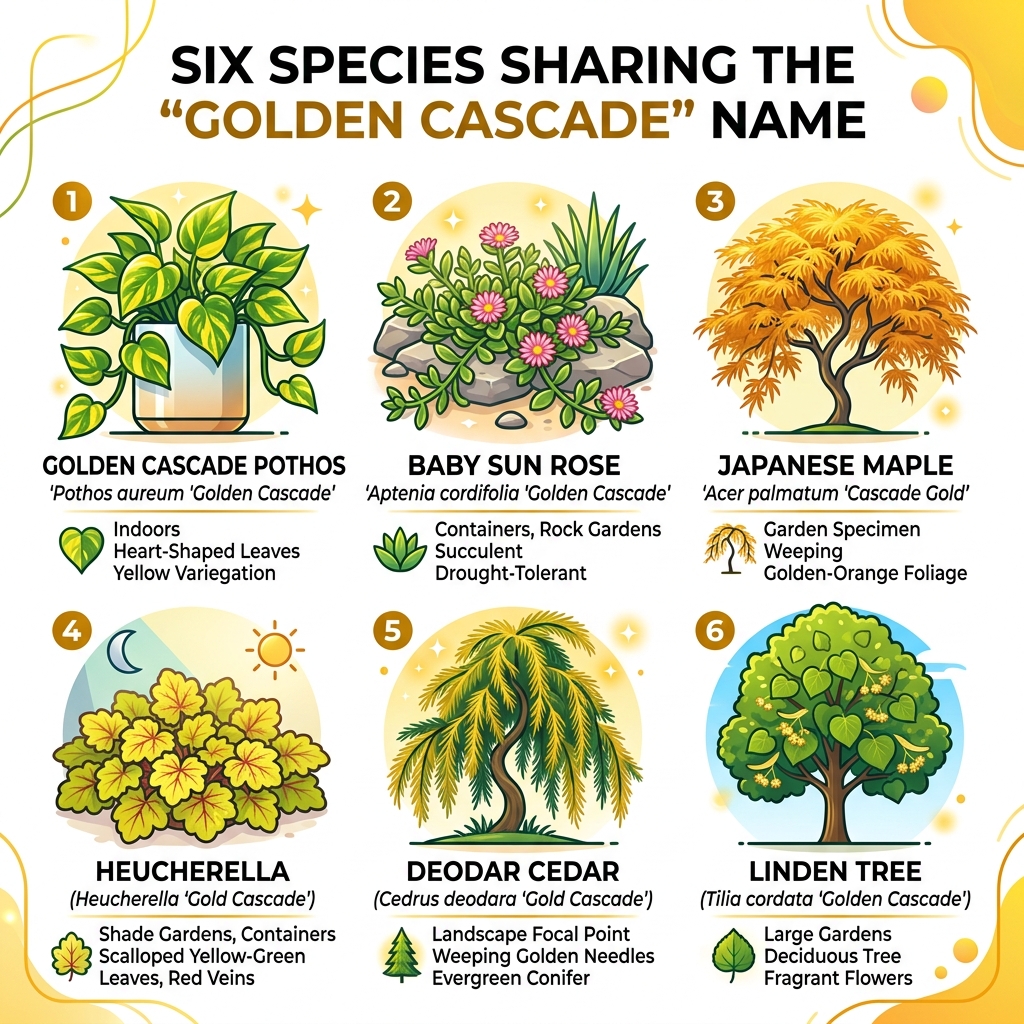
The golden cascade plant is not a single species — it’s a popular name shared by at least six distinct plants across gardens, homes, and nurseries worldwide.
Here’s a quick overview of the most common plants sold under this name:
| Common Name | Scientific Name | Best For | Key Feature |
|---|---|---|---|
| Golden Cascade Pothos | Pothos aureum ‘Golden Cascade’ | Indoors | Heart-shaped leaves, yellow variegation |
| Baby Sun Rose | Aptenia cordifolia ‘Golden Cascade’ | Containers, rock gardens | Succulent, drought-tolerant trailer |
| Japanese Maple | Acer palmatum ‘Cascade Gold’ | Garden specimen | Weeping, golden-orange foliage |
| Heucherella | Heucherella ‘Gold Cascade’ | Shade gardens, containers | Scalloped yellow-green leaves, red veins |
| Deodar Cedar | Cedrus deodara ‘Gold Cascade’ | Landscape focal point | Weeping golden needles, evergreen conifer |
| Linden Tree | Tilia cordata ‘Golden Cascade’ | Large gardens | Deciduous tree, fragrant flowers |
So which one do you actually have — or want?
That depends on where you bought it, what it looks like, and where you plan to grow it. A trailing vine with heart-shaped leaves from an indoor plant shop is a very different plant from a weeping conifer at a garden center, even if the label reads nearly the same.
This mix-up happens because nurseries often use descriptive marketing names rather than botanical ones. “Golden” signals bright, warm-colored foliage. “Cascade” signals a trailing or weeping growth habit. Put them together, and you’ve got a name that fits a surprisingly wide range of plants.
For urban dwellers looking to bring greenery indoors to freshen the air, knowing exactly which Golden Cascade you’re dealing with makes all the difference — some thrive on a shaded shelf, while others need a full sun garden bed to survive.
Decoding the Golden Cascade Plant: One Name, Many Species
We have all been there: you walk into a nursery, fall in love with a plant labeled golden cascade plant, and bring it home only to realize the care instructions you found online describe a giant tree, while you have a tiny vine. This cultivar confusion is a byproduct of the nursery trade, where catchy, descriptive names often take precedence over complex botanical nomenclature.
In botany, names are precise. However, in retail, “Golden Cascade” is simply too good a name to waste on just one species. It evokes images of sunlight pouring over a balcony or a waterfall of shimmering leaves in the corner of a room. Because of this, several different genera have adopted the moniker.
For example, if you are looking for a perennial that loves the shade and offers a “spiller” effect in your patio pots, you are likely looking for Heucherella ‘Gold Cascade’ | TERRA NOVA® Nurseries, Inc.. This plant is a hybrid between Heuchera and Tiarella, combining the best of both worlds: the stunning foliage colors of the former and the trailing habit of the latter.
Understanding these distinctions is the first step to successful gardening. We don’t want you trying to water a drought-tolerant succulent like it’s a moisture-loving Japanese Maple!
Identifying Your Specific Golden Cascade Plant
To tell these plants apart, we need to look at three main things: foliage shape, growth habit, and where it’s meant to live.
- The Foliage:
- Heart-shaped leaves with yellow splashes? You likely have a Pothos.
- Thick, fleshy, succulent leaves that feel like they are filled with water? That’s the Baby Sun Rose (Aptenia).
- Scalloped, deeply lobed leaves with red veins? That is a Heucherella.
- Tiny, needle-like leaves on a woody branch? You’re looking at a Deodar Cedar.
- The Growth Habit:
- Does it climb or trail with long, flexible vines? (Pothos or flowering vines).
- Does it form a low, spreading mat that stays close to the ground? (Baby Sun Rose or Heucherella).
- Does it have a central woody trunk with branches that weep downward like a waterfall? (Japanese Maple or Cedar).
- Bloom Color:
- While many “Golden Cascades” are grown for their foliage, some bloom. The Aptenia variety often has small, “mini” flowers (sometimes green or reddish depending on the specific cultivar), while the Linden tree produces fragrant yellow-green clusters.

Why the “Golden Cascade” Name is Popular
Why do we see this name everywhere? It’s all about marketing and visual appeal. In the garden design world, “vertical interest” and “cascading growth” are highly sought-after traits. Most gardeners want something that breaks up the flat lines of a flower bed or a bookshelf.
Golden variegation is also a massive selling point. Plants with yellow or chartreuse leaves brighten up dark corners and create a sense of warmth even on cloudy days. By combining these two desirable traits—the color of sun and the movement of water—nurseries created a “brand” that sells itself. Whether it’s a majestic tree or a budget-friendly houseplant, the name promises a certain level of elegance and vibrancy.
Top Varieties of the Golden Cascade Plant and Their Traits
When we talk about a golden cascade plant, we are usually talking about one of four or five heavy hitters in the horticultural world. Each has its own personality, size, and hardiness.
The Majestic Weeping Japanese Maple
One of the most breathtaking versions is the Acer palmatum ‘Cascade Gold’ (P) | Japanese maple ‘Cascade Gold’ Shrubs/RHS /details). This is a compact, deciduous shrub that acts more like a living sculpture than a simple plant.
- Appearance: It features a weeping, prostrate habit. The leaves are a stunning yellow-orange with orange-red margins in the spring. As summer hits, they turn a bright, refreshing green before exploding into yellow-orange and red hues in the autumn.
- Size and Growth: It’s a slow grower, taking 10 to 20 years to reach its ultimate height of about 0.5 to 1 meter. This makes it perfect for small city gardens or as a focal point in a courtyard.
- Hardiness: It is quite hardy (H6 in the UK system), meaning it can handle most winters without a fuss, though it prefers a sheltered spot away from harsh winds.
According to Acer palmatum Cascade Gold – Golden Foliage Weeping Waterfall Japanese Maple , this variety was actually bred as a cross between the “Ryusen” (known for its waterfall-like weeping habit) and the “Orange Dream” (famous for its golden color). The result is a plant that literally flows over the edges of containers or stone walls.
The Indoor Favorite: Pothos aureum ‘Golden Cascade’
For those of us focusing on indoor air quality and home aesthetics, the Pothos version is the undisputed king. We often recommend this to beginners because it is nearly impossible to kill.
The Pothos aureum ‘Golden Cascade’ is characterized by its vigorous trailing vines and heart-shaped leaves. Unlike the plain green varieties, this one features striking golden-yellow variegation that looks like it was painted on with a brush. It’s one of our favorite low-maintenance air-purifying plants because it works hard to scrub the air of common household toxins while requiring very little from you in return.
- Best For: Hanging baskets, trailing from high shelves, or even climbing a moss pole.
- Growth Rate: Fast. In the right conditions, it can grow several feet in a single season.
- Maintenance: Low. It thrives in indirect light and only needs water when the top inch of soil feels dry.
The Sun-Loving Succulent: Aptenia cordifolia
If you have a sunny balcony or a rock garden that gets baked by the sun, the Aptenia cordifolia ‘Golden Cascade’ (also known as Baby Sun Rose) is your best friend. This is a trailing succulent that loves the heat.
- Foliage: Vibrant golden-chartreuse leaves that are thick and juicy.
- Hardiness: This is a warm-weather plant, hardy in USDA Zones 9a through 11b. In colder climates, we treat it as an annual or bring it inside for the winter.
- Drought Tolerance: Extremely high. Once established, it needs very little water, making it a “set it and forget it” option for summer containers.
The Majestic Conifer: Cedrus deodara ‘Gold Cascade’
For a truly permanent landscape feature, the Cedrus deodara ‘Gold Cascade’ | Landscape Plants | Oregon State University is a showstopper. This Deodar Cedar originated in Australia and brings a touch of the exotic to any yard.
- Visuals: It’s an evergreen conifer with a dwarf, low-spreading habit. The needles are a brilliant gold, especially on the new growth.
- Versatility: While it naturally spreads out along the ground, you can stake it to grow upright. If you do, it creates a narrow, weeping pillar of gold that looks incredible against a backdrop of dark green evergreens.
- Hardiness: It is hardy to USDA Zone 6, making it suitable for a wide range of climates.
Essential Care Guide for Your Golden Cascade Plant
Because the name covers so many species, care isn’t “one size fits all.” However, we can break down the essentials based on which type you have. We always tell our readers that the key to a healthy plant is mimicking its natural environment.
Light and Temperature Needs
Light is the most critical factor for maintaining that “golden” color.
- For the Pothos: It loves bright, indirect light. If you put it in too much direct sun, the leaves will scorch. If you put it in too little light, it will lose its golden variegation and turn solid green to maximize its food production.
- For the Japanese Maple: Partial shade is actually best for the best leaf color. While it can handle full sun, the delicate leaves might crisp at the edges during a heatwave.
- For the Succulent (Aptenia): Give it all the sun you’ve got! It needs at least 4-6 hours of direct sunlight to stay compact and vibrant.
- For the Cedar and Linden: These are full-sun trees. They want to be out in the open where they can soak up the rays.
If you are looking for indoor options that are also great for your health, check out our guide on the top houseplants for allergies. Many of these, including the Pothos, are excellent at trapping dust and pollen.
Soil and Water Management
The one thing almost every golden cascade plant agrees on is that they hate “wet feet.”
- Drainage is King: Whether it’s a pot or a garden bed, the soil must drain well. For the indoor Pothos, a standard potting mix with a bit of perlite works wonders. For the outdoor varieties like the Japanese Maple or the Cedar, they prefer moist but well-drained soil with an acidic or neutral pH.
- Watering Schedules:
- Pothos: Water when the soil is dry to the touch.
- Aptenia: Water sparingly; it’s a desert native at heart.
- Japanese Maple: Needs consistent moisture, especially in the summer. Don’t let it dry out completely, but don’t let it sit in a puddle either.
- Fertilization: Most of these aren’t heavy feeders. A balanced, slow-release fertilizer in the spring is usually enough to keep them happy. For the Heucherella, aim for a pH of 5.5–6.5 and moderate fertility.
For those on a budget, we have a great list of budget-friendly air-purifying plants that don’t require expensive fertilizers or fancy setups.
Best Placements: From Indoor Air Purifiers to Garden Showstoppers
Where you put your golden cascade plant determines whether it survives or thrives. We like to think of plant placement as “interior design with benefits.”
Landscaping with Woody Varieties
If you have the outdoor space, the woody varieties of Golden Cascade offer year-round beauty.
- Specimen Trees: The Japanese Maple ‘Cascade Gold’ is a perfect specimen tree. Place it near a pond or a stone path where its weeping form can be fully appreciated.
- Rock Gardens: The Aptenia and Heucherella are fantastic for rock gardens. They will spill over the stones, softening the hard edges with their golden foliage.
- Borders: Use the Heucherella as a border plant or for underplanting larger shrubs like roses. It fills in the gaps beautifully and keeps the soil cool.
Enhancing Indoor Air Quality
This is where we at Mount Pilchuck get really excited. Plants like the Golden Cascade Pothos aren’t just pretty; they are functional. By placing these plants in your living spaces, you can significantly improve the air circulation and quality in your home.
- The Bedroom: Placing a Pothos on a nightstand or hanging it from the ceiling can help remove toxins like formaldehyde while you sleep. See our list of top air-purifying plants for bedrooms for more ideas.
- The Office: A small pot of Pothos on your desk can reduce stress and clean the air around your computer.
- The Bathroom: If you have a window, the humidity in a bathroom makes it a tropical paradise for a Pothos.
We always recommend choosing the best leafy plants for air purification if you live in a city or a home with poor ventilation.
Troubleshooting Common Growing Challenges
Even the easiest plants have their “off” days. Here is how to manage the most common issues:
- Pest Management:
- Vine Weevil: This is a common enemy of the Heucherella, especially when grown in containers. The larvae eat the roots, and the adults notch the leaves. Keep an eye out for sudden wilting.
- Aphids: These tiny sap-suckers love the new growth on Japanese Maples. A quick blast with a garden hose or some insecticidal soap usually does the trick.
- Root Rot: This is the #1 killer of the indoor golden cascade plant. If the leaves are turning yellow and mushy, you are likely overwatering. Repot the plant in fresh, dry soil and cut back on the H2O.
- Leaf Scorch: If your golden leaves are turning brown and crispy at the tips, the sun might be too intense or the humidity too low. Move the plant to a slightly more shaded spot or mist it occasionally.
- Pruning Techniques: For the weeping trees, pruning should be minimal. Only remove dead or crossing branches in late autumn or midwinter. For the Pothos, you can pinch off the ends of the vines to encourage a bushier growth habit.
For more help with keeping your greenery alive, check out our easy-care plants for home air quality guide.
Frequently Asked Questions about Golden Cascade Plants
Is the Golden Cascade plant toxic to pets?
It depends on the variety! The Golden Cascade Pothos (Pothos aureum) is toxic to both cats and dogs if ingested, as it contains calcium oxalate crystals. However, the Baby Sun Rose (Aptenia cordifolia) is generally considered non-toxic. Always check the specific scientific name before bringing a plant into a pet-friendly home.
How fast does a Golden Cascade Japanese Maple grow?
It is a slow-growing plant. It typically takes 10 to 20 years to reach its full size of 1 meter. It’s a plant for the patient gardener who enjoys watching a slow transformation.
Can I grow Golden Cascade Pothos in low light?
Yes, it will survive in low light, but it won’t “thrive.” In low-light conditions, the plant will likely lose its beautiful golden variegation and turn solid green. For the best color, keep it in bright, indirect light.
Conclusion
Choosing a golden cascade plant is a wonderful way to bring light, movement, and health into your life. Whether you are planting a weeping cedar to anchor your landscape or hanging a pothos to scrub the air in your bedroom, these plants offer a unique blend of beauty and utility.
The secret to a “stunning” plant isn’t a green thumb—it’s just knowing which plant you have and giving it what it needs. Take a moment to identify your variety, check its light and water requirements, and you’ll be rewarded with a cascade of gold that lasts for years.
Ready to transform your home into a fresh-air sanctuary? Explore more indoor plant guides at Mount Pilchuck and discover how the right greenery can improve your health and your home.
