
Why the Best Cubicle Plants Belong on Your Desk Right Now
The best cubicle plants are a simple, low-cost way to breathe life into a dull workspace — and the science backs it up.
Here’s a quick look at the top picks to get you started:
| Plant | Light Needs | Maintenance Level | Best For |
|---|---|---|---|
| Snake Plant | Low to medium | Very low | No-window cubicles |
| ZZ Plant | Low to bright indirect | Very low | Forgetful waterers |
| Pothos | Low to bright indirect | Low | Trailing desk vines |
| Peace Lily | Low to medium | Low | Air purification + blooms |
| Lucky Bamboo | Low to indirect | Low | Gifting + Feng Shui |
| Spider Plant | Medium indirect | Low | Easy propagation |
| Succulents | Bright indirect | Very low | Tiny desk spaces |
| Cast Iron Plant | Low | Very low | Truly windowless offices |
Most of us spend the bulk of our waking hours at work. Yet the average cubicle is a pretty harsh environment — stagnant air, artificial lighting, and zero greenery. That’s a recipe for low energy and mental fatigue.
The good news? Even one plant on your desk can make a real difference. A UK study found that having indoor plants in a workspace can reduce tiredness and boost output by up to 15%. Meanwhile, NASA research confirmed that many common houseplants actively filter harmful pollutants like benzene, formaldehyde, and trichloroethylene from indoor air.
You don’t need a green thumb. You just need the right plant for the right spot.
Why You Need the Best Cubicle Plants for Your Workspace
We’ve all felt that mid-afternoon slump where the fluorescent lights feel a little too bright and the cubicle walls feel a little too close. Integrating biophilic design—the practice of connecting human environments to nature—isn’t just a trendy interior design choice; it’s a fundamental shift in workplace wellness.
When we talk about the best cubicle plants, we aren’t just talking about decoration. We are talking about biological tools that improve our daily lives. According to a UK study, bringing greenery into the office environment enhanced productivity by 15%. The presence of plants helps us focus, stay motivated, and even improves our overall job satisfaction.
Beyond the mental boost, there is the physical benefit of air purification. Modern office buildings are often sealed tight, leading to a buildup of “stale” air. A famous NASA study proved that indoor plants act as natural air filters. They absorb carbon dioxide and release pure oxygen, but more importantly, they scrub the air of harmful pollutants. Chemicals like formaldehyde (often found in office furniture, carpets, and particle board) and benzene are neutralized by the roots and leaves of these hardy plants.
By choosing the right Indoor Plants for Office Spaces, you are essentially installing a silent, beautiful air purifier on your desk. This leads to fewer irritants in the atmosphere, fewer sick days, and a much happier workforce.
Top Low-Light and Windowless Best Cubicle Plants
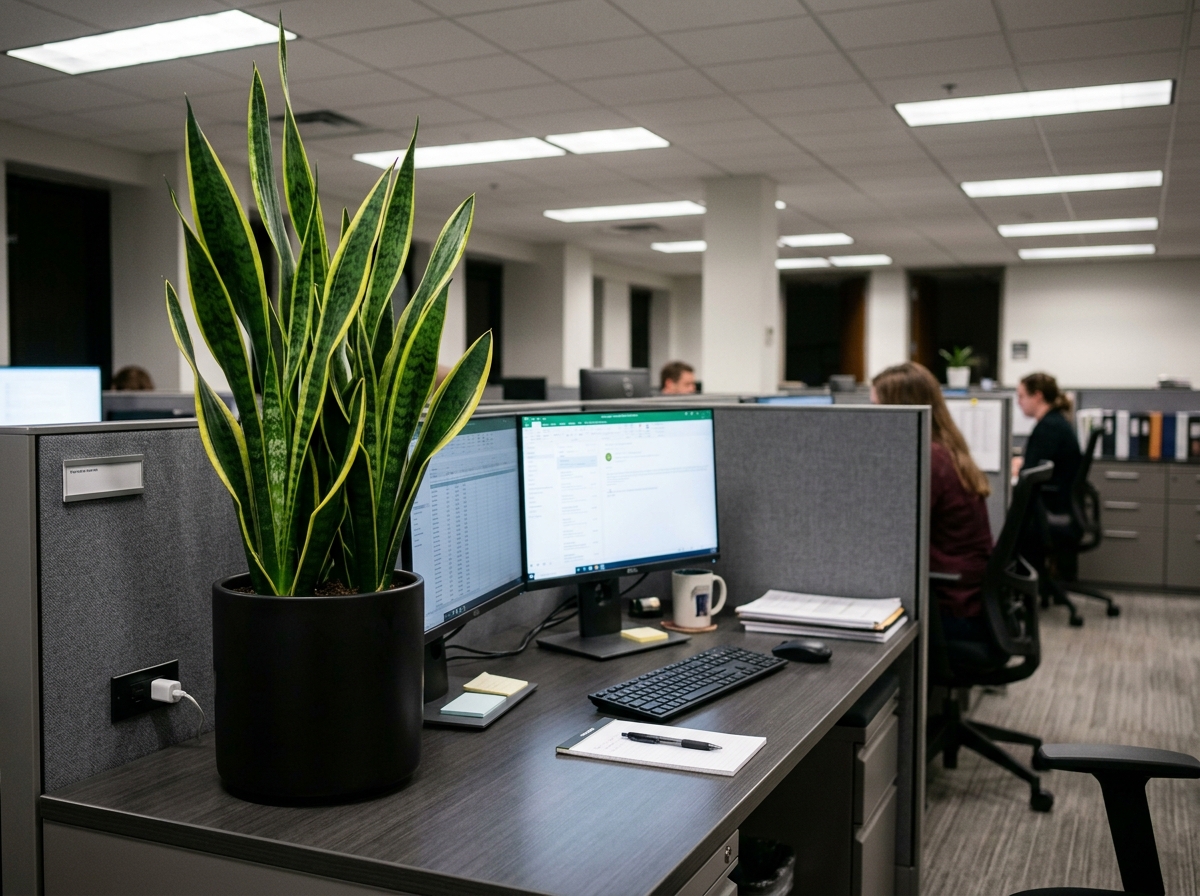
One of the biggest hurdles for “cubicle dwellers” is the lack of natural sunlight. Many of us work in the middle of a floor plan where the nearest window is thirty feet away. Fortunately, many tropical plants have evolved on the floors of dense rainforests, meaning they are naturally adapted to thrive in the “shade” of overhead fluorescent lighting.
If you are looking for Indoor Plants for Low-Light Rooms, you need species that don’t just “survive” in the dark but actually look good doing it.
The “Unkillable” ZZ Plant
The Zamioculcas zamiifolia, or ZZ Plant, is often called the “fiddle-leaf fig of cubicle plants” because of its architectural beauty and extreme hardiness. It features waxy, deep green leaves that actually reflect the overhead artificial light, brightening up dark corners.
The ZZ plant is a master of drought tolerance because it stores water in potato-like underground structures called rhizomes. This means if you go on a two-week vacation and forget to ask a colleague to water it, you’ll likely return to a plant that looks exactly the same. For a more stylish, compact look, we recommend the “Zenzi” variety—a dwarf ZZ plant with tightly curled, glossy leaves that stays small enough for a crowded desk.
Resilient Snake Plants
Commonly known as “Mother-in-Law’s Tongue,” the Snake Plant (Dracaena trifasciata) is a vertical grower, making it perfect for saving precious desk real estate. It is one of the few plants that continues to produce oxygen at night through a process called Crassulacean Acid Metabolism (CAM) respiration.
Snake plants are incredibly resilient to temperature fluctuations from office AC units and can go weeks without water. They check every box for a windowless office: they tolerate low light, they purify the air of toxins like xylene and toluene, and they add a sharp, modern aesthetic to any cubicle.
Compact and Stylish: Greenery for Limited Space
Space is a premium in a cubicle. Between your monitors, keyboard, coffee mug, and stacks of paperwork, finding room for a giant fern is impossible. That’s why the best cubicle plants for small spaces are those that grow slowly and stay compact.
Using Indoor Plants for Small Apartments as inspiration, we can find several varieties that fit perfectly on a 4×4-inch corner of your desk.
Best Cubicle Plants for Small Desks
- Air Plants (Tillandsia): These are the ultimate space-savers. They don’t require soil, meaning you can place them in a small glass globe, on a piece of driftwood, or even stick them to your cubicle wall with a magnet. They absorb moisture and nutrients through their leaves.
- Miniature Cactus & Haworthia: If you have a desk lamp or a bit of indirect light, these tiny desert dwellers are perfect. Haworthia, in particular, is great because it handles lower light better than most cacti.
- Marimo Moss Balls: For a “power move” that will definitely spark conversation, try Marimo moss balls. These are actually rare algal colonies that live in a small jar of water. They require almost zero light and are incredibly soothing to look at.
Best Cubicle Plants for Gifting
Plants make excellent gifts for colleagues or new hires. Lucky Bamboo is a top choice here. In Feng Shui, it is a symbol of prosperity and good fortune. It grows hydroponically (in just water and pebbles), so the recipient doesn’t even have to worry about soil.
Another great gift is the Money Tree (Pachira aquatica). While the larger versions are floor plants, you can find braided mini-versions that fit on a desk. They are believed to bring positive energy and “wealth” to the workspace—something every office worker can appreciate!
Low-Maintenance Options for Busy Professionals
Let’s be honest: work gets busy. There will be weeks when you barely have time to eat lunch, let alone monitor the soil pH of a finicky orchid. The best cubicle plants for professionals are those that thrive on a bit of neglect.
We always recommend Low-Maintenance Air Purifying Plants for those who want the benefits of nature without the stress of a high-maintenance hobby.
Golden Pothos and Philodendron
Pothos is arguably the most popular office plant in the world, and for good reason. It is incredibly forgiving. If you forget to water it, the leaves will go limp to let you know, and they usually perk right back up within an hour of a drink.
Pothos and Heartleaf Philodendrons are trailing vines. You can let them drape over the edge of your desk or even train them to climb up your cubicle partitions. They are also very easy to propagate; just snip off a vine, put it in water, and you’ll have a new plant to give to your cubicle neighbor in a few weeks. One tip: wipe the leaves with a damp cloth every few months to remove dust, which helps the plant “breathe” and photosynthesize better under office lights.
The Dramatic Peace Lily
The Peace Lily (Spathiphyllum) is the “drama queen” of the plant world, but in a helpful way. It provides very clear visual cues; when it’s thirsty, the entire plant wilts dramatically. This makes it a great “starter plant” because it tells you exactly what it needs.
Peace Lilies are powerhouses for air purification and can even produce beautiful white blooms under the right fluorescent lighting. They also act as natural humidifiers, releasing moisture into the air to combat the dry, parched atmosphere created by office heating and cooling systems.
Essential Care Tips for Your Cubicle Jungle
Maintaining a thriving “desk jungle” requires understanding that an office isn’t a natural environment. Here is how we recommend keeping your green friends happy:
- Watering Frequency: The #1 killer of office plants is overwatering. Because offices are often cool and lack sun, soil stays wet longer. Always feel the top inch of soil; if it’s damp, walk away.
- Drainage is Key: Never let your plant sit in a pool of water at the bottom of a decorative pot. This leads to root rot. Use a pot with drainage holes and a saucer.
- Temperature Fluctuations: Try to keep your plants away from direct blasts of AC or heating vents. Most tropical plants hate cold drafts.
- Dust Removal: Office environments are surprisingly dusty. A thick layer of dust on leaves blocks light. Wipe your plants down once a month.
- Pet Safety: If your office is “dog-friendly,” be careful. Many common plants like ZZ plants, Pothos, and Peace Lilies are toxic if ingested. If there are furry friends around, stick to pet-safe options like the Spider Plant or Money Tree.
For those who want to go the extra mile for their health, combining plants with Workplace Comfort: Mini Air Purifiers for Desks can create a truly pristine breathing zone in your cubicle.
Frequently Asked Questions about Cubicle Plants
What are the best plants for an office with no natural light?
The champions of windowless spaces are the ZZ Plant, Snake Plant, and Cast Iron Plant. These species have evolved to survive in very low light levels. They can thrive entirely on the light provided by standard overhead fluorescent office fixtures, provided the lights are on for at least 8–10 hours a day.
Which office plants are safe for shared spaces with pets?
If your office allows dogs or cats, the Spider Plant and the Money Tree are your best bets. Both are non-toxic and won’t harm a curious pet that decides to take a nibble. Avoid Pothos or Philodendrons in these environments, as they contain calcium oxalate crystals that can cause irritation.
How often should I water my desk plant in an air-conditioned office?
Air conditioning strips moisture from the air, which can dry out the leaves, but the soil often stays wet longer because there is no sun to evaporate it. For most low-maintenance plants like the Snake Plant or ZZ Plant, once every 2–3 weeks is usually plenty. For thirstier plants like the Peace Lily, check the soil once a week.
Conclusion
At Mount Pilchuck, we believe that your workspace should be more than just a place to process emails—it should be an environment that supports your health and focus. Turning your desk into a mini-jungle using the best cubicle plants is one of the most effective ways to boost your mood and clean your air simultaneously.
Whether you choose a towering Snake Plant to guard your monitor or a tiny Marimo moss ball to keep you company during long calls, adding a touch of nature is an investment in your well-being. Ready to transform your office? Explore more indoor plant guides to find the perfect foliage for every room in your life.
