
Your Basement Doesn’t Have to Be a Plant Graveyard
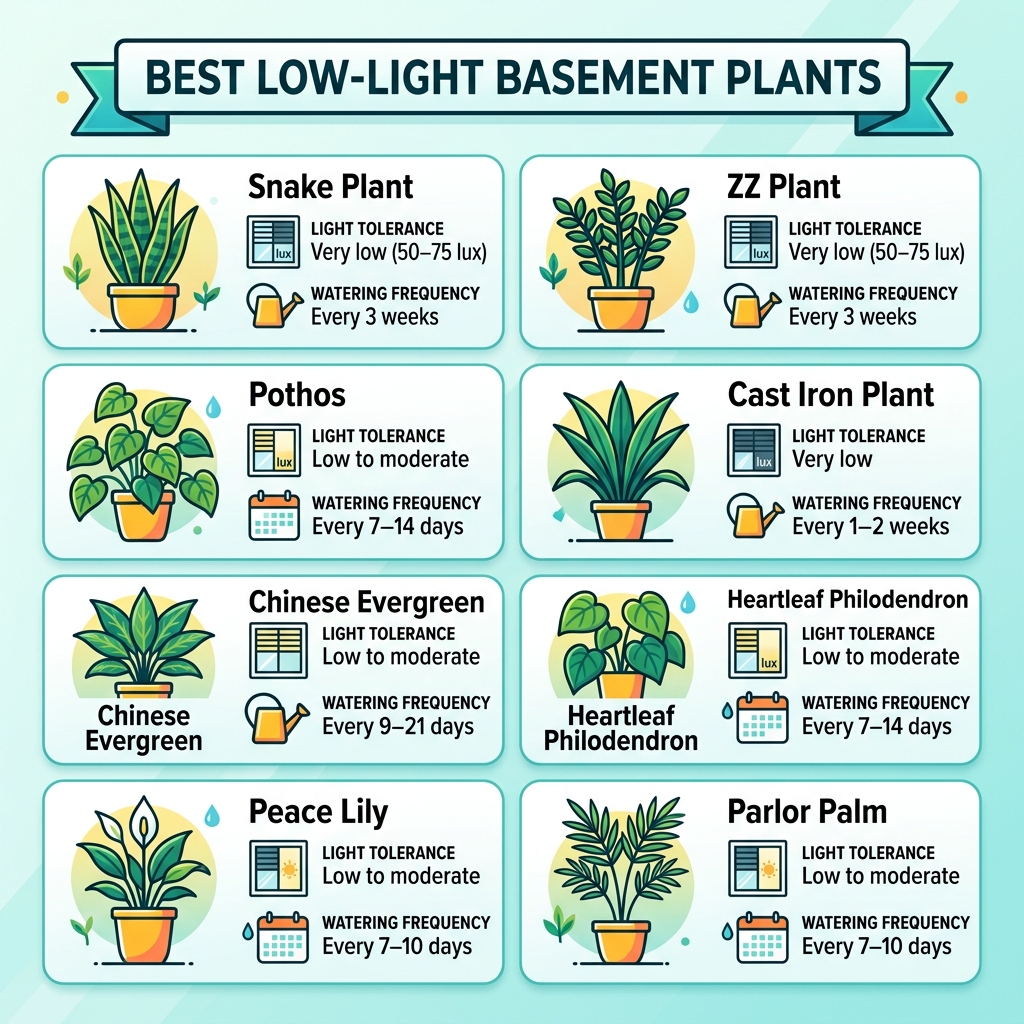
The best plants for basement low light include Snake Plant, ZZ Plant, Pothos, Cast Iron Plant, Chinese Evergreen, Heartleaf Philodendron, Peace Lily, and Parlor Palm.
| Plant | Light Tolerance | Watering Frequency |
|---|---|---|
| Snake Plant | Very low (50–75 lux) | Every 3 weeks |
| ZZ Plant | Very low (50–75 lux) | Every 3 weeks |
| Pothos | Low to moderate | Every 7–14 days |
| Cast Iron Plant | Very low | Every 1–2 weeks |
| Chinese Evergreen | Low to moderate | Every 9–21 days |
| Heartleaf Philodendron | Low to moderate | Every 7–14 days |
| Peace Lily | Low to moderate | Every 7–10 days |
| Parlor Palm | Low to moderate | Every 7–10 days |
Most people kill basement plants before they even get started. They pick something beautiful at the nursery, bring it downstairs, and watch it slowly give up on life.
The problem usually isn’t care. It’s the wrong plant for the conditions.
Basements are dim. Often cooler. Sometimes dry. Most popular houseplants — think ficus, rubber trees, money trees — simply aren’t built for that. They tolerate low light for a few weeks, then decline fast.
But some plants genuinely thrive down there. Not just survive. Thrive.
This list focuses on exactly those plants — the ones that can handle the darkness, improve the air quality in your space, and still look good doing it.
What “Low Light” Actually Means for Your Basement
When we talk about the best plants for basement low light, we have to define what “low light” actually looks like. In a garden center, “low light” is often a marketing term, but in your basement, it’s a biological reality.
Technically, low light is measured between 50 and 75 lux. To put that in perspective, that is deep shade—the kind of dimness where you would struggle to read a physical book without turning on a lamp. In a basement, this usually means a spot more than 10 feet away from a small window, or a room that only receives filtered sun through a window well.
There is a massive difference between a plant that thrives in these conditions and one that merely tolerates them.
| Condition | What it Means for the Plant | Basement Example |
|---|---|---|
| Thriving | The plant grows new leaves, maintains its color, and remains sturdy. | A ZZ Plant in a corner with a north-facing window. |
| Tolerating | The plant stays alive but stops growing. It may become “leggy” as it stretches for light. | A Fiddle Leaf Fig in a windowless room (it won’t last long). |
If your basement is truly windowless, no plant will survive forever on vibes alone. All plants need some form of light to photosynthesize. In these “no-light” scenarios, artificial lighting becomes your best friend. Modern full-spectrum LED grow lights can mimic the sun’s rays, allowing you to turn a dark storage room into a lush sanctuary.
Expert advice suggests that for windowless rooms, you should aim for at least 12 hours of artificial light daily. Without it, even the hardiest survivors will eventually “ghost” you.
The Best Plants for Basement Low Light That Genuinely Thrive
Finding a plant that actually enjoys the basement is like finding a roommate who actually enjoys doing the dishes—rare, but life-changing.

Zamioculcas zamiifolia (ZZ Plant)
The ZZ Plant is the undisputed heavyweight champion of basement living. It features waxy, emerald-green leaves that look so perfect people often touch them to see if they’re plastic. Its secret weapon is its rhizomatous roots—thick, bulb-like structures under the soil that store water like a camel.
The ZZ Plant can thrive in light as low as 50 lux. Because it stores so much moisture, it actually prefers to be ignored. If you water it too often, you’ll kill it with kindness. It’s the perfect choice for balancing out a basement fireplace or a dark TV unit.
Aspidistra elatior (Cast Iron Plant)
The name says it all. In the 1800s, these plants were staples in Victorian parlors. These rooms were notoriously dark, drafty, and filled with fumes from coal lamps. If a plant could survive a Victorian winter, your basement is a walk in the park. It grows slowly, but its deep green, sword-shaped leaves are virtually indestructible.
Chamaedorea elegans (Parlor Palm)
Most palms are sun-worshippers, but the Parlor Palm is the exception. We’ve learned through trial and error that while we associate palms with tropical beaches, this specific variety actually thrives in bright-to-low light locations. In a basement with a small window, it can eventually reach over six feet tall, though it grows slowly enough that you won’t need to worry about it taking over the ceiling anytime soon.
Snake Plant: The Best Plants for Basement Low Light and Air Quality
If you want a plant that works as hard as a high-end air purifier, look no further than the Snake Plant (Sansevieria). Often called “Mother-in-law’s tongue” because of its sharp, upright leaves, this plant is a powerhouse of health.
According to NASA’s Clean Air Study, the Snake Plant is one of the top five air-purifying plants. It’s specifically effective at filtering out benzene and formaldehyde—chemicals often found in common household cleaners and carpets.
The care routine is a dream for the busy (or forgetful) homeowner. It only needs water about every three weeks. In the winter, you can often go even longer. It is practically indestructible; it doesn’t mind dry basement air or the occasional draft.
ZZ Plant: The Best Plants for Basement Low Light and Neglect
We mentioned the ZZ plant earlier, but its relationship with neglect deserves its own spotlight. If you are the type of person who forgets a plant exists for a month at a time, the ZZ is your soulmate. Its waxy leaves prevent moisture loss, and it requires very little fertilization—maybe once or twice a year at most. It’s also remarkably pest-resistant, making it a “set it and forget it” addition to your basement decor.
Pothos and Heartleaf Philodendron: Vining Survivors
Pothos (Epipremnum aureum), also known as “Devil’s Ivy,” is perhaps the most popular indoor plant in the world for a reason. It’s nearly impossible to kill. Pothos vines can grow 12 to 18 inches in a single month, even in low-light areas with only fluorescent lighting.
However, keep an eye out for Pothos disease identification such as root rot, which happens if the soil stays swampy. Pothos is excellent for hanging baskets or trailing off a high shelf.
A quick tip: If you buy a variegated Pothos (one with white or yellow splashes), it may turn solid green in a dark basement. This is the plant’s way of creating more chlorophyll to soak up what little light is available. If you want to keep that beautiful marbling, you’ll need a bit more light.
Essential Care for Plants in Low-Light Basement Conditions
Growing the best plants for basement low light requires a shift in how you think about plant care. Because there is less light, the plant’s metabolism slows down. It’s essentially living in “low power mode.”
Watering: The Golden Rule
The number one killer of basement plants is overwatering. In a dim, cool basement, water doesn’t evaporate quickly. Before you reach for the watering can, use the “knuckle test.” Stick your finger an inch or two into the soil. If it feels even slightly damp, walk away. For plants like the Snake Plant or ZZ, wait until the soil is bone-dry all the way through.
Soil and Drainage
Don’t just grab “dirt” from the backyard. Low-light plants need well-draining soil to prevent their roots from sitting in water. An “aroid mix”—which includes potting soil, perlite, and perhaps some orchid bark—is ideal. This creates air pockets that help the roots breathe.
The “Clean Leaf” Strategy
Dust is the enemy of the basement plant. In a low-light environment, the plant needs every photon it can get. Dust buildup on leaves acts like a curtain, blocking out light. Wipe your plants’ leaves down once a month with a damp microfiber cloth. Not only does this help them “breathe” and photosynthesize, but it also makes them look magazine-worthy.
Rotation and Humidity
Plants naturally grow toward the light source. To prevent your plant from leaning like the Tower of Pisa, give the pot a quarter-turn every two weeks. This ensures even growth.
As for humidity, many basements are naturally humid, which tropical plants love. However, if your basement is dry due to a furnace or fireplace, consider grouping your plants together or using a small humidifier to keep them happy.
Troubleshooting and Safety in Dim Spaces
Even the hardiest plants will occasionally show signs of distress. Learning to read these signs is the difference between a quick fix and a trip to the compost bin.
- Leggy Growth: If your plant is growing long, spindly stems with very few leaves, it’s desperately reaching for light. Move it closer to a window or add a grow light.
- Yellowing Leaves: This is usually a sign of overwatering. Check the roots; if they are mushy and brown, you have root rot.
- Slow Growth: In a basement, slow growth is normal! It’s not necessarily a sign of an unhealthy plant; it’s just the plant adapting to its environment.
A Note on Safety
While we love these plants for their beauty and air-purifying qualities, some come with a warning label. Many low-light favorites, including Pothos and Philodendrons, contain calcium oxalate crystals.
According to the Pet Poison Helpline’s guide for Pothos, these crystals can cause intense mouth irritation, drooling, and swelling if ingested by cats or dogs. If you have curious pets or toddlers, keep these plants on high shelves or in hanging baskets where they can’t be reached.
For a safer alternative, the Aglaonema Maria (Chinese Evergreen) is a stunning choice that is generally easier to manage, though still best kept out of reach of nibbling pets.
Frequently Asked Questions about Basement Greenery
Can plants grow in a basement with no windows?
Yes, but they cannot grow in total darkness. If your basement has no windows, you must use artificial lighting. Full-spectrum LED grow lights are the most efficient option. Set them on a timer for 12–14 hours a day to mimic a natural day-night cycle.
Why is my low-light plant growing so slowly?
Light is food for plants. When light levels are low, the plant produces less energy, which results in slower growth. This is actually a survival mechanism. As long as the leaves look healthy and firm, slow growth is nothing to worry about.
How often should I fertilize basement plants?
Very rarely. Because they grow slower, they don’t use up nutrients as quickly. Fertilizing once in the spring and once in the summer at half-strength is usually more than enough. Over-fertilizing in low light can actually lead to salt buildup in the soil, which damages the roots.
Conclusion
Bringing life into a dim space doesn’t have to be a struggle. By choosing the best plants for basement low light, you can transform a “dark dungeon” into a vibrant, healthy living area. Whether it’s the indestructible Snake Plant or the elegant Parlor Palm, these green companions do more than just sit there—they work to improve your air quality and boost your mood.
At Mount Pilchuck, we believe that every room deserves the health-boosting benefits of greenery and better air circulation. If you’re ready to start your indoor jungle, check out our guide on indoor plants for low light rooms to find the perfect match for your home.
Don’t let a lack of windows stop you from enjoying nature indoors. Explore more indoor plant categories and find the hardy survivors that will stay with you for years to come.
