
The Best Plants for Minimal Light: A Quick Answer Before We Dive In
The best plants for minimal light are hardy species that evolved under dense forest canopies, making them perfectly happy in dim rooms, north-facing apartments, and even offices lit only by overhead fluorescents.
Here are the top picks at a glance:
| Plant | Light Tolerance | Beginner-Friendly? |
|---|---|---|
| ZZ Plant | Very low to low | Yes |
| Snake Plant | Very low to low | Yes |
| Cast Iron Plant | Very low | Yes |
| Pothos | Low to medium | Yes |
| Peace Lily | Low to medium | Yes |
| Chinese Evergreen | Low to medium | Yes |
| Parlor Palm | Low to medium | Yes |
| Heartleaf Philodendron | Low to medium | Yes |
| Spider Plant | Low to medium | Yes |
| Dracaena ‘Janet Craig’ | Low | Yes |
| Lucky Bamboo | Low | Yes |
| Nerve Plant | Low | Yes |
| Arrowhead Plant | Low to medium | Yes |
| Blue Star Fern | Low | Moderate |
| Peacock Plant | Low | Moderate |
If you’ve ever stared at a dim corner of your apartment and thought “I wish I could put a plant there” — you’re not alone. Most people assume that low light means no plants. That’s simply not true.
Many of the world’s most popular houseplants originally grew on tropical rainforest floors, where towering trees block most of the sun. These plants didn’t just survive the shade — they thrived in it. That same adaptation makes them ideal for urban homes with limited windows, basements, and artificially lit offices.
The challenge isn’t finding a plant that can handle low light. It’s knowing which ones will actually look good and stay healthy — and how to care for them without making the most common mistakes (overwatering being the biggest one).
This guide covers all of that.
Understanding Low Light: What Your Plants Actually See
When we talk about the best plants for minimal light, we first need to define what “low light” actually looks like to a living organism. In indoor gardening, low light isn’t pitch blackness; it’s more like “ambient” light. If you can comfortably read a newspaper in the middle of the day without turning on a lamp, you have low light.
Technically, low light is often found in rooms with north-facing windows or in the deep corners of rooms with east or west-facing windows. In these spots, the sun never hits the leaves directly. Scientists measure this intensity in “foot-candles”—a unit of light. While a sunny windowsill might provide over 1,000 foot-candles, a low-light corner might only offer 50 to 100.
Plants are incredibly resilient, though. Scientific research on how plants adapt to low light shows that shade-tolerant species can actually rearrange their internal structures to capture every stray photon of energy. They increase their chlorophyll density or grow broader, thinner leaves to maximize surface area.
However, distance from windows is the biggest factor. Light intensity drops off exponentially as you move away from the glass. A plant five feet away from a window receives significantly less energy than one sitting on the sill. For a deeper look at specific room setups, check out our guide on Indoor plants for low-light rooms.
The 15 Best Plants for Minimal Light and Easy Care
Choosing the right species is half the battle. We’ve curated a list of the most reliable performers that won’t just survive in the shadows but will actually bring a lush, vibrant feel to your home.
1. ZZ Plant (Zamioculcas zamiifolia)
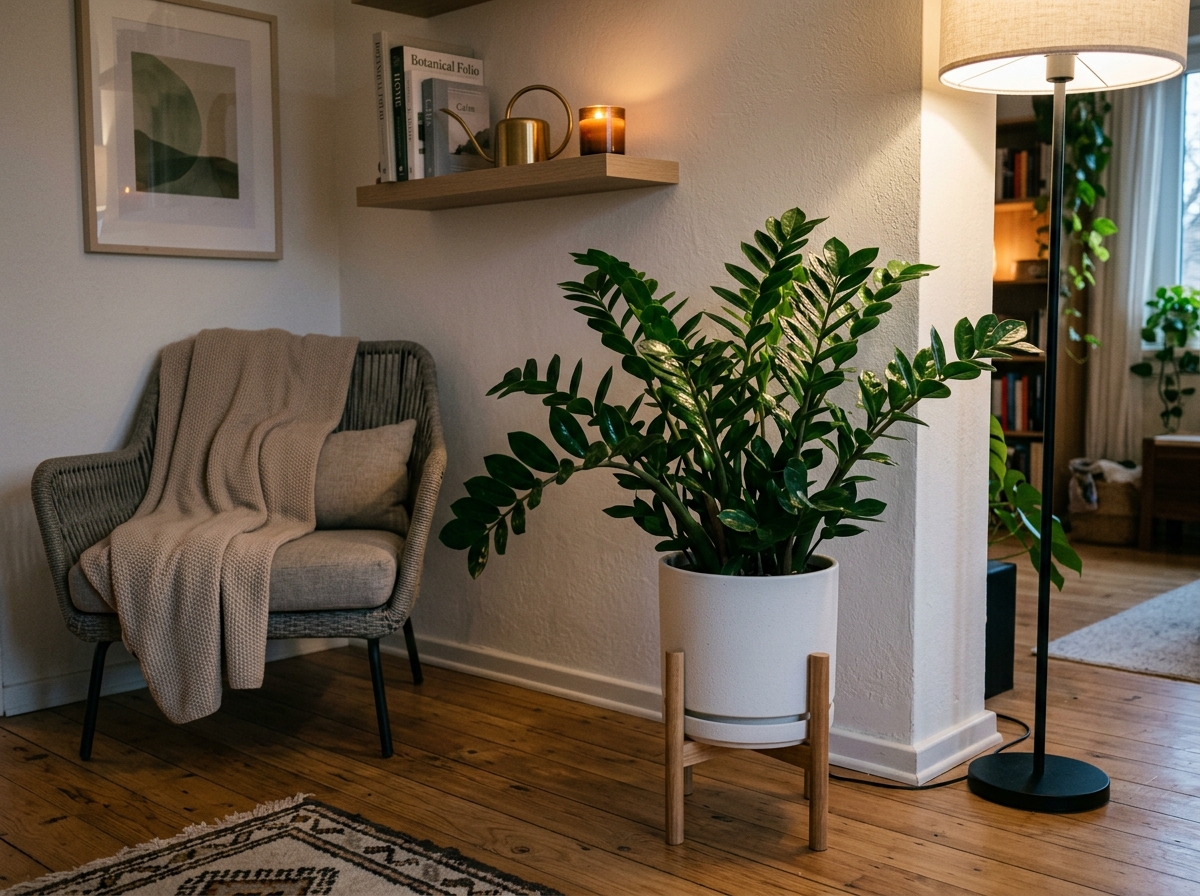
The ZZ plant is the undisputed heavyweight champion of low light. Native to East Africa, it has evolved to survive months of drought and deep shade. Its waxy, green leaves are so shiny they almost look plastic. It grows slowly, meaning it won’t outgrow its spot quickly, and it stores water in thick, potato-like rhizomes underground.
2. Snake Plant (Dracaena trifasciata)
Often called “Mother-in-Law’s Tongue,” this plant is practically indestructible. It features stiff, sword-like leaves that shoot straight up, making it perfect for tight corners. It is famous for its ability to handle neglect—you can practically forget it exists for three weeks, and it will still look great.
3. Cast Iron Plant (Aspidistra elatior)
Living up to its name, the Cast Iron plant was a staple in dark, drafty Victorian parlors. It handles low light, poor air quality, and temperature fluctuations with ease. It’s the “steady” plant of the bunch—it won’t grow fast, but it also won’t die on you.
4. Chinese Evergreen (Aglaonema)
If you want color without the sun, this is your plant. While many variegated plants need sun to keep their patterns, darker green varieties of Aglaonema thrive in dim spots. They are incredibly beginner-friendly and offer a lush, bushy look.
5. Peace Lily (Spathiphyllum)
Nicknamed the “closet plant,” the Peace Lily is one of the few low-light plants that will actually produce flowers (white spathes) in shaded conditions. Just a warning: it’s a bit of a “drama queen” and will wilt visibly when it’s thirsty, though it perks right back up after a drink.
6. Parlor Palm (Chamaedorea elegans)
If you want a tropical vibe in a basement, the Parlor Palm is the answer. Unlike most palms that crave direct sun, this species evolved under the dense canopy of Mexican rainforests. It stays relatively small and adds a soft, feathery texture to a room.
7. Spider Plant (Chlorophytum comosum)
The Spider Plant is a classic for a reason. It’s tough, adaptable, and produces “pups” or babies that hang down from the mother plant. It’s very forgiving of inconsistent watering and thrives in the ambient light of a bedroom or kitchen.
8. Dracaena ‘Janet Craig’
This variety of Dracaena is a favorite for offices. It features solid green, downward-curving leaves and is particularly tolerant of the dry air and fluorescent lighting found in commercial spaces.
9. Arrowhead Plant (Syngonium podophyllum)
With its distinct spade-shaped leaves, the Arrowhead plant is a versatile grower. It can be kept bushy with regular pruning or allowed to vine out. It prefers a bit more humidity but handles low light like a pro.
10. Nerve Plant (Fittonia albivenis)
Perfect for terrariums or small desks, the Nerve Plant has striking veined foliage. It loves high humidity (think bathrooms) and will “faint” when dry, signaling you exactly when it needs water.
11. Lucky Bamboo (Dracaena sanderiana)
Not actually bamboo, this plant is a type of Dracaena that can grow in just a vase of water and pebbles. It’s a staple for windowless offices because it survives perfectly well under overhead LED lights.
12. Blue Star Fern (Phlebodium aureum)
Most ferns are finicky, but the Blue Star is surprisingly hardy. It has a unique blue-grey tint and doesn’t shed its fronds as easily as the Boston Fern. It loves the low light and high humidity of a bathroom.
13. Peacock Plant (Calathea makoyana)
For those who want a “showpiece,” the Peacock Plant offers stunning, feather-like patterns on its leaves. It’s a bit more sensitive to water quality (it prefers filtered water), but it actually dislikes direct sun, which can bleach its beautiful colors.
14. Lady Palm (Rhapis excelsa)
The Lady Palm is a slow-growing, multi-stemmed palm that looks like a piece of living architectural art. It is one of the most shade-tolerant palms in existence and is very resistant to common indoor pests.
15. Corn Plant (Dracaena fragrans)
Growing on a thick woody cane, the Corn Plant looks like a miniature indoor tree. It’s a great floor plant for filling vertical space in a dim living room.
Trailing and Vining Best Plants for Minimal Light
If you have high shelves or hanging baskets, vining plants are the way to go. They create a “jungle” feel as they cascade down.
- Golden Pothos: Known as “Devil’s Ivy” because it’s nearly impossible to kill. It handles low light better than almost any other vine.
- Heartleaf Philodendron: Very similar to Pothos but with heart-shaped leaves. It’s slightly more shade-tolerant and very graceful.
- Silver Pothos (Scindapsus pictus): Features matte green leaves with silvery splashes. It’s a bit slower growing but very elegant in dim light.
- English Ivy: While it can be a bit prone to spider mites if the air is too dry, it’s a classic choice for trailing along a mantle in a cool, north-facing room.
For those specifically looking to green up a subterranean space, don’t miss our article on The best plants for basement low light that won’t ghost you.
Architectural and Upright Best Plants for Minimal Light
Sometimes you need a plant that stands tall and holds its shape. These “architectural” plants are perfect for modern interiors:
- Snake Plant Laurentii: Features yellow margins that add a pop of color even in the shade.
- ZZ Raven: A stunning cultivar with leaves that emerge lime green and turn almost jet black.
- Aspidistra elatior: The classic Cast Iron plant, perfect for a minimalist, steady look.
Essential Care Strategies for Low-Light Success
Caring for the best plants for minimal light requires a different mindset than caring for sun-lovers. Because these plants aren’t receiving as much energy, their biological processes—like photosynthesis and transpiration—slow down significantly.
The Golden Rule: Water Less
The most common way people kill low-light plants is by overwatering. In a dim room, water evaporates much slower from the soil. If you water on a strict weekly schedule, you’ll likely end up with “wet feet,” leading to root rot.
- The Finger Test: Always stick your finger two inches into the soil. If it feels damp, wait.
- Drainage is Non-Negotiable: Ensure your pots have holes. Without them, water pools at the bottom and suffocates the roots.
Humidity and Leaf Cleaning
Low light often goes hand-in-hand with poor air circulation. Dust builds up on leaves, which acts like a “blindfold,” preventing the plant from absorbing what little light is available. We recommend wiping leaves with a damp cloth once a month. This doesn’t just help the plant breathe; it also keeps it looking vibrant. Scientific research on indoor plant transpiration suggests that clean leaves help plants regulate their internal “breathing” more effectively.
Fertilizing and Growth
Don’t expect your low-light plants to explode with growth. Because they have less energy, they don’t need much “food.” We suggest fertilizing only once or twice during the spring and summer at half-strength. In the winter, stop fertilizing entirely as the plant enters a rest phase.
Preventing “Leggy” Growth
If your plant starts to look stretched out, with long gaps between leaves, it’s “reaching” for light. This is called leggy growth. You can fix this by:
- Moving the plant a few feet closer to the light source.
- Rotating the pot 90 degrees every week so all sides get equal exposure.
- Pruning back the long stems to encourage bushier growth.
Health Benefits: Air Purification and Circulation in Dim Spaces
At Mount Pilchuck, we are passionate about the health-boosting properties of indoor greenery. Even in low-light conditions, these plants are hard at work improving your environment.
Air Purification
Many of the plants on our list, specifically the Peace Lily, Snake Plant, and Spider Plant, were featured in NASA’s Clean Air Study. They are capable of removing Volatile Organic Compounds (VOCs) like formaldehyde, benzene, and trichloroethylene from the air. These toxins are often found in common household items like carpets, glues, and cleaning supplies.
Mental Health and Stress Reduction
Living in a windowless office or a dim apartment can feel isolating. Adding the best plants for minimal light introduces a living element that has been shown to lower cortisol levels and improve focus. The simple act of caring for a plant—watching a new leaf unfurl on a ZZ plant—provides a sense of accomplishment and a connection to nature.
Air Circulation and Humidity
Plants naturally release moisture through a process called transpiration. In dry, heated winter apartments, a group of low-light plants can act as a natural humidifier, easing dry skin and respiratory discomfort. Furthermore, their presence encourages better air circulation in stagnant corners of the home.
Frequently Asked Questions about Best Plants for Minimal Light
Can any plants survive in completely windowless rooms?
The short answer is: not without help. All plants need light to perform photosynthesis. However, many of the plants we’ve discussed—like the ZZ plant and Lucky Bamboo—can thrive using only artificial light. If your office or bathroom has no windows, but the overhead LED or fluorescent lights are on for 8-10 hours a day, these plants will be perfectly happy. For truly dark spots, you can supplement with a small LED grow light to keep the plant’s circadian rhythm on track.
Which low-light houseplants are pet-safe and non-toxic?
Pet safety is a major concern for many plant parents. While Pothos and Snake Plants are mildly toxic if chewed, there are several excellent non-toxic options:
- Parlor Palm: Completely safe for cats and dogs.
- Spider Plant: Non-toxic (though cats sometimes find the leaves “hallucinogenic” and like to nibble them!).
- Cast Iron Plant: Very safe and sturdy.
- Peacock Plant: A safe way to add color to a pet-friendly home. Always refer to the ASPCA guidelines if you are unsure about a specific species.
What are the signs that a low-light plant is not getting enough light?
Your plant will tell you if it’s struggling. Look out for:
- Yellowing Leaves: This can be a sign of too much water or too little light.
- Loss of Variegation: If a variegated plant (like a Marble Queen Pothos) starts growing solid green leaves, it’s trying to increase its chlorophyll to compensate for low light.
- Stunted Growth: While low-light plants grow slowly, a complete lack of new growth for over a year might mean it needs a bit more light.
- Leaning: If the plant is tilting heavily toward the nearest light source, it’s time to move it closer or rotate it.
Conclusion
Creating a lush, green sanctuary doesn’t require a sun-drenched solarium. By choosing the best plants for minimal light—like the resilient ZZ plant, the architectural Snake plant, or the graceful Parlor Palm—you can breathe life into the dimmest corners of your home.
The key to success in the shadows is patience and a light hand with the watering can. These plants aren’t just decorations; they are health-boosting companions that improve air quality, reduce stress, and bring a touch of the tropical understory into your daily life.
At Mount Pilchuck, we believe everyone deserves a greener, healthier indoor environment, regardless of how many windows they have. For more expert advice on selecting the perfect greenery for your unique space, explore our full library of resources at https://www.mountpilchuck.com/category/indoor-plants/. Happy planting!
