
Your Indoor Air Is More Polluted Than You Think — Here’s the Fix
The money tree purifies air by absorbing harmful volatile organic compounds (VOCs) like formaldehyde, benzene, and xylene through its leaves, roots, and soil microbes — a natural process called phytoremediation.
Quick answer: What does a money tree remove from indoor air?
| Pollutant | Common Source |
|---|---|
| Formaldehyde | Furniture, flooring, cleaning products |
| Benzene | Paints, plastics, cigarette smoke |
| Xylene | Adhesives, varnishes, vehicle exhaust |
| Trichloroethylene | Dry-cleaned fabrics, solvents |
| Ammonia | Cleaning sprays, fertilizers |
If you live or work in a sealed indoor space, the air around you may be 3 to 5 times more polluted than the air outside. Furniture off-gasses chemicals. Cleaning products release fumes. Synthetic materials constantly shed invisible toxins.
Most people don’t notice — until they feel sluggish, congested, or just “off.”
The money tree (Pachira aquatica) is one of the most practical, low-maintenance ways to fight back. It’s compact, beautiful, and backed by NASA research as an effective indoor air filter.
This guide covers exactly how it works, how to get the most out of it, and whether it’s the right investment for your home.
How the Money Tree Purifies Air: The Science of Phytoremediation
When we talk about how a money tree purifies air, we aren’t just making it up to sound “earthy.” There is hard science behind it. The primary mechanism is a process called phytoremediation. This is a fancy botanical term for how plants (and their associated soil microbes) act as a biological vacuum cleaner, sucking up contaminants from the air and soil.
The famous NASA Clean Air Study was one of the first major research efforts to prove this. NASA was looking for ways to keep space station air clean for astronauts. They discovered that plants like the Money Tree (Pachira aquatica) can remove up to 87% of formaldehyde and significant levels of benzene and trichloroethylene within 24 hours in a sealed environment.
But it’s not just the leaves doing the heavy lifting. While the leaves absorb carbon dioxide and some gases through their stomata (tiny pores), the root zone and the soil microbes are the unsung heroes. These microorganisms living in the potting soil actually break down the absorbed toxins into forms the plant can use for its own growth. It’s a perfect recycling system: your “trash” (air pollution) becomes the plant’s “treasure” (nutrients).
A study by Vadoud Niri and his colleagues at the State University of New York further confirmed that certain plants excel at VOC removal more than others. In their testing, they found that while some plants were good at one specific toxin, the Money Tree was a versatile all-rounder.
To give you an idea of how the Money Tree stacks up, let’s look at a comparison of toxin removal rates based on these scientific findings:
| Feature | Money Tree (Pachira aquatica) | Peace Lily (Spathiphyllum) |
|---|---|---|
| Formaldehyde Removal | High (Excellent for furniture fumes) | High |
| Benzene Removal | Moderate to High | High |
| Xylene Removal | High | Moderate |
| Ammonia Removal | Low | High |
| Pet Safety | Safe / Non-toxic | Toxic if ingested |
| Humidity Regulation | High (Great for dry rooms) | Moderate |
As you can see, while the Peace Lily is a powerhouse, it’s not pet-friendly. For those of us with curious cats or dogs, the Money Tree is often the superior investment for indoor wellness.
Specific Toxins the Money Tree Purifies from Air
Why should we care about these chemicals with long names? Because they are likely in your home right now.
- Formaldehyde: According to formaldehyde facts from the EPA, this chemical is found in resins used in manufactured wood products (like your IKEA desk or plywood floors), as well as some fabrics and glues. It can cause respiratory irritation and is a known carcinogen.
- Benzene: The benzene risks identified by the American Cancer Society include its presence in plastics, synthetic fibers, and detergents. It’s one of the most common VOCs found in urban homes.
- Xylene and Toluene: These are often found in printing inks, adhesives, and varnishes. If you’ve recently painted a room or bought new furniture, your xylene levels are likely spiked.
- Trichloroethylene: As noted in trichloroethylene exposure guides, this is frequently found in dry-cleaning solvents and degreasers.
The money tree purifies air by taking these synthetic chemicals and neutralizing them, making your living room or office a much safer “bubble” to breathe in.
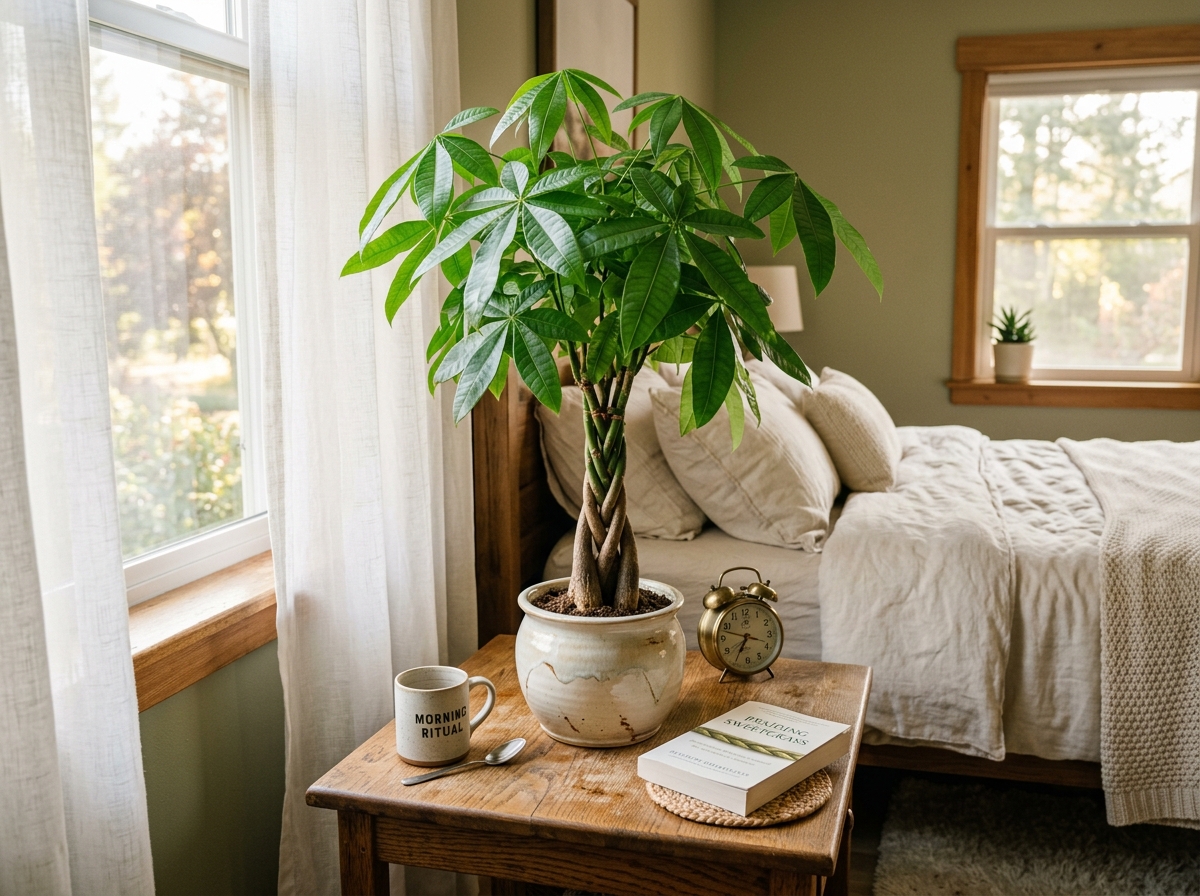
Why a Money Tree Purifies Air Better in the Bedroom
Most plants take in CO2 during the day and release it at night. However, the Money Tree is often categorized alongside CAM (Crassulacean Acid Metabolism) plants or those that are highly efficient at nighttime gas exchange. This means it continues to work while you sleep, providing a fresh boost of oxygen.
We’ve discussed this in our guide on top-air-purifying-plants-for-bedrooms, noting that the Money Tree is a top-tier choice for sleep environments. Beyond oxygen, it acts as a natural humidifier. Through a process called transpiration, the plant releases moisture from its leaves. This increases the humidity in your bedroom, which can soothe dry skin, reduce “scratchy” throats in the morning, and improve overall breathing.
Maximizing Your Money Tree’s Air-Purifying Potential
A sick plant can’t clean your air. To ensure the money tree purifies air at its maximum capacity, you need to keep it thriving. A healthy plant has more active stomata and a more robust root system, both of which are essential for toxin absorption.
The first rule of thumb is light. Money Trees love bright, indirect sunlight. Think of a spot near a window with a sheer curtain. Direct sunlight will scorch those beautiful green leaves, while too little light will cause the plant to drop leaves—and fewer leaves mean less air purification.
Secondly, you need well-draining soil. These trees are native to swamps in Central and South America, but in a pot, they don’t like to sit in “wet feet.” We recommend a high-quality potting mix with some perlite or sand to ensure water moves through quickly.
For more tips on keeping your green filters healthy, check out our easy-care-plants-for-home-air-quality resource.
One “pro tip” we always share: Clean the leaves! Dust acts as a barrier. If your Money Tree’s leaves are covered in a layer of household dust, it can’t “breathe” in the pollutants as effectively. Once a month, take a damp cloth and gently wipe down the leaves. This simple act of maintenance significantly boosts the plant’s ability to trap airborne particles.
Optimal Watering and Humidity for Toxin Absorption
Watering is where most people go wrong. We like to follow the “top-inch” rule: wait until the top inch of soil is dry before watering again. Overwatering leads to root rot, which kills the soil microbes that help break down VOCs.
Because the Money Tree is a tropical plant, it thrives in humidity. If your home is dry (especially during winter), your plant might struggle. You can help it out by:
- Misting: Give the leaves a light spray of water a few times a week.
- Pebble Trays: Place the pot on a tray of pebbles filled with water (ensuring the pot itself isn’t sitting in the water).
- Grouping: Grouping several plants together creates a small microclimate with higher humidity.
Higher humidity doesn’t just help the plant; it helps you. As we mention in our article on indoor-plants-that-improve-breathing, regulated humidity can reduce the survival of airborne viruses and allergens.
Don’t forget to feed your “investment.” During the growing season (spring and summer), use a balanced liquid fertilizer once a month. This ensures the plant has the energy to produce new, toxin-hungry leaves.
Beyond Clean Air: Feng Shui and Mental Health Benefits
While we love the fact that the money tree purifies air, that’s only half the story. The Pachira aquatica is steeped in cultural history. In Feng Shui, it is known as the “Good Luck Tree.” The braided trunk is said to “trap” fortune and prosperity within its folds, while the five leaves on each stem represent the five elements: earth, fire, water, metal, and wood.
If you’re looking to boost your “wealth energy,” Feng Shui experts recommend placing your Money Tree in the southeast corner of your home or office—the traditional wealth sector. Even if you aren’t superstitious, there is a clear psychological benefit to biophilic design.
Research shows that having greenery in your workspace can:
- Reduce Stress: The sight of nature lowers cortisol levels.
- Boost Productivity: Clean air and a pleasant view help you stay focused for longer periods.
- Improve Mood: Caring for a living thing provides a sense of accomplishment and calm.
For those of us working from home, placing a Money Tree in a home office is a double win: you get the air-clearing benefits and a significant mental health boost.
A Pet-Friendly Choice for Healthy Homes
One of the biggest hurdles for plant lovers is safety. Many of the most famous air purifiers—like the Snake Plant or the Peace Lily—can be mildly toxic to cats and dogs if they decide to have a snack.
The Money Tree is a rare gem because it is completely non-toxic to pets and humans. This makes it a perfect choice for households with toddlers or curious kittens. You can breathe easy knowing your air is getting cleaner without putting your furry family members at risk. We’ve compiled a full list of indoor-plants-safe-for-pets if you’re looking to build a worry-free indoor jungle.
Troubleshooting and Maintenance for a Healthy Money Tree
Even the best investments need a little maintenance. If your Money Tree starts looking sad, it’s usually trying to tell you something.
- Yellowing Leaves: This is almost always a sign of overwatering. Check the drainage holes in your pot. If the soil is soggy, let it dry out completely before watering again.
- Leaf Drop: This often happens when the plant is moved or exposed to a cold draft. Money Trees like stability. Keep them away from AC vents or drafty windows.
- Pests: Occasionally, you might see spider mites or mealybugs. Don’t panic! A gentle spray of neem oil or insecticidal soap will usually do the trick.
Maintaining your plant is part of the “low-maintenance” appeal we discuss in our guide to low-maintenance-air-purifying-plants. Every year or two, you may need to repot your tree to give the roots more room to grow. Choose a pot that is only 1–2 inches wider than the current one to avoid “drowning” the roots in excess soil.
Frequently Asked Questions about Money Trees
How many money trees do I need to purify a room?
This is the most common question we get. While one plant is better than none, the “NASA standard” suggests about one medium-sized plant for every 100 square feet of floor space. If you have a large living room with high ceilings, you might want two or three trees to see a significant drop in VOC levels.
That plant density matters. We often recommend mixing the Money Tree with other plants that filter toxins from the air to create a diverse “bio-filter” in your home.
Can a money tree replace a mechanical air purifier?
In a word: No. While the money tree purifies air effectively, it does so slowly. A mechanical air purifier with a HEPA filter can move hundreds of cubic feet of air per minute, trapping dust and pollen instantly. A plant relies on natural air currents to bring pollutants to its leaves.
Think of plants as a complementary strategy. The air purifier handles the heavy lifting of dust and allergens, while the Money Tree works 24/7 to neutralize the invisible chemical gases (VOCs) that mechanical filters sometimes miss. It’s the difference between a sprint (mechanical) and a marathon (biological).
Does the size of the money tree affect its purification rate?
Yes! Air purification is a numbers game based on leaf surface area. A 6-foot-tall Money Tree with hundreds of leaves will absorb significantly more toxins than a small 1-foot desktop version. However, even small plants contribute to the “micro-environment” directly around your desk or bedside table. If you have the space, investing in a larger, braided specimen will give you the best “return” on your air quality investment.
Conclusion
At Mount Pilchuck, we believe that your home should be a sanctuary. The air you breathe is the foundation of your health, and the money tree purifies air in a way that is sustainable, beautiful, and culturally rich.
By investing in a Pachira aquatica, you aren’t just buying a piece of decor; you’re hiring a 24-hour biological air scrubber that brings a sense of calm and prosperity to your space. Whether you’re looking to spruce up a low-light apartment or want to ensure your home office is a peak-performance zone, the Money Tree is truly the best “green” investment you can make.
Ready to take your indoor air quality to the next level? Explore more info about air purifiers and how they can work in tandem with your new Money Tree to create the ultimate healthy home.
