
Why Air Purifier Plants in Your Office Are Worth the Investment
Air purifier plants office workers rely on most include the Snake Plant, Peace Lily, Spider Plant, Pothos, and ZZ Plant — all proven to filter common indoor toxins while thriving in typical office conditions.
Best air purifying plants for offices at a glance:
| Plant | Key Benefit | Light Needs | Maintenance |
|---|---|---|---|
| Snake Plant | Removes formaldehyde, benzene | Low to bright indirect | Very low |
| Peace Lily | Filters benzene, ammonia, mold | Low to medium indirect | Low |
| Spider Plant | Removes formaldehyde, CO | Low to bright indirect | Low |
| Pothos | Absorbs VOCs from carpets, paint | Low to medium indirect | Very low |
| ZZ Plant | Tolerates neglect, removes toxins | Very low to medium | Very low |
Most office air is worse than you think.
The U.S. EPA estimates that indoor pollutant levels are often 2 to 5 times higher than outdoor levels. In a typical office, that means you’re likely breathing in VOCs (volatile organic compounds) released by furniture, paint, printers, cleaning products, and synthetic carpets — all day, every day.
The result? Headaches. Fatigue. Difficulty concentrating. This cluster of symptoms even has a name: Sick Building Syndrome.
The good news is that nature offers a simple, low-cost fix. NASA’s landmark 1989 research by Dr. Bill Wolverton showed that common houseplants can remove significant amounts of airborne toxins through their leaves and root systems. More recent studies back this up — one found that Cordyline fruticosa reduced VOC concentrations by 87.5% in a real lab setting within just 40 minutes.
Plants won’t replace good ventilation. But as part of a smart office setup, they make a real, measurable difference — not just for air quality, but for focus, mood, and overall well-being.
The Science of Air Purifier Plants for Office Environments
The idea that a potted plant can act as a “botanical guardian” isn’t just a hunch; it’s rooted in decades of rigorous testing. It all started with the NASA 1989 study led by scientist Bill Wolverton. NASA was looking for ways to keep the air clean in sealed space stations, and they discovered that common indoor plants were surprisingly effective at neutralizing organic chemicals.
This process is known as phytoremediation. Essentially, plants use their biological systems to degrade or sequester pollutants. In an office, these pollutants usually take the form of Volatile Organic Compounds (VOCs) like:
- Formaldehyde: Found in particleboard, carpets, and upholstery.
- Benzene: Often present in inks, oils, and detergents.
- Trichloroethylene: Found in printing inks, lacquers, and adhesives.
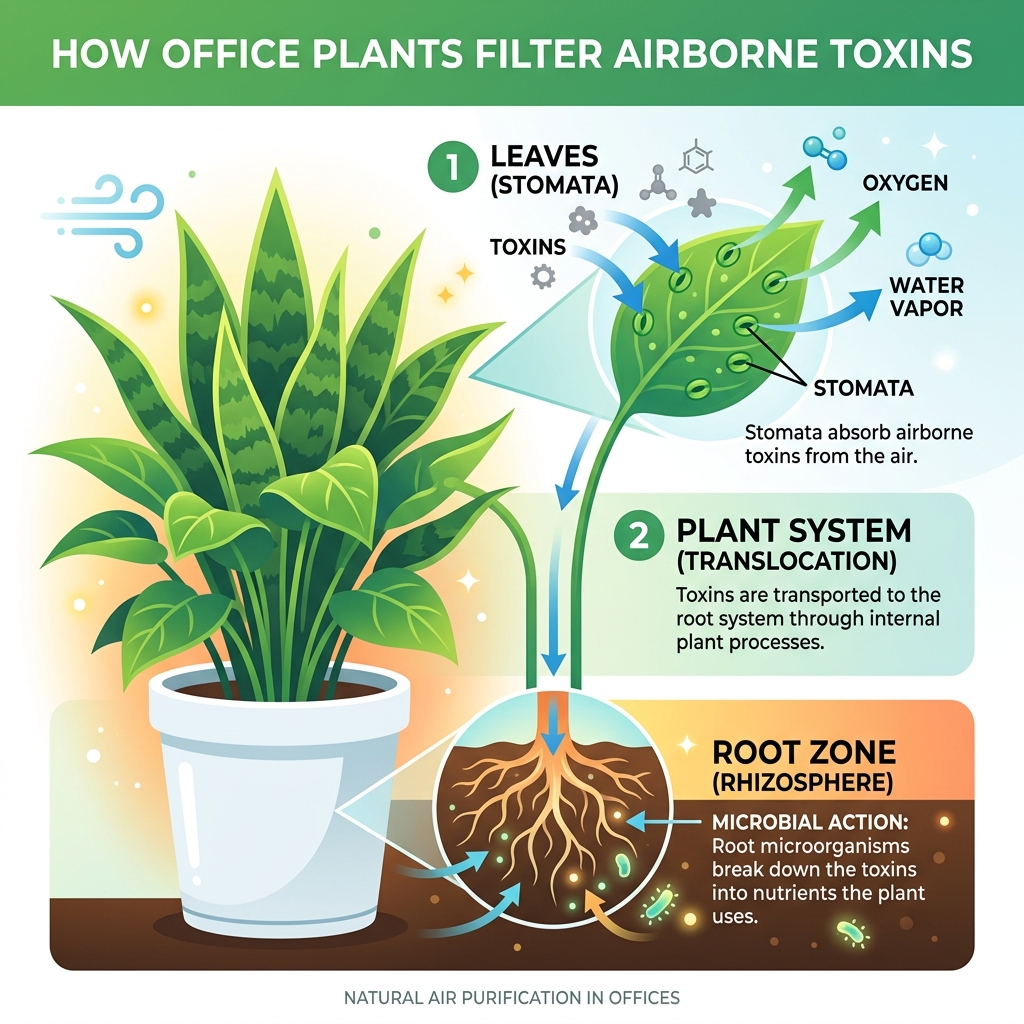
By incorporating indoor plants for office spaces, we aren’t just decorating; we are installing a living filtration system. Research shows that houseplants can remove as much as 87% of airborne toxins in as little as 24 hours in controlled settings. They do this through stomatal uptake—where the tiny pores on the leaves “breathe in” the pollutants—and through the action of root zone microbes, which break down toxins in the soil.
How Air Purifier Plants Office Workers Love Remove Toxins
It’s not just about the leaves. While the foliage adsorbs pollutants, the real magic often happens in the pot. The symbiotic relationship between the plant roots and specialized soil bacteria allows the plant to process chemicals that would otherwise linger in your cubicle.
Recent research on VOC removal in pharmaceutical labs highlighted specific high-performers. For instance, Cordyline fruticosa showed a staggering 87.5% removal efficiency, while Syngonium podophyllum (the Arrowhead plant) achieved 100% removal of particulate matter like PM2.5 and PM10. This is vital because fine dust and printer particles can irritate the respiratory system and lead to long-term health issues.
Furthermore, best leafy plants for air purification contribute to transpiration. As plants release water vapor into the air, they naturally regulate humidity levels. Maintaining an office humidity between 40% and 60% is the “sweet spot” for human comfort, helping to prevent dry skin, itchy eyes, and the spread of airborne viruses.
Boosting Productivity with an Air Purifier Plants Office Setup
Beyond the chemistry of the air, there is a profound psychological impact. We are biologically wired to be near nature—a concept known as Biophilia. When we bring greenery into a sterile work environment, we see a measurable 15% productivity boost.
A landmark study on workplace greenery and focus found that employees in “green” offices were more engaged and had higher levels of job satisfaction. The benefits include:
- Stress Reduction: Simply looking at a plant can lower blood pressure and reduce cortisol levels.
- Cognitive Performance: Clean air means more oxygen for the brain, leading to sharper focus and better decision-making.
- Reduced Sick Days: Better air quality and higher humidity can lead to fewer respiratory complaints and less absenteeism.
For those of us who weren’t born with a green thumb, low-maintenance air-purifying plants offer these benefits without adding “plant care” to your already overflowing to-do list.
Top Science-Backed Plants for the Workplace
When selecting an air purifier plants office kit, you need species that are tough, effective, and aesthetically pleasing. Here are our top picks based on scientific evidence and practical office survival rates.

1. Snake Plant (Sansevieria)
The “indestructible” champion of the office. The Snake Plant is unique because it performs CAM metabolism, meaning it converts CO2 to oxygen at night. It is a powerhouse at removing formaldehyde (18.2 μg/hr/m²) and benzene. It can survive in windowless rooms and only needs water every few weeks.
2. ZZ Plant (Zamioculcas zamiifolia)
If you tend to forget your plants, the ZZ is for you. It has been documented to survive over 90 days without a single drop of water. It features waxy, deep green leaves that excel at removing toxins like xylene and toluene.
3. Peace Lily (Spathiphyllum)
The “top tier” cleaner. Peace Lilies are famous for their ability to absorb mold spores through their leaves and use them as food at the root level. They are effective against a broad range of pollutants including ammonia and trichloroethylene. Note: They will “droop” dramatically when they need water, making them great communicators!
4. Pothos (Epipremnum aureum)
Often called “Devil’s Ivy” because it’s so hard to kill, Pothos is a trailing vine that looks great on high shelves or in hanging baskets. It is particularly good at removing formaldehyde from carpets and furniture finishes.
5. Spider Plant (Chlorophytum comosum)
A classic for a reason. The Spider Plant is highly efficient at removing carbon monoxide and xylene. It’s also incredibly easy to propagate—you can snip off the “babies” and grow a whole new army of air purifiers for your coworkers.
Plant Comparison Table
| Plant | Best For | Light Requirement | Toxin Target |
|---|---|---|---|
| Snake Plant | Windowless Offices | Very Low | Formaldehyde, Benzene |
| ZZ Plant | Frequent Travelers | Low | Xylene, Toluene |
| Peace Lily | Humidifying Air | Medium | Mold Spores, Ammonia |
| Pothos | High Shelves | Low to Medium | Formaldehyde, Benzene |
| Spider Plant | Desk Corners | Medium | Carbon Monoxide, Xylene |
Essential Care Protocol for Office Greenery
Maintaining an air purifier plants office environment doesn’t require a degree in botany, but it does require a consistent “living infrastructure” mindset. Dust is the enemy of purification; a layer of dust on a leaf can reduce photosynthesis by up to 40%, essentially “clogging” the plant’s lungs.
To keep your plants thriving, follow our 7-step office protocol:
- Assess Your Light Tiers: Use a phone app to measure lux levels. Shade-lovers need 500–2,000 lux (100–300 PPFD), while brighter spots might hit 5,000 lux.
- The Top-Inch Rule: Most office plants die from overwatering. Only water when the top inch of soil feels dry to the touch. For easy care plants for home air quality, this usually means once a week or every ten days.
- Maintain Humidity: Office HVAC systems are notorious for drying out the air. Grouping plants together creates a microclimate that boosts relative humidity (RH) to the ideal 40–60% range.
- Monthly Dusting: Wipe leaves with a damp microfiber cloth once a month. This keeps the stomata (pores) clear so the plant can continue to “breathe” in toxins.
- Quarterly Fertilization: Use a diluted, balanced fertilizer during the growing season (spring and summer). Skip the winter months when plants are dormant.
- Ensure Drainage: Never let a plant sit in standing water. Use pots with drainage holes and empty the saucers after watering to prevent root rot.
- Rotate for Even Growth: Give your pots a quarter turn every week. This ensures all sides of the plant get equal light and prevents them from leaning awkwardly toward the window.
Strategic Integration of Plants and Technology
While we love our “green superheroes,” we have to be realistic. To truly transform your indoor air, a combined approach is best. Plants are excellent at removing VOCs and regulating humidity, but mechanical air purifiers are the heavy lifters for removing smoke, pollen, and fine dust.
Pairing your plants with workplace comfort mini air purifiers for desks creates a comprehensive wellness strategy. High-efficiency particulate air (HEPA) filters can remove 99.97% of airborne particles, while your plants handle the gaseous toxins that filters might miss.
For larger corporate spaces, active green walls or biofilters are becoming popular. These systems use fans to force air through the root zones of hundreds of plants, amplifying the purification effect far beyond what a single potted plant could achieve.
Pro Tip: Place your plants 3 to 8 feet from windows for the best light, but keep them away from direct HVAC vents. The constant blast of hot or cold air can stress the leaves and lead to brown edges.
Frequently Asked Questions about Office Air Quality
Are there pet-friendly air purifying plants for the office?
Absolutely! If your office allows “bring your dog to work” days, safety is a priority. According to ASPCA guidelines, the Spider Plant, Parlor Palm, and Boston Fern are non-toxic to dogs and cats. While Peace Lilies and Pothos are effective purifiers, they can be mildly toxic if chewed, so keep them on high shelves or opt for the non-toxic varieties. For more on safe choices, check our guide on top houseplants for allergies.
How many plants are needed to make a measurable difference?
A general rule of thumb for noticeable air improvement is one medium-sized plant (in a 6-to-8-inch pot) for every 100 square feet of office space. However, for a “biophilic oasis” feel that truly impacts mood and focus, we recommend one plant per 25 to 40 square feet. Strategic grouping—placing 3 or 5 plants together—is more effective than scattering them single-file, as it creates a stronger humidity microclimate.
Can office plants survive in windowless rooms?
Yes, but you have to choose wisely. The Snake Plant and ZZ Plant are the “kings of the cave.” They can maintain their chlorophyll levels even in low-light environments (below 100 lux). For other plants, consider using LED grow lights with a 4,000 K spectrum. A simple desk lamp with a grow bulb on a timer can provide the “sunlight” your plants need to stay healthy and active.
Conclusion
At Mount Pilchuck, we believe that plants are more than just decoration—they are “living infrastructure” essential for a healthy modern life. Investing in an air purifier plants office setup is an investment in your team’s health, focus, and happiness.
By selecting the right species, following a simple care protocol, and integrating them with smart technology, you can transform a sterile cubicle into a thriving sanctuary. Ready to start your journey to a greener workspace?
Breathe easier with our full collection of indoor plants and discover how the right botanical guardians can change the way you work.
