
Defining “Low Light” for Your Indoor Space
The best low light low maintenance houseplants are ideal for anyone who wants greenery without the fuss — especially in dim apartments, offices, or rooms with no south-facing windows.
Top picks at a glance:
| Plant | Light Needed | Watering Frequency | Pet Safe? |
|---|---|---|---|
| Snake Plant | Very low | Every 2-6 weeks | No |
| ZZ Plant | Very low | Every 2-3 weeks | No |
| Pothos | Low to medium | Every 1-2 weeks | No |
| Aglaonema Maria | Very low | Every 14-21 days | No |
| Peace Lily | Low | Every 1-2 weeks | No |
| Cast Iron Plant | Very low | Every 2-4 weeks | Yes |
Most of us want plants in our homes. But between long work days, poor natural light, and the lingering memory of that fern you accidentally killed, it can feel impossible.
Here’s the thing: the right plant in the wrong spot will always struggle. But the right plant in the right spot — even a dim corner — can thrive for years with almost no effort.
Many online plant lists set people up to fail by recommending plants that only tolerate low light, not ones that actually thrive in it. This guide cuts through that noise.
Whether you’re dealing with stagnant air in a city apartment, a windowless home office, or just a busy schedule that leaves little time for plant care, these plants work hard for you — cleaning your air and adding life to dark spaces — without demanding much in return.
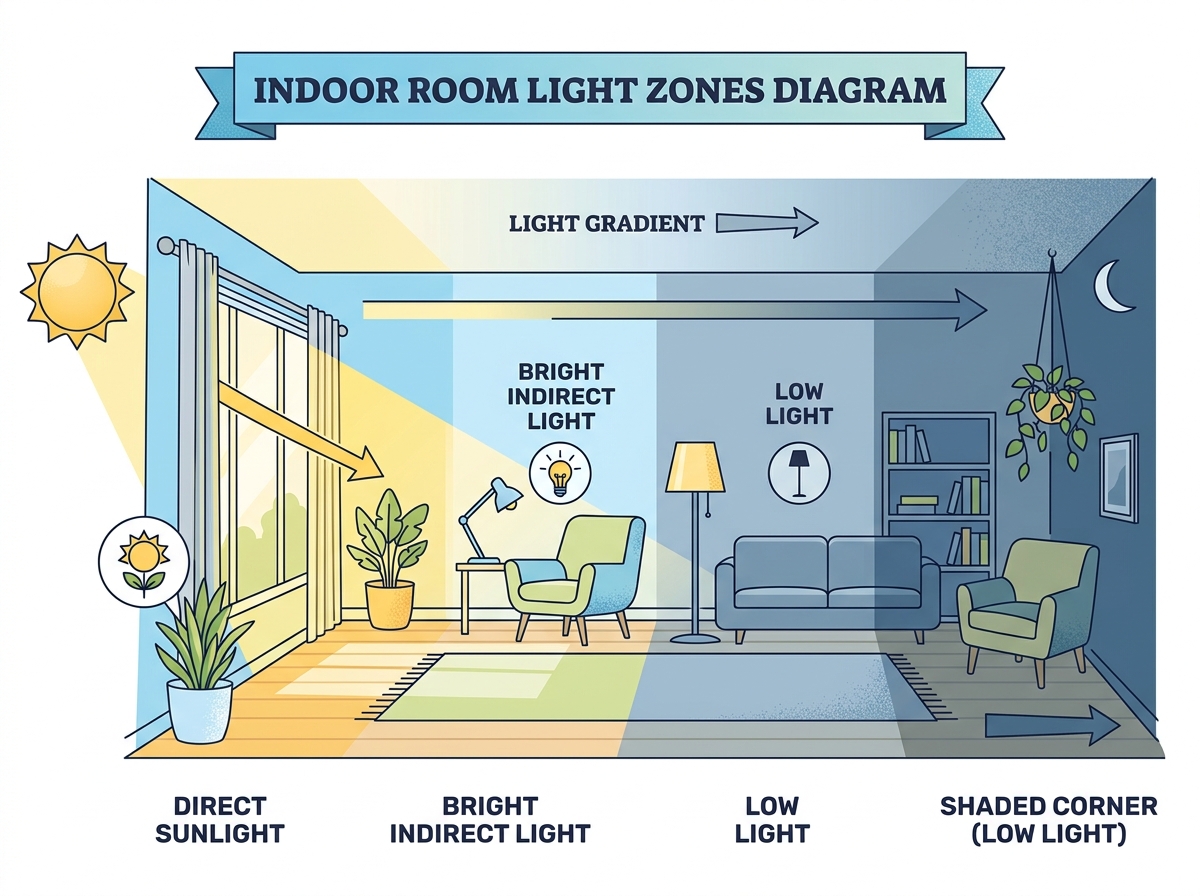
One of the biggest hurdles for new plant parents is understanding what “low light” actually means. In horticulture, light is measured in “lux.” To give you a baseline, a bright, sunny day outdoors can hit 100,000 lux. In contrast, the best low light low maintenance houseplants can survive in as little as 50–75 lux—which is essentially deep shade.
When we talk about low light indoors, we are usually referring to:
- North-facing rooms: These windows receive the least amount of intensity and no direct sun.
- The “4-12 foot” rule: This is the area of a room that is several feet away from a window, where the sun’s rays don’t directly hit the floor or furniture.
- Office lighting: Many plants, like the Aglaonema Maria, can photosynthesize efficiently under 100–200 lux, which is typical for standard office fluorescent lighting.
- Hallways and corners: Areas where you can see to read a book during the day, but you cannot see the sky through a window.
It is a common myth that plants can grow in total darkness. Even the most resilient species need some light to produce chlorophyll. If you have a room with absolutely no windows, you will need to supplement with grow lights. Modern LED grow lights are incredibly efficient and can provide the blue spectrum needed for foliage growth and the red spectrum for health, all without a massive electricity bill. For more tips on setting up these spaces, check out our guide on Indoor plants for low-light rooms.
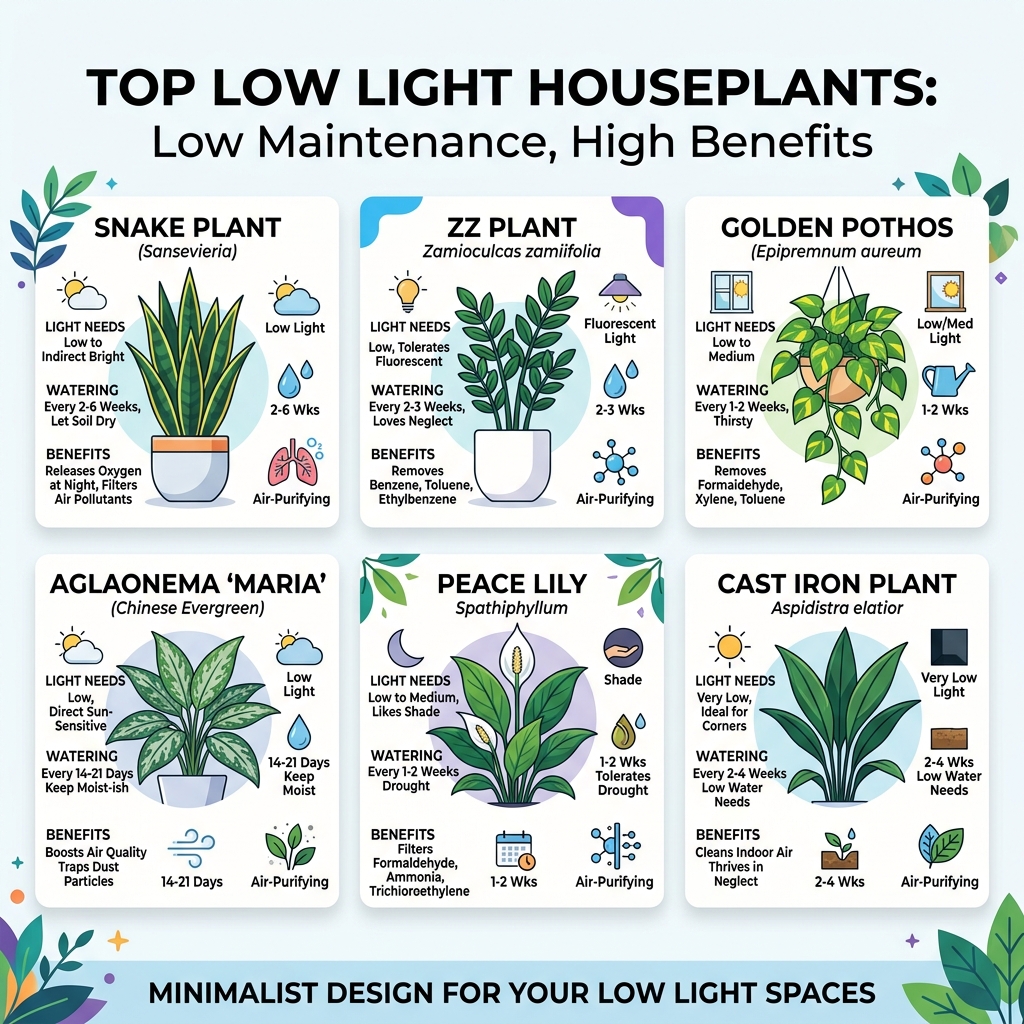
The Best Low Light Low Maintenance Houseplants: Top Picks
When selecting the best low light low maintenance houseplants, we look for “survivors.” These are plants that don’t just “tolerate” the dark but maintain their health and aesthetic appeal without constant hovering.
| Plant Variety | Growth Rate | Toxicity (Pets) | Unique Feature |
|---|---|---|---|
| Aglaonema Maria | Slow (3-6 leaves/year) | Toxic | Silver-patterned leaves |
| Cast Iron Plant | Very Slow | Pet-Safe | Virtually indestructible |
| Peace Lily | Moderate | Toxic | Elegant white flowers |
| Snake Plant | Slow to Moderate | Toxic | Vertical, architectural leaves |
| ZZ Plant | Slow | Toxic | Glossy, “polished” foliage |
Aglaonema Maria (Chinese Evergreen)
The Aglaonema Maria is a superstar for beginners. It is so efficient that it can thrive in hallways with no direct window access. Research shows that keeping its leaves clean is vital; dull, dusty leaves can lead to a 30% decrease in photosynthesis. In low light, these plants are patient growers, typically reaching a mature size of 24–36 inches over 5 to 8 years.
Cast Iron Plant (Aspidistra elatior)
The name says it all. Historically known as the “bar room plant,” it earned its reputation by surviving in the dim, smoky corners of Victorian-era pubs. It is one of the few truly pet-safe options for low-light environments. It handles neglect, poor soil, and low humidity with grace.
Peace Lily (Spathiphyllum)
If you want a plant that “talks” to you, this is it. The Peace Lily wilts dramatically when it’s thirsty but perks up within hours of watering. Beyond its beauty, the NASA Clean Air Study on air-purifying plants ranked the Peace Lily in the top five for removing indoor toxins like benzene and formaldehyde. To learn more about how these plants improve your environment, see our article on Low-maintenance air-purifying plants.
Why Snake Plants are the Best Low Light Low Maintenance Houseplants
Scientifically known as Dracaena trifasciata (and formerly Sansevieria), the Snake Plant is the gold standard of easy-care greenery. These plants are native to tropical Africa, where they adapted to survive in both scorching sun and deep shade.
What makes them the best low light low maintenance houseplants is their unique metabolism. They use Crassulacean Acid Metabolism (CAM), meaning they keep their pores (stomata) closed during the day to conserve water and open them at night to take in carbon dioxide. This makes them incredibly drought-tolerant; you can literally go on a month-long vacation, and your Snake Plant will likely be fine.
They are also powerhouse air purifiers. NASA research found that they are effective at removing four out of the five targeted indoor toxins. Whether you choose the tall ‘Laurentii’ with its yellow edges or the compact ‘Hahnii’ (Bird’s Nest), you are getting a plant that thrives on neglect. Explore more about Easy-care plants for home air quality to see why the Snake Plant is a must-have.
ZZ Plant: Indestructible Greenery for Dark Corners
The ZZ Plant (Zamioculcas zamiifolia) looks so perfect with its waxy, emerald-green leaves that people often mistake it for a fake plant. Native to East Africa, it is designed for survival.
The secret to its resilience lies underground. The ZZ Plant grows from thick, potato-like tubers called rhizomes. These rhizomes store water, allowing the plant to withstand months of drought. It is the perfect choice for a windowless hallway or a basement office. It grows in spurts—you might see no movement for months, followed by several new stems shooting up almost overnight.
Because it requires so little water and can survive in very dim conditions, it is one of our top Budget-friendly air-purifying plants. Just be sure to wear gloves when repotting, as the sap can be a skin irritant for some.
Pothos: The Best Low Light Low Maintenance Houseplants for Beginners
Often called “Devil’s Ivy” because it’s nearly impossible to kill, the Pothos (Epipremnum aureum) is the ultimate trailing plant. It is highly adaptable; while it prefers bright indirect light, it will maintain its lush look even in much darker corners, though its variegation (the white or yellow spots) may fade to solid green to maximize chlorophyll production.
Pothos are excellent for Indoor plants for small apartments because they can be grown in hanging baskets or trailed along bookshelves, saving precious floor space. They are also incredibly easy to “read”—if the leaves look a bit limp, it’s time for a drink.
Essential Care Guide for Low Light Greenery
Caring for the best low light low maintenance houseplants is more about what you don’t do than what you do. Because these plants are in low light, their metabolic rate is slower, meaning they need less of everything—especially water.
Watering and Soil
The #1 killer of low-light plants is overwatering. In a dim corner, water evaporates much slower than it does in a sunny window.
- The Knuckle Test: Before watering, stick your finger two inches into the soil. If it feels moist, wait a week.
- Frequency: In winter, plants like the Aglaonema Maria may only need water every 14–21 days. Snake plants can go even longer.
- Bottom Watering: This technique involves placing the pot in a tray of water for 20 minutes, allowing the roots to soak up what they need. This can lead to 80% fewer fungus gnats!
- Potting Mix: Always use a well-draining soil. For Snake and ZZ plants, a cactus or succulent mix with added perlite is ideal.
Pots and Drainage
Never put a low-light plant in a pot without a drainage hole. Stagnant water at the bottom of a pot leads to root rot, which is often fatal. Terracotta pots are excellent because they are porous and help the soil “breathe,” though plastic nursery liners inside decorative “cachepots” also work well. For those living in tight quarters, check out our tips on Small potted plants for apartments.
Temperature and Humidity
Most of these plants are tropical and prefer temperatures between 65°F and 80°F. If you are comfortable, they are likely comfortable. However, be careful with:
- Drafts: Keep plants away from AC vents or drafty winter windows.
- Dry Air: While ZZ and Snake plants handle dry air well, Peace Lilies and Aglaonemas appreciate a bit more humidity (around 40-50%). Grouping plants together can create a small microclimate that naturally boosts humidity.
Seasonal Adjustments
Plants have a “circadian rhythm.” During the winter, even the best low light low maintenance houseplants enter a period of dormancy. Growth will slow down, and they will require significantly less water. Avoid fertilizing during the winter months; wait until the brighter days of spring to give them a nutrient boost.
Troubleshooting and Propagating Your Easy-Care Plants
Even the toughest plants can run into trouble. Here is how to spot and fix common issues:
- Yellow Leaves: Usually a sign of overwatering. Let the soil dry out completely before the next watering.
- Brown, Crispy Edges: This often indicates low humidity or tap water sensitivity. Try using filtered water or misting the plant.
- Pests: Mealybugs (white cottony spots) and spider mites (tiny webs) can occasionally appear. Wipe the leaves with a mixture of water and a drop of mild dish soap, or use neem oil.
- Dust: Dust acts like a blanket, blocking light. Wipe leaves weekly with a damp microfiber cloth to keep them healthy.
Propagation: Growing Your Collection for Free
One of the most rewarding parts of being a plant parent is propagation. The best low light low maintenance houseplants are often the easiest to multiply.
- Water Cuttings: Pothos and Aglaonema Maria can be propagated by taking a stem cutting (ensure there is at least one “node” or bump on the stem) and placing it in water. Aglaonema cuttings in water have a 95% success rate!
- Division: For Snake Plants and ZZ Plants, the easiest method is division. When you repot the plant, gently pull the root ball apart into two or three sections and pot them separately.
- Success Rates: Propagation is most successful in spring and summer. In winter, the success rate for Aglaonema cuttings can drop from 95% to about 60%.
For more ways to green your home without breaking the bank, see our guide on Budget-friendly air-purifying plants 2.
Frequently Asked Questions about Low Light Plants
Can these plants survive in a room with no windows?
Generally, no. All plants need some light to survive long-term. In a windowless room or basement, you must use a grow light for at least 8–12 hours a day. Without it, the plant will eventually use up its stored energy and die.
How do I know if my plant is getting too much light?
Even “low light” plants can get sunburned! If you see scorched brown patches on the leaves or if the leaves feel “bleached” and pale, move the plant further away from the window.
Are these low-maintenance plants safe for cats and dogs?
Many of the most popular low-light plants, including Snake Plants, ZZ Plants, and Pothos, contain calcium oxalate crystals which are toxic if ingested. They can cause mouth irritation and digestive upset. If you have curious pets, the Cast Iron Plant is your best pet-safe bet. Always place toxic plants on high shelves or in hanging baskets out of reach.
Conclusion
At Mount Pilchuck, we believe that everyone deserves the health-boosting benefits of indoor greenery, regardless of how much sun their home gets or how busy their schedule is. The best low light low maintenance houseplants like the Snake Plant, ZZ Plant, and Aglaonema Maria are more than just decorations—they are living air purifiers that reduce stress and improve indoor air circulation.
By choosing plants that truly thrive in dim conditions and following a “less is more” care routine, you can enjoy a lush, vibrant home without the stress of complicated maintenance. Ready to start your low-light jungle? Explore our full collection of indoor plants for more expert advice and inspiration.
