
Can You Really Grow Plants With No Sunlight?
The best plant for no sunlight is the ZZ Plant (Zamioculcas zamiifolia) — it tolerates extremely low light, survives weeks without water, and thrives in windowless offices and bathrooms. But it’s not alone.
Here are the top low-light plants for dark indoor spaces:
| Plant | Why It Works in Low Light |
|---|---|
| ZZ Plant | Stores water in rhizomes; nearly impossible to kill |
| Snake Plant | NASA-recognized air purifier; survives on artificial light |
| Cast Iron Plant | Handles dark, drafty spots with minimal care |
| Pothos | Fast-growing; thrives on fluorescent office lighting |
| Heartleaf Philodendron | Adapts to dim corners; easy to propagate |
| Chinese Evergreen | Darker leaf varieties built for low-light rooms |
| Peace Lily | Blooms even under overhead office lights |
| Spider Plant | Resilient and great for hanging in shaded spots |
| Dracaena | Tall, architectural, and low-maintenance in dark spaces |
| Bird’s Nest Fern | Loves humid, windowless bathrooms |
Not every home or office gets flooded with natural light. If you live in an urban apartment, work in a windowless cubicle, or have a bathroom with no windows — you’ve probably looked at a bare corner and wished you could put something green there.
The good news: many houseplants are naturally adapted to low-light environments. In the wild, they grow on rainforest floors under dense canopies, where direct sunlight barely reaches. That evolutionary history makes them perfect for your dim spare room or dark office desk.
The key thing to understand is that no light and low light are not quite the same thing — and that difference matters a lot for which plant you choose and how you care for it.
Understanding “No Sunlight” vs. Low Light for Houseplants
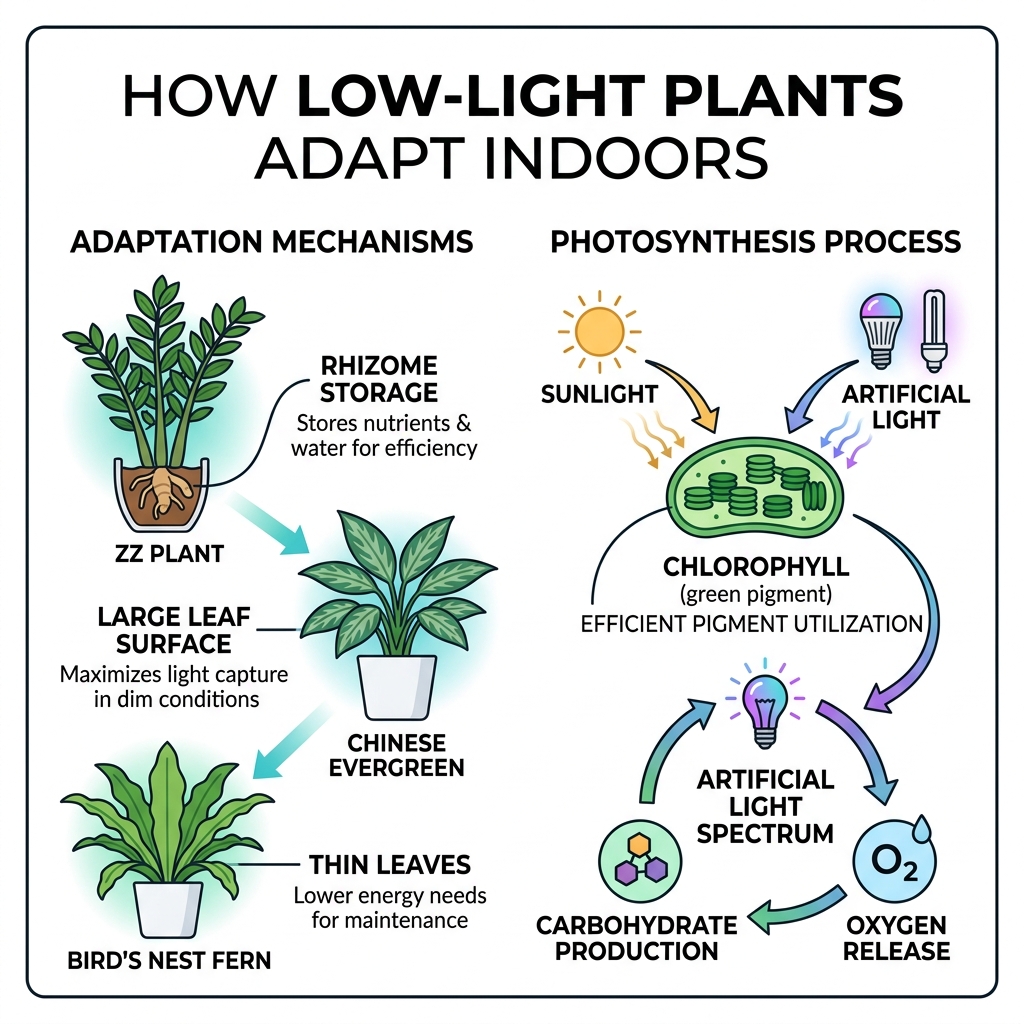
When we talk about the best plant for no sunlight, we have to get honest about biology. All plants need some form of light to perform photosynthesis—the process of turning light into energy. However, “no sunlight” doesn’t have to mean “total darkness.”
According to experts like University of Minnesota Extension horticulture educator Laura Irish-Hanson, plants can be surprisingly adaptable to artificial light sources. In a windowless office, the humming fluorescent bulbs overhead or modern LED grow-lights can often provide enough “food” for the right species to survive and even grow.
Low light is generally defined as a spot where you might struggle to read a book without a lamp during the day. This includes north-facing rooms, corners blocked by large furniture, or spaces where the nearest window is more than 8 to 10 feet away. In these environments, the light intensity is low, but the duration of light (how many hours the lights are on) can compensate for the lack of sun.

Defining the Best Plant for No Sunlight Environments
In professional interiorscaping, light is often measured in foot-candles. A sunny windowsill might have over 1,000 foot-candles, while a “low-light” corner might only have 25 to 50.
If you are looking for a plant for a windowless bathroom or a basement office, you are looking for a “survivor.” These plants don’t necessarily thrive on darkness—they simply have a slower metabolism that allows them to maintain their foliage without much fuel. The best plant for no sunlight in these cases is one that can effectively use the light from standard office fixtures for 8 to 12 hours a day.
The Best Plant for No Sunlight: Top 10 Resilient Varieties
Choosing the right greenery for a dim space is about matching the plant’s natural habitat to your home. Most of these selections come from the tropical understory, where they’ve spent millions of years learning to love the shade.
- Snake Plant (Sansevieria): Often called “Mother-in-Law’s Tongue,” this is a powerhouse of resilience. It can go weeks without water and handles dim corners like a pro.
- ZZ Plant (Zamioculcas zamiifolia): The gold standard for “unkillable” plants. Its waxy leaves reflect what little light is available.
- Cast Iron Plant (Aspidistra elatior): Named for its toughness, this plant was a favorite in drafty, dark Victorian manors.
- Pothos (Epipremnum aureum): Also known as “Devil’s Ivy” because it’s so hard to kill, it loves to trail down bookshelves.
- Heartleaf Philodendron: A classic vining plant that is much more tolerant of low light than its variegated cousins.
- Chinese Evergreen (Aglaonema): A versatile choice; just remember that darker green varieties handle low light better than the colorful ones.
- Spider Plant (Chlorophytum comosum): Known for its long stolons Spider Plants that produce “babies,” these create a lush curtain of foliage even in shaded spots.
- Peace Lily (Spathiphyllum): One of the few low-light plants that will actually bloom (producing white bracts) without direct sun.
- Dracaena Lisa: A tall, structural plant that is perfect for narrow, dark office corners.
- Bird’s Nest Fern: Unlike many ferns that are finicky, this one handles lower light and loves the humidity of a windowless bathroom.
Snake Plant: The Best Plant for No Sunlight for Air Purification
If you want a plant that works as hard as you do, the Snake Plant is the winner. It was famously voted by NASA as one of the top air-purifying plants. While most plants take in CO2 and release oxygen during the day, the Snake Plant continues to produce oxygen at night.
This makes it the best plant for no sunlight in bedrooms or offices where air circulation might be poor. It filters toxins like formaldehyde and benzene from the air, helping you breathe easier while adding a sharp, architectural look to your decor.
ZZ Plant: The Best Plant for No Sunlight for Busy Owners
For those of us who forget to water for a month (or two), the ZZ Plant is a miracle. It grows from thick, potato-like bulbs called rhizomes that store water underground. This evolutionary trick allows it to survive in rooms with absolutely no windows, relying entirely on fluorescent light.
Its shiny, waxy leaves are designed to catch every stray photon of light. It’s a slow grower, which is actually a benefit in low light—it won’t quickly outgrow its pot or become “leggy” and unattractive.
Essential Care Guide for Your Low-Light Greenery
While these plants are tough, they aren’t made of plastic! They still require a bit of love. You can find more info about indoor plants for low light rooms on our dedicated guide, but here are the basics to keep your dark-room survivors happy.
- Watering Frequency: This is the most important rule: Water less. In low light, water evaporates slowly, and the plant’s metabolism is sluggish. Overwatering is the fastest way to kill a low-light plant.
- Well-Draining Soil: Use a potting mix with plenty of perlite or sand. You want the water to move through the soil, not sit around the roots.
- Temperature Stability: Most low-light plants are tropical. They prefer temperatures between 60°F and 80°F. Avoid placing them directly in front of AC vents or drafty doors.
- Humidity: Plants like ferns and Peace Lilies love moisture in the air. If your room is dry, a quick misting or a pebble tray can help.
Adjusting Maintenance for Windowless Rooms
When a plant lives in a windowless room, it faces unique challenges. Without natural air movement, dust can settle on the leaves, blocking what little light the plant is trying to absorb. We recommend wiping the leaves with a damp cloth once every two weeks. This not only helps the plant “breathe” but also keeps it looking vibrant.
Also, keep an eye on seasonal changes. Even if your room is windowless, the ambient humidity and temperature in your home will change between summer and winter. You may find you only need to water your Snake Plant once every six weeks during the winter months!
Troubleshooting: Is Your Plant Thriving or Dying?
It can be hard to tell if a plant is just “resting” or if it’s struggling. Low-light plants grow slowly, so don’t expect a new leaf every week. However, there are clear signs that your plant needs a change.
| Sign | Meaning | Fix |
|---|---|---|
| Leggy/Stretched Stems | Searching for light | Move closer to a light source or add an LED bulb. |
| Pale/Yellow Leaves | Usually overwatering | Let the soil dry out completely before watering again. |
| Brown, Crispy Tips | Low humidity or tap water chemicals | Use filtered water and mist the leaves. |
| Small, Stunted New Growth | Not enough energy | The plant needs a bit more light to produce healthy leaves. |
| Leaning to One Side | Uneven light | Rotate the pot 90 degrees every time you water. |
Plants to Avoid in Dark Conditions
Not every plant is a candidate for the “dark side.” If you try to put a succulent or a cactus in a windowless room, it will likely stretch out, turn pale, and eventually rot. These plants require high-intensity light to maintain their structure.
Similarly, avoid highly variegated plants (those with lots of white or yellow on the leaves). These white patches don’t contain chlorophyll, meaning the plant has to work twice as hard to produce energy. In a dark room, a variegated plant will often lose its color and turn solid green as it tries to survive, or it will simply wither away.
Frequently Asked Questions about the Best Plant for No Sunlight
Can plants survive with absolutely no light?
No plant can survive in total, 24/7 darkness forever. However, many “no sunlight” plants can thrive on artificial light alone. If you have a windowless office, leaving the overhead fluorescent lights on for 10–12 hours a day is often sufficient for a ZZ Plant or a Pothos. If the room is dark most of the time, you will need to invest in a small LED grow light on a timer.
What are the benefits of plants in windowless offices?
Beyond just looking nice, plants provide a significant productivity boost. Studies show that greenery in the workspace can reduce stress and increase focus. For windowless offices, plants also help with air circulation and humidity, making a “stale” room feel much fresher.
Which plants are best for humid, dark bathrooms?
Bathrooms are a unique environment. The high humidity from showers is a dream for tropical plants. The best plant for no sunlight in a bathroom is the Bird’s Nest Fern or the Staghorn Fern. Peace Lilies also love the extra moisture, though you should ensure they aren’t sitting in a puddle of water.
Conclusion
Creating a green oasis in a dark room is entirely possible with the right selection. Whether you choose the indestructible ZZ Plant or the air-purifying Snake Plant, adding life to your dimmest corners is a great way to boost your mood and improve your indoor environment.
At Mount Pilchuck, we believe everyone deserves a touch of nature, regardless of how many windows they have. Our expert advice focuses on helping you choose health-boosting greenery that improves air circulation and brings a sense of calm to your home or office. Ready to start your low-light jungle? Shop our collection of indoor plants today and find your perfect dark-room companion.
