
The Best Trailing Houseplants for Low Light (And Why Your Home Needs Them)
The best trailing houseplants for low light include Golden Pothos, Heartleaf Philodendron, Spider Plant, Boston Fern, Satin Pothos, English Ivy, String of Hearts, String of Turtles, Swedish Ivy, and Pilea glaucophylla.
Quick answer at a glance:
| Plant | Light Tolerance | Pet Safe? |
|---|---|---|
| Golden Pothos | Full shade to bright indirect | No |
| Heartleaf Philodendron | Low to bright indirect | No |
| Spider Plant | Partial shade to bright indirect | Yes |
| Boston Fern | Full shade to indirect | Yes |
| Satin Pothos | Low to moderate indirect | No |
| English Ivy | Low to bright indirect | No |
| String of Hearts | Moderate shade to bright indirect | Yes |
| String of Turtles | Low to bright indirect | Yes |
| Swedish Ivy | Low to bright indirect | Yes |
| Pilea glaucophylla | Partial shade | Yes |
If you live in an apartment or a room with small windows, you know the struggle. Stagnant air. Low energy. That stuffy feeling that never quite goes away.
Plants can help — but most need more light than your space can offer.
That’s where trailing houseplants shine. They drape beautifully from shelves and hanging baskets, they’re low-maintenance, and the best ones thrive even in dim corners. Many also help freshen indoor air, which matters a lot when you spend most of your day inside.
The vines can grow surprisingly long too. Pothos, for example, can reach up to 15 feet indoors — filling a dark corner with lush, living greenery without needing a sunny windowsill.
The key is picking the right plants for low light. Not every trailing plant will survive in shade, and some will just slowly decline without you realizing why.
This guide covers the top 10 options, how to care for them, and how to display them even if you can’t drill a single hole in your wall.
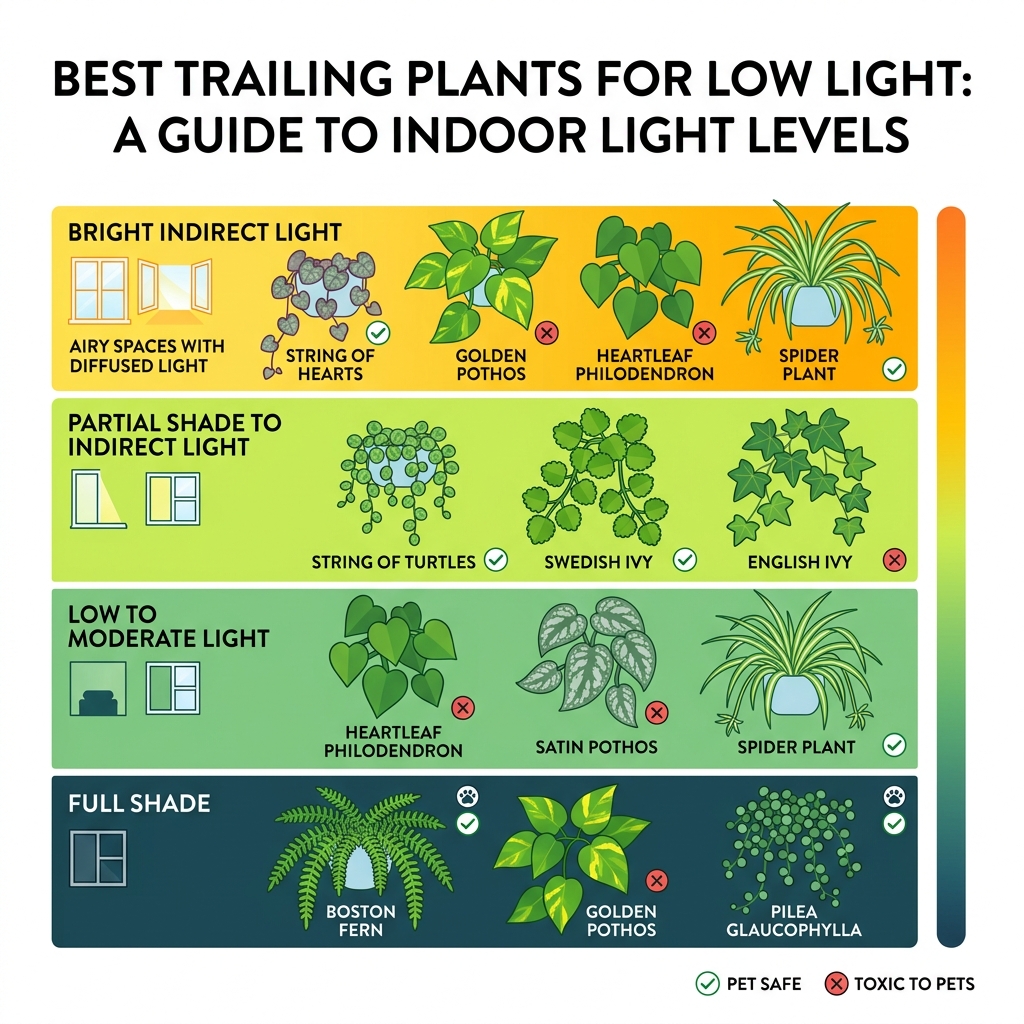
Top 10 Best Trailing Houseplants for Low Light
Finding the perfect greenery for a dim corner doesn’t mean you have to settle for plastic fakes. Many tropical plants evolved under the dense canopy of rainforests, meaning they are biologically programmed to thrive in the shadows. When we bring these into our homes, they become the best trailing houseplants for low light because they don’t just survive; they cascade.

1. Golden Pothos (Epipremnum aureum)
Often called “Devil’s Ivy” because it is nearly impossible to kill, the Golden Pothos is the gold standard for beginners. It features heart-shaped leaves with yellow variegation. While it loves bright light, it is famous for maintaining its growth in near-total shade. We recommend this as a top choice for indoor-plants-for-low-light-rooms/ because it adapts to almost any environment.
2. Heartleaf Philodendron (Philodendron hederaceum)
Frequently confused with Pothos, the Heartleaf Philodendron has thinner, smoother leaves with a more pronounced heart shape. It is a champion of the “low light” world, growing about 2 inches per month even in darker spots. It’s a wonderful choice for creating a “living wall” effect.
3. Spider Plant (Chlorophytum comosum)
A classic since the 1970s, the Spider Plant is more than just a nostalgic decor piece. A famous NASA Clean Air Study found that Spider Plants are among the most effective indoor plants for improving air quality, removing harmful pollutants like formaldehyde from the home. They produce “pups” or offshoots that dangle down like tiny spiders, creating a multi-tiered trailing effect.
4. Boston Fern (Nephrolepis exaltata)
If you have a bathroom with a small, frosted window, the Boston Fern is your best friend. These plants have been popular since Victorian times and can grow up to 3 feet wide and tall. They love the high humidity of a shower room and can tolerate full shade, though they do require consistent moisture to keep their fronds from turning crispy.
5. English Ivy (Hedera helix)
English Ivy is a vigorous grower that can add a touch of “English cottage” charm to your bookshelf. It is incredibly resilient and can even be grown in rooms with no windows if you provide some fluorescent overhead lighting. Just be careful—this one is toxic to pets, so keep it high up!
6. String of Hearts (Ceropegia woodii)
For something a bit more delicate, the String of Hearts offers dainty, heart-shaped leaves on purple-toned vines that can reach over 10 feet in length. It is a succulent-like plant, meaning it stores water in its leaves, making it perfect for those of us who occasionally forget to water.
7. String of Turtles (Peperomia prostrata)
This tiny gem features round leaves with patterns that look exactly like turtle shells. It is native to the wet tropical areas of Ecuador and thrives in lower light, though its “turtle” patterns may become slightly less vibrant if the room is very dark.
8. Swedish Ivy (Plectranthus verticillatus)
Despite the name, it’s not actually an ivy, and it’s not from Sweden (it’s South African!). It is a thick-stemmed, lush plant that is very easy to propagate. It can survive significant neglect and still look vibrant and green.
9. Pilea glaucophylla (Silver Sparkle)
This plant features tiny, silver-green leaves on red stems. It creates a misty, cloud-like appearance as it trails over the side of a pot. It’s an excellent choice for adding texture to a plant collection.
10. Satin Pothos (Scindapsus pictus)
The Satin Pothos has matte, dark green leaves splashed with silvery grey. In the wild, it grows in the deep shade of large trees, making it naturally suited for the darker corners of your apartment.
Why Pothos is one of the Best Trailing Houseplants for Low Light
The Golden Pothos (Epipremnum aureum) earns its own spotlight because of its sheer versatility. In its native habitat, it climbs trees, but indoors, its vines can trail down for 15 feet or more. It is one of the easy-care-plants-for-home-air-quality/ because it doesn’t demand much. It can grow in soil, or even just a jar of water, and it is highly resistant to pests. If you are a self-proclaimed “black thumb,” the Pothos is the plant that will finally change your mind.
Caring for the Best Trailing Houseplants for Low Light
Caring for these plants is generally straightforward, but low light conditions mean the plant’s metabolism is slower. Here is our expert advice for keeping them healthy:
- Watering: In low light, water evaporates more slowly. Always check the soil by sticking your finger an inch deep. If it feels moist, wait. Overwatering is the #1 killer of low-light plants.
- Feeding: Use a balanced 10-10-10 NPK fertilizer, but only during the spring and summer. We suggest low-maintenance-air-purifying-plants/ because they don’t need heavy feeding—once every 4 to 6 weeks is plenty.
- Pruning: If your vines start looking “leggy” (long stems with few leaves), don’t be afraid to snip them. Pruning encourages the plant to branch out, making it look fuller and bushier.
Essential Care and Potting for Shady Vines
The secret to success with the best trailing houseplants for low light isn’t just about where you put them—it’s about what you put them in. Because light is limited, the soil stays wet longer, which can lead to the dreaded root rot.
The Right Soil Mix
We always recommend a well-draining potting mix. A standard “houseplant compost” is okay, but you can make it better by mixing in:
- Perlite: These little white “popcorn” rocks create air pockets in the soil, ensuring the roots can breathe.
- Peat Moss or Coco Coir: This helps retain just enough moisture without letting the soil become a swamp.
Root Rot Prevention
Root rot happens when roots sit in stagnant water. To prevent this, always use a pot with drainage holes. If you find a beautiful decorative pot that doesn’t have holes, use it as a “cachepot”—keep the plant in a plastic nursery liner inside the decorative pot, and pour out any excess water after watering. This is especially important for top-air-purifying-plants-for-bedrooms/ where you want the plant to stay healthy and active.
Watering Needs Comparison
| Plant Type | Watering Frequency | Soil Preference |
|---|---|---|
| Ferns (Boston, Bird’s Nest) | Keep consistently moist | High organic matter |
| Vines (Pothos, Philodendron) | Let top 2 inches dry | Standard well-draining |
| Succulent Vines (String of Hearts/Turtles) | Let soil dry completely | Cactus/Succulent mix |
Humidity and Misting
Many trailing plants are tropical and love humidity. If your home is dry, especially in winter, consider:
- Misting: Use a spray bottle to lightly mist the leaves of ferns and ivy.
- Pebble Trays: Place the pot on a tray filled with pebbles and water. As the water evaporates, it creates a humid microclimate around the plant.
- Grouping: Grouping plants together naturally raises the local humidity levels through transpiration.
Safety and Creative Display Solutions
When you’re dealing with trailing plants, the “trailing” part is the whole point! But if you have pets or live in a rental where you can’t drill holes, you need to get creative.
Pet Safety First
It’s a sad reality that many beautiful vines are toxic. Plants like Pothos, Philodendron, and English Ivy contain calcium oxalate crystals, which can cause irritation or worse if chewed by a curious cat or dog. If you have furry friends, stick to these pet-safe options:
- Spider Plant
- Boston Fern
- String of Turtles
- Swedish Ivy
For those with sensitivities, we have a guide on top-houseplants-for-allergies/ to help you choose plants that won’t trigger sneezing.
No-Drill Hanging Hacks
You don’t need a power drill to enjoy a jungle vibe. Here are our favorite ways to display trailing plants:
- Command Hooks: Heavy-duty adhesive hooks can hold surprisingly heavy hanging baskets.
- Tension Rods: Place a sturdy shower curtain rod or tension rod across a window frame or between two walls to hang multiple plants.
- High Shelves: Placing small-potted-plants-for-apartments/ on top of a bookshelf or kitchen cabinet lets the vines cascade down naturally without any hardware.
- Macrame Hangers: These can be looped over curtain rods or existing hooks to add texture and height.
Frequently Asked Questions about Low Light Trailing Plants
How do I propagate trailing plants like Pothos or Philodendron?
Propagating these plants is incredibly rewarding and easy!
- Snip: Find a healthy vine and cut a 4-6 inch section. Ensure there are at least two “nodes” (the little bumps where leaves grow).
- Strip: Remove the bottom leaves so the nodes are bare.
- Submerge: Place the bare nodes in a jar of room-temperature water.
- Wait: In a few weeks, you’ll see white roots growing. Once they are about 2 inches long, you can plant them in soil. This is one of the reasons these are the best-leafy-plants-for-air-purification/—you can easily turn one plant into ten!
Which trailing plants are safest for homes with cats and dogs?
As mentioned, the Spider Plant, Boston Fern, and String of Turtles are excellent non-toxic choices. Swedish Ivy is also a very safe bet. These are perfect budget-friendly-air-purifying-plants/ because they grow fast and won’t result in an expensive vet bill if your cat decides to take a nibble.
Can trailing plants survive in a room with no windows?
“Low light” does not mean “no light.” All plants need some light to photosynthesize. However, if you have a windowless office or bathroom, you can use:
- Fluorescent Lights: Standard office lights actually provide enough of the light spectrum for Pothos and Heartleaf Philodendrons to survive.
- Grow Lamps: You can buy small LED grow bulbs that fit into regular desk lamps.
- The Rotation Method: Keep two plants and swap them every two weeks between the windowless room and a room with a window. This makes them ideal indoor-plants-for-small-apartments/ where natural light is a luxury.
Conclusion
At Mount Pilchuck, we believe that everyone deserves a breath of fresh air, regardless of how many windows their home has. Choosing the best trailing houseplants for low light is a simple, effective way to boost your mood, improve air circulation, and turn a stagnant corner into a lush sanctuary.
Whether you start with a resilient “Devil’s Ivy” or a delicate “String of Hearts,” these vines offer expert-level beauty with beginner-level effort. They work hard to scrub the air and provide a sense of calm that only nature can bring.
Ready to start your indoor jungle? Explore our full guide to indoor plants for more expert advice on health-boosting greenery and home wellness.
