
The Best Small Houseplants for Low Light (And Why Your Apartment Needs Them)
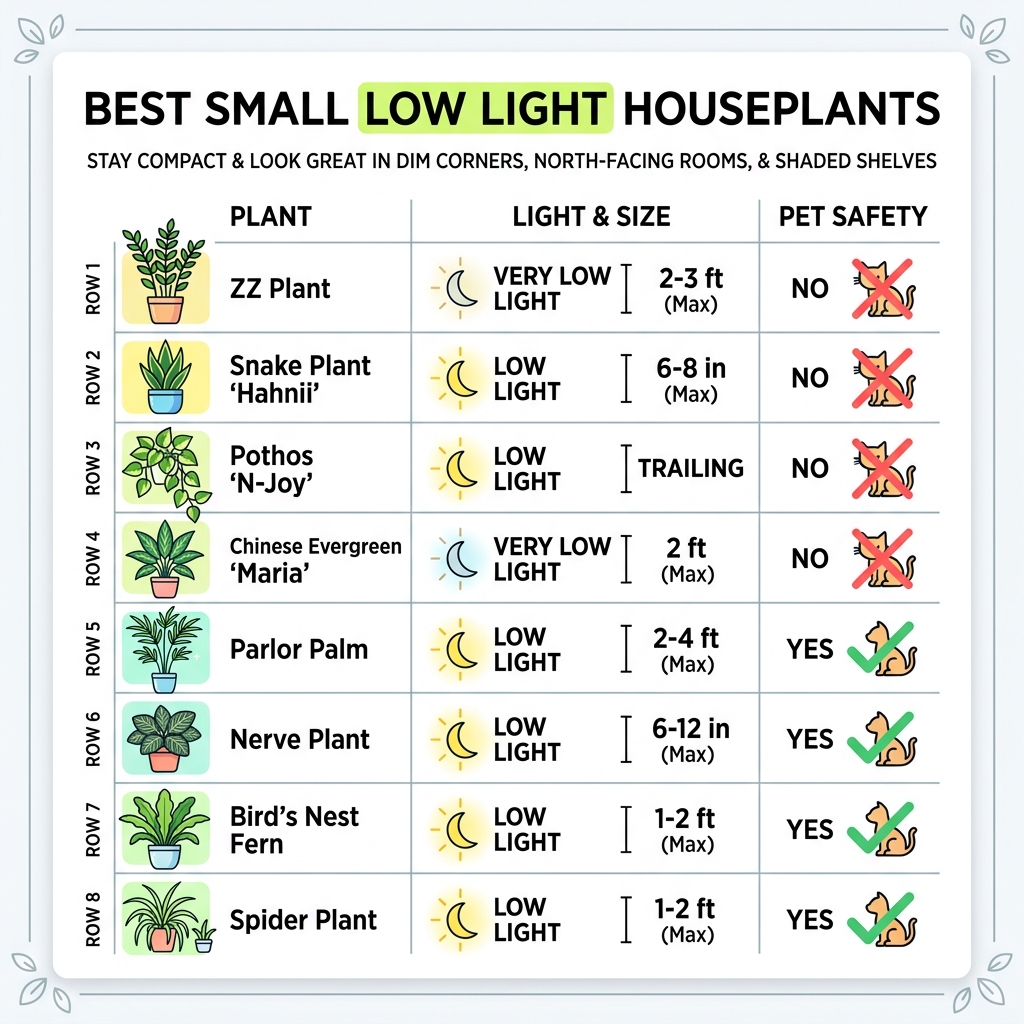
The best small houseplants for low light thrive in the dim corners, north-facing rooms, and shaded shelves that most plants hate. Here are the top picks at a glance:
| Plant | Max Size | Light Needed | Pet-Safe? |
|---|---|---|---|
| ZZ Plant | 2-3 ft | Very low | No |
| Snake Plant ‘Hahnii’ | 6-8 in | Low | No |
| Pothos ‘N-Joy’ | Trailing | Low | No |
| Chinese Evergreen ‘Maria’ | 2 ft | Very low | No |
| Parlor Palm | 2-4 ft | Low | Yes |
| Nerve Plant | 6-12 in | Low | Yes |
| Bird’s Nest Fern | 1-2 ft | Low | Yes |
| Spider Plant | 1-2 ft | Low | Yes |
Not every room gets good natural light. City apartments, basement offices, and north-facing rooms can feel like plant graveyards. But the right plants don’t just survive in low light — they stay compact, look great, and can even help freshen the air you breathe every day.
Many of these plants come from the shaded floors of tropical rainforests, so dim indoor conditions are actually close to their natural habitat. That’s why they’re so forgiving.
If stagnant air, allergens, or low energy in a small space are problems you’re dealing with, adding the right compact greenery is a low-effort, high-impact fix.
Defining the Best Small Houseplants for Low Light
Before we dive into our favorite picks, we need to clear up a common mystery: what does “low light” actually mean? In the plant world, low light isn’t “no light.” If you put a plant in a windowless closet, it will eventually say goodbye, no matter how hardy it is.
When we talk about the best small houseplants for low light, we are generally referring to spots in your home where the sun never directly hits the leaves. This could be a north-facing window, a corner ten feet away from a bright window, or an office that relies mostly on overhead fluorescent lights.
Measuring Light: Foot-Candles and Lux
If you want to get technical (and we do, because we’re experts!), light is often measured in foot-candles or lux.
- Low Light: 25 to 100 foot-candles (roughly 250 to 1,000 lux). This is the level of light where you can comfortably read a book during the day without turning on a lamp, but there are no visible shadows.
- Indirect Light: 100 to 500 foot-candles. This is bright but filtered, like light through a sheer curtain.
Visualizing light levels is easier than you think. Stand in the spot where you want to put your plant. If you can’t see the sky at all from that vantage point, you’re in a low-light zone. For more help on identifying these spaces, check out our guide on indoor-plants-for-low-light-rooms.
Why “Small” Matters
In a compact apartment or a crowded office desk, you don’t want a Monstera taking over your keyboard. The plants we’ve selected for this list are chosen for their slow growth rates and tabletop-friendly dimensions. They won’t outgrow their welcome in a few months. Instead, they’ll sit quietly, boosting your air circulation and looking sharp.
Top Recommended Small Low Light Houseplants
Now, let’s get into the stars of the show. These are the plants that we’ve found to be the most resilient, compact, and effective at bringing life to dim spaces.
ZZ Plant (Zamioculcas zamiifolia)
The ZZ plant is the undisputed heavyweight champion of low-light tolerance. It has glossy, waxy leaves that look so perfect people often ask if it’s plastic.
- The Secret: It stores water in thick, potato-like underground rhizomes. This means if you forget to water it for three weeks because life got busy, it won’t hold a grudge.
- Small Space Tip: While they can eventually get 3 feet tall, they grow incredibly slowly in low light. You can keep a small ZZ on a shelf for years before it needs a bigger home.
Snake Plant ‘Hahnii’ (Sansevieria trifasciata ‘Hahnii’)
You probably know the tall, sword-like snake plants, but the ‘Hahnii’ variety (also called the Bird’s Nest Snake Plant) is the miniature version your desk is dreaming of. It stays under 8 inches tall and forms a tight rosette of leaves.
- Health Benefit: Snake plants are famous for their air-purifying powers, often cited for their ability to convert CO2 into oxygen at night.
- Expert Advice: This is one of the small-potted-plants-for-apartments that thrives on neglect. Overwatering is its only enemy.
Chinese Evergreen ‘Maria’ (Aglaonema)
Aglaonemas are the colorful chameleons of the low-light world. The ‘Maria’ cultivar is particularly famous for its deep green leaves with silvery-gray accents.
- Why we love it: It was specifically bred for superior shade tolerance. It can survive in lux levels as low as 50-75, though it prefers a bit more to push out new leaves.
- Air Quality: Aglaonema species were part of NASA’s famous study on indoor air quality, proven to help remove common household toxins like formaldehyde.

Parlor Palm (Chamaedorea elegans)
If you want a tropical vibe without the “tropical” light requirements, the Parlor Palm is your best bet. It has been a favorite since the Victorian era because it survived in dark, drafty parlors.
- Compact Growth: Unlike other palms that want to touch the ceiling, the Parlor Palm stays relatively small and grows very slowly indoors.
- Pet Safety: It’s 100% non-toxic to cats and dogs, making it a stress-free addition to any home.
Compact Pothos: The Best Small Houseplants for Low Light
Pothos (Epipremnum aureum) is often called “Devil’s Ivy” because it is nearly impossible to kill. While the standard Golden Pothos can grow vines 20 feet long, the ‘N-Joy’ variety is perfect for small spaces.
- The ‘N-Joy’ Difference: This cultivar has smaller, variegated leaves and a much slower, bushier growth habit. It doesn’t “run” as aggressively as its cousins.
- Maintenance: You can easily prune Pothos to keep it at a specific size. Simply snip the vines, and the plant will redirect energy to the base, making it look fuller and more compact.
- Air Circulation: Pothos is a workhorse for low-maintenance-air-purifying-plants, helping to keep indoor air fresh even in rooms with poor ventilation.
Nerve Plants and Ferns: Best Small Houseplants for Low Light
For those who want something with a bit more texture, Nerve Plants (Fittonia) and certain ferns are excellent choices.
- Nerve Plants (Fittonia): These are small, low-growing plants with striking white or pink veins. They are the “drama queens” of the plant world—if they get too dry, they will literally faint (wilt flat), only to perk back up an hour after you water them.
- Bird’s Nest Fern: Unlike the messy Boston Fern, the Bird’s Nest Fern has solid, wavy fronds that don’t shed. It loves the humidity of a bathroom or a kitchen.
- Tabletop Terrariums: Because these plants love humidity and stay small, they are perfect candidates for glass terrariums. This helps manage allergies by keeping soil mold contained while acting as a natural humidifier. For more on this, see our list of top-houseplants-for-allergies.
Essential Care for Miniature Low Light Greenery
Caring for the best small houseplants for low light is actually easier than caring for high-light plants, but the rules are different. Because these plants aren’t getting blasted by the sun, their metabolism is slower. They don’t eat or drink as fast as a sun-drenched succulent.
The Golden Rule: Don’t Overwater
The number one reason small indoor plants die is “kindness”—specifically, too much water. In low light, the soil takes much longer to dry out.
- The Finger Test: Always stick your finger an inch into the soil. If it feels damp, walk away.
- Drainage: Ensure every pot has a drainage hole. If you find a cute pot without one, use it as a “cachepot” (a decorative outer pot) and keep the plant in its plastic nursery liner inside.
- Root Rot: If the soil stays soggy, the roots will suffocate and rot. This is a common issue we discuss in our budget-friendly-air-purifying-plants guide.
Humidity and Temperature
Most low-light plants are tropical at heart. They hate cold drafts from air conditioners or the dry heat from radiators.
- Pebble Trays: If your apartment air is dry, place your plant on a tray filled with pebbles and a little water. As the water evaporates, it creates a mini-microclimate of humidity around the leaves.
- Cleaning: Dust acts like a shield that blocks light. Wipe your plant’s leaves with a damp cloth once a month to ensure they can photosynthesize as much as possible in their dim environment.
Fertilizing and Dormancy
In the winter, your low-light plants will likely go dormant. They stop growing to save energy. During this time, stop fertilizing and cut back on watering. When spring hits, you can use a diluted liquid fertilizer once a month to encourage new growth. For specific help identifying issues with your trailing plants, the University of Florida offers a great guide on Pothos disease identification.
Strategic Placement for Health and Aesthetics
Where you put your plant matters just as much as how you water it. Since we are dealing with small spaces, we have to get creative.
The Bathroom Oasis
Bathrooms are often the most humid rooms in the house, making them perfect for ferns and Nerve Plants. Even if your bathroom only has a tiny frosted window, the supplemental humidity will help these plants thrive. Just make sure the temperature stays consistent.
The Bedroom Nightstand
Small snake plants and ZZ plants are perfect for nightstands. They don’t take up much room, and they don’t mind the lower light levels often found in bedrooms with heavy curtains. Plus, having greenery near your bed is great for relaxation. Check out our recommendations for the top-air-purifying-plants-for-bedrooms.
Vertical Shelving and Bookshelves
If you’ve run out of table space, look up!
- Trailing Nooks: A Pothos ‘N-Joy’ on a high bookshelf looks amazing as it cascades down.
- Grouping: Grouping plants together doesn’t just look good; it actually helps them stay healthy by creating a shared pocket of humidity.
- Rotating: Every two weeks, give your plant a quarter-turn. Plants naturally grow toward the light, and rotating them prevents them from becoming lopsided or “leaning” too hard toward the window.
Frequently Asked Questions about Small Low Light Plants
Can these plants survive in windowless rooms?
This is a tough one. Most of the best small houseplants for low light can survive for a while in a windowless office, but they won’t grow. To help them thrive, we recommend using supplemental lighting. Standard LED desk lamps or fluorescent overhead lights can provide enough of the light spectrum to keep a ZZ plant or Snake plant happy.
Plants have a circadian rhythm just like us; they need a period of darkness to “reset” their metabolism. So, don’t leave the office lights on 24/7! Aim for 8-12 hours of light.
Are there pet-friendly small low light houseplants?
Yes! While popular plants like Pothos and ZZ plants contain calcium oxalate crystals (which can cause irritation if chewed), there are plenty of non-toxic options.
- Parlor Palm: Completely safe.
- Spider Plant: Safe and very easy to propagate.
- Calathea: Beautiful patterns and pet-safe. For more safe options, visit our budget-friendly-air-purifying-plants-2 guide.
How do I keep my low light plants from getting leggy?
“Leggy” growth happens when a plant stretches out, creating long stems with very few leaves because it’s searching for light.
- Pruning: Don’t be afraid to snip off the long, reaching stems. This encourages the plant to grow fuller at the base.
- Increase Light: If a plant is getting very leggy, it’s telling you it needs just a little more light. Move it a foot closer to the window or add a small LED grow bulb.
- Chlorophyll Production: In very low light, plants produce less chlorophyll, which can lead to stunted growth or pale leaves. A slight move can make a world of difference for indoor-plants-for-small-apartments.
Conclusion
Finding the best small houseplants for low light is all about matching the right plant to your specific “dim” reality. Whether it’s a tiny Snake Plant on your desk or a trailing Pothos on a bookshelf, these compact greens do more than just sit there. They work to improve air circulation, boost your mood, and bring a touch of the natural world into even the most cramped city apartment.
At Mount Pilchuck, we believe that everyone deserves a healthy, vibrant indoor environment. By choosing health-boosting greenery that actually fits your lifestyle and light levels, you’re taking a big step toward better indoor wellness.
Ready to start your miniature jungle? Explore more of our expert advice on indoor-plants and transform your home today.
