
Why Air Purifying Plant Care Matters for Your Home and Health
Air purifying plant care is the set of practices that keep your indoor plants healthy enough to actually clean your air — covering light, water, soil, humidity, and placement.
Quick-start care checklist:
- Light: Most air-purifying plants need bright, indirect light (a few tolerate low light well)
- Watering: Water when the top inch of soil is dry — overwatering is the #1 killer
- Soil: Use well-draining mix with perlite to prevent root rot
- Humidity: Tropical species like Boston Fern and Peace Lily prefer 50%+ humidity
- Fertilizing: Feed monthly with balanced fertilizer during spring and summer
- Placement: One plant per 100 sq ft is a practical starting point for air quality benefits
- Pet safety: Check toxicity — Peace Lily and Pothos are harmful to cats and dogs
We spend roughly 90% of our time indoors. Yet most of us give little thought to what’s floating in the air around us — formaldehyde from furniture, benzene from cleaning products, xylene from paints. These volatile organic compounds (VOCs) build up quietly in sealed, poorly ventilated spaces.
That’s where air-purifying plants come in. NASA’s landmark 1989 research demonstrated that common houseplants can absorb these toxins through their leaves and root systems — a process called phytoremediation. The Peace Lily alone showed removal rates of up to 87% for formaldehyde in controlled conditions.
But here’s the catch: a neglected plant purifies almost nothing. A drooping, root-rotted Snake Plant sitting in a dark corner isn’t cleaning your air — it’s just surviving. To get real benefits, your plants need proper care.
This guide walks you through exactly how to do that.
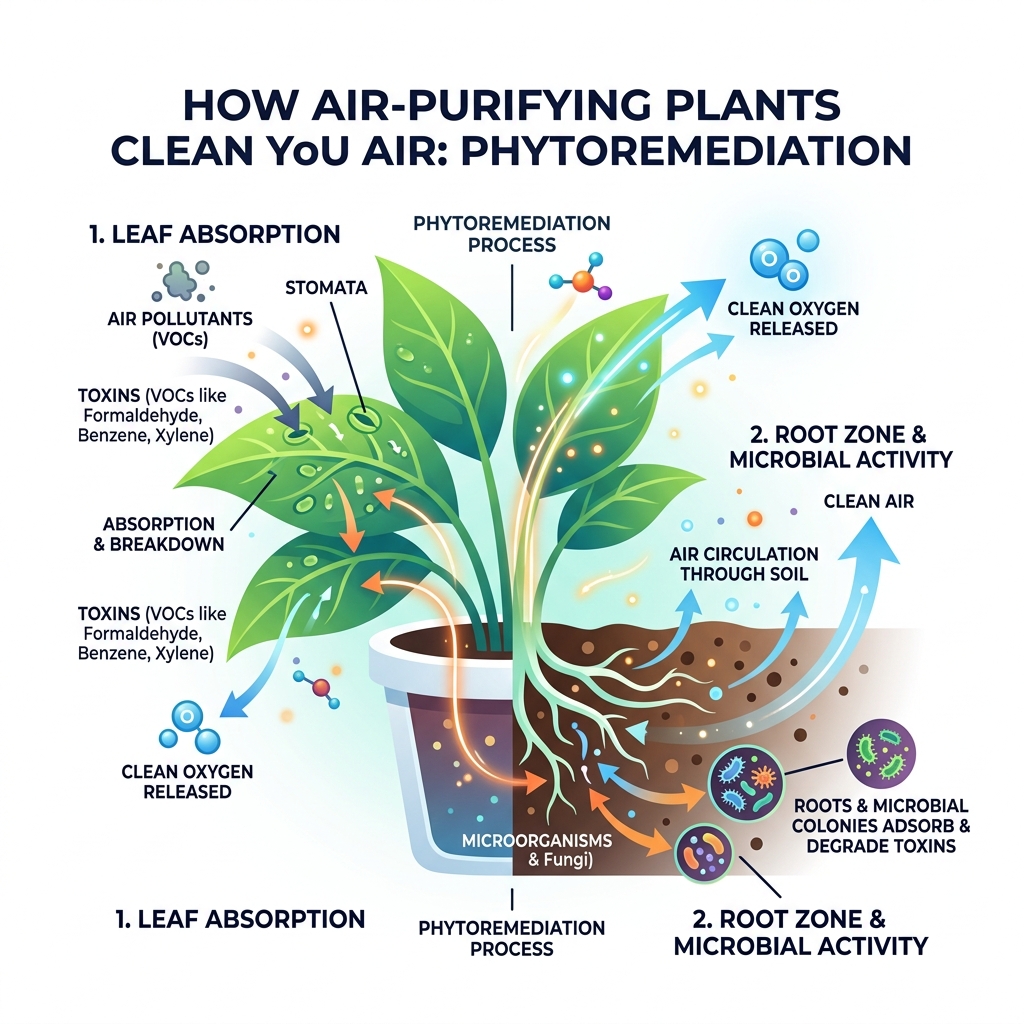
The Science of Phytoremediation: How Air Purifying Plants Work
To master air purifying plant care, we first need to understand the “engine” under the hood. The process by which plants clean our environment is known as phytoremediation. While we often think of plants simply “breathing” in CO2 and breathing out oxygen, their cleaning power goes much deeper.
In the late 1980s, NASA scientist Bill Wolverton conducted a landmark 1989 study on indoor toxins to determine if plants could keep the air breathable in sealed space stations. The results were groundbreaking. He found that common houseplants could scrub the air of Volatile Organic Compounds (VOCs) like:
- Formaldehyde: Found in carpets, upholstery, and particleboard.
- Benzene: Often present in plastics, synthetic fibers, and detergents.
- Trichloroethylene: Found in printing inks, paints, and varnishes.
How do they do it? It’s a team effort between the leaves and the roots. The leaves absorb these chemicals through tiny pores called stomata. From there, the toxins travel down to the root zone, where soil microbes break them down into food for the plant. This is why healthy soil is just as important as healthy leaves.
If you want to see this science in action, we highly recommend watching this TED Talk: How to grow fresh air by Kamal Meattle, who used specific plants to solve air quality issues in a large office complex.
Toxin Removal Comparison
While all plants produce oxygen, some are specialized “scrubbers.” Here is how two of the most popular species compare based on NASA’s findings:
| Pollutant | Peace Lily Removal Rate | Snake Plant Removal Rate |
|---|---|---|
| Formaldehyde | 87% | 52% |
| Benzene | 80% | 48% |
| Trichloroethylene | 65% | 13% |
| Xylene | 75% | 22% |
| Ammonia | 70% | 0% |
As you can see, the Peace Lily is a powerhouse, but it requires more intensive air purifying plant care than the sturdy Snake Plant. To dive deeper into which species target specific chemicals, check out our guide on Plants that Filter Toxins from the Air.
Essential Air Purifying Plant Care for Beginners
Starting your journey into indoor gardening can feel overwhelming, but most air-scrubbing champions are surprisingly resilient. The secret is matching the plant to your home’s “microclimate.”

Light Requirements: The Fuel for Purification
Photosynthesis is the engine of air purification. If a plant isn’t getting enough light, its metabolic rate drops, and it stops absorbing toxins effectively.
- Bright Indirect Light: This is the “Goldilocks” zone for most plants like the Spider Plant and Peace Lily. Think of a spot near an east-facing window or a few feet back from a sunny south-facing window.
- Low Light: If you have a dim hallway or a north-facing room, you aren’t out of luck. The Snake Plant and ZZ Plant are famous for their ability to survive in low-light conditions. You can find more suggestions in our list of Indoor Plants for Low Light Rooms.
- Artificial Light: Many office-friendly plants can adapt to fluorescent or LED grow lights if natural sun isn’t available.
If you’re worried about your “black thumb,” start with Low Maintenance Air Purifying Plants that forgive a little forgetfulness.
Watering and Soil for Air Purifying Plant Care
The fastest way to kill an air purifier is “kindness”—specifically, overwatering. When soil stays soggy, oxygen can’t reach the roots, leading to fungal root rot.
- The Finger Test: Before grabbing the watering can, stick your finger an inch into the soil. If it feels damp, wait. If it’s dry, it’s time for a drink.
- Well-Draining Soil: Never use garden soil for indoor plants. Instead, use a high-quality potting mix amended with perlite or pumice. This creates air pockets that allow roots to breathe.
- The Drainage Hole: Your pot must have a hole at the bottom. If you love a decorative planter that doesn’t have one, keep the plant in its plastic nursery liner and place that inside the decorative “cachepot.”
- Moisture Meters: For larger plants like the Areca Palm, a moisture meter can be a lifesaver, telling you exactly what’s happening at the bottom of the root ball.
For a deeper dive into hydration schedules, see our Easy Care Plants for Home Air Quality guide.
Fertilizing for Optimal Growth and Purification
Plants in pots eventually exhaust the nutrients in their soil. To keep them growing vigorously—and purifying at maximum capacity—they need a “nitrogen boost” during the growing season.
- When to Feed: Only fertilize during the spring and summer when you see active new growth.
- What to Use: A balanced, water-soluble liquid plant food (look for an N-P-K ratio like 10-10-10 or 20-20-20) diluted to half-strength is usually best.
- Avoid Overfeeding: Too much fertilizer can cause salt buildup in the soil, leading to “burned” leaf tips.
Healthy foliage is the key to clean air, so check out our tips on the Best Leafy Plants for Air Purification to see which ones respond best to feeding.
Maximizing Efficiency: Placement and Pet Safety
A single small plant in a massive open-concept living room won’t move the needle on your air quality. To get the benefits NASA described, we need to talk about density and placement.
NASA’s research suggests that for a meaningful impact in a typical home, you might need as many as 10 plants per square foot in highly polluted areas. However, for general wellness, a more practical rule of thumb is one large plant (in a 6-inch pot or larger) for every 100 square feet of living space.
- Bedroom Placement: Since we spend 6–8 hours sleeping, the bedroom is a prime spot for air purifiers. Snake Plants are excellent here because they are among the few plants that continue to release oxygen at night. Explore the Top Air Purifying Plants for Bedrooms for more ideas.
- Small Spaces: Living in a studio? You can still breathe easy. Use vertical space with hanging Pothos or wall-mounted planters. Check out our tips for Indoor Plants for Small Apartments.
Pet-Friendly Air Purifiers
Many of the most effective air cleaners, like the Peace Lily and Philodendron, contain calcium oxalate crystals that are toxic to cats and dogs. If you have curious furry friends, stick to these non-toxic champions:
- Boston Fern: A lush, humidity-loving air scrubber.
- Spider Plant: Incredibly easy to grow and safe for all pets.
- Areca Palm: A great “floor plant” that adds a tropical vibe without the danger.
Safety first! Always verify your choices with our list of Indoor Plants Safe for Pets.
Workplace and Office Integration
Indoor air in offices can be up to five times more polluted than outdoor air due to printers, cleaning chemicals, and poor ventilation. Adding greenery isn’t just about aesthetics; it’s a productivity tool. Studies have shown that office plants can increase productivity by up to 15% and significantly improve mental wellness.
Plants like the ZZ Plant and Golden Pothos are excellent for offices because they adapt well to fluorescent lighting and low-humidity environments. Learn how to green your cubicle with our guide on Indoor Plants for Office Spaces.
Advanced Maintenance and Troubleshooting
Even with the best intentions, things can go wrong. Air purifying plant care involves being a bit of a “green detective.”
Humidity Levels and Dust Management
Most air-purifying plants are tropical natives. Our heated or air-conditioned homes are often too dry for them, especially in winter.
- Misting: While it feels helpful, misting only raises humidity for a few minutes.
- Pebble Trays: Fill a tray with pebbles and water, then set the plant pot on top (ensuring the pot isn’t sitting in the water). As the water evaporates, it creates a humid microclimate.
- Humidifiers: If you have a collection of ferns or Peace Lilies, a small room humidifier is the best investment.
- Cleaning Leaves: Dust acts like a barrier to light and toxins. Gently wipe leaves with a damp cloth once a month. This also helps Indoor Plants that Reduce Dust perform their job more effectively.
Seasonal Air Purifying Plant Care Strategies
Your plants’ needs change with the calendar.
- Winter: Most plants go into a semi-dormant state. Growth slows down, so you should reduce watering and stop fertilizing entirely. Watch out for cold shock from drafty windows or “toasting” from being too close to a radiator.
- Summer: This is the peak purification season! Plants will drink more water and grow faster. Ensure they have enough hydration to handle the heat.
- Air Circulation: Plants actually help move air around, but they also need a bit of a breeze to prevent fungal issues. Discover more about Plants to Improve Indoor Air Circulation.
Propagation and Problem Solving
If your plant is thriving, why not make more for free?
- Division: Plants like the Peace Lily grow in clumps. You can gently pull them apart during repotting to create two or three new plants.
- Stem Cuttings: Pothos and Philodendrons can be propagated by snipping a vine and placing it in water until roots form.
- Troubleshooting:
- Yellowing leaves: Usually a sign of overwatering or a nitrogen deficiency.
- Brown, crispy tips: Often caused by low humidity or chemicals (like fluoride) in tap water.
- No flowers on Peace Lily: Usually means the plant needs more light or a boost of phosphorus.
Ready to expand your collection? Check out our Turn Your Houseplants into Air Purifiers a DIY Guide for propagation secrets.
Frequently Asked Questions about Air Purifying Plant Care
How do plants contribute to indoor air quality alongside other solutions?
Plants are a biological solution, but they aren’t a total replacement for mechanical air purifiers. While plants excel at removing VOCs (gases), they aren’t as efficient at removing large particulates like smoke or heavy dust. For the best results, use a combined approach: a HEPA filter for dust and pollen, and a variety of houseplants for chemical toxins and oxygen production. This creates a highly energy-efficient, holistic air-cleaning system. Read more about the Health Benefits of Plant Air Filters.
How many plants do I need per room?
As mentioned, NASA’s “lab” results required a very high density. For real-world homes, aim for one medium-to-large plant per 100 square feet. In a standard 12′ x 12′ bedroom, two or three well-placed plants (like a Snake Plant by the bed and a Spider Plant on the dresser) will provide a noticeable boost in air freshness.
Why are my air-purifying plant’s leaves turning brown?
The most common culprit is fluoride and chlorine sensitivity. Peace Lilies and Spider Plants are particularly sensitive to the chemicals in municipal tap water. If you see brown tips despite proper watering, try using rainwater, distilled water, or let your tap water sit out overnight before using it. Low humidity and over-fertilization are the next most likely causes.
Conclusion
At Mount Pilchuck, we believe that your home should be a sanctuary. Proper air purifying plant care is about more than just keeping a plant alive; it’s about fostering a living ecosystem that supports your health. Beyond scrubbing the air, these green companions provide a significant mood boost, regulate indoor humidity, and connect us to the natural world.
Whether you are starting with a single, sturdy Snake Plant or building a lush indoor jungle, every leaf counts toward a cleaner, more vibrant home.
Ready to find your next botanical roommate? Explore our full directory of indoor plants for more expert advice on health-boosting greenery.
