
The Darkest Dahlia You’ll Ever Grow — And Why It’s Worth It
Dahlia ‘Arabian Night’ is one of the most dramatic flowers you can grow, with deep burgundy blooms that appear almost black in certain light. Here’s a quick overview to get you started:
Quick-Start Guide: Dahlia Arabian Night
| Factor | Details |
|---|---|
| Flower color | Deep burgundy-maroon, nearly black |
| Bloom size | 4-6 inches across |
| Plant height | 36-48 inches |
| Bloom time | Mid-summer until first frost |
| Sun needs | Full sun, 6-8 hours daily |
| Planting depth | 4-6 inches deep |
| Spacing | 18-24 inches apart |
| Hardiness zones | USDA 8-11 (lift tubers in colder zones) |
| Best uses | Cut flowers, borders, containers |
This variety has been a staple in cutting gardens since its introduction in 1951 — over 60 years of proven performance. Gardeners and floral designers keep coming back to it for one simple reason: nothing else looks quite like it.
The velvety, almost-black petals create a striking contrast against lighter blooms and green foliage. Expert gardeners Mary Keen and David Joyce have both praised it — Keen saying she “would not wish to be without it,” and Joyce calling it “outstanding for the depth of its dark red.”
Whether you’re growing it for bouquets, borders, or pure garden drama, this guide covers everything you need — from planting your first tuber to overwintering like a pro.
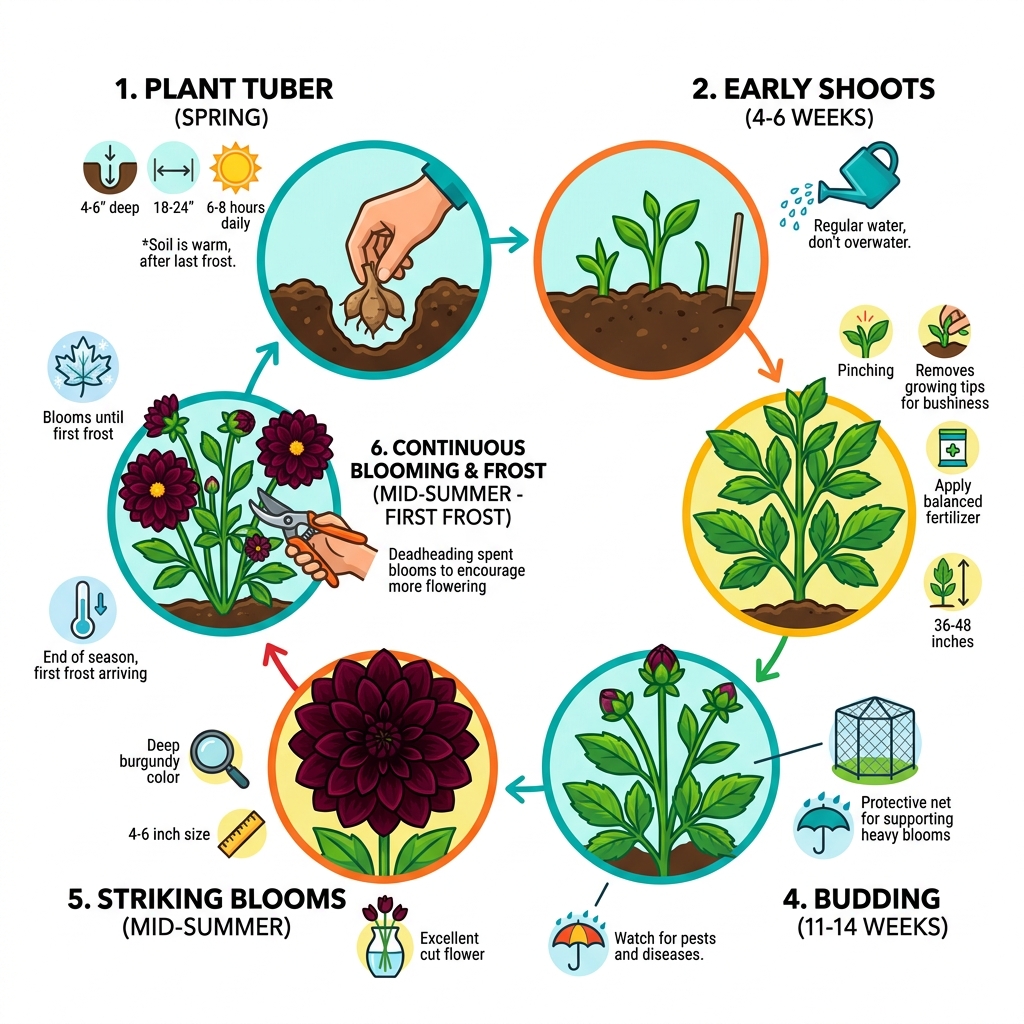
Botanical Profile of the Dahlia ‘Arabian Night’
To understand the dahlia arabian night, we first have to look at its family tree. This plant is a member of the Asteraceae family, which includes sunflowers and daisies. Specifically, it is classified as a Decorative Dahlia within Group 5(d). This means it produces fully double flowerheads where the petals (or ray florets) are typically broad and flat, sometimes slightly involute (curved inward) at the margins.
The dahlia arabian night is a tuberous-rooted perennial that originally traces its lineage back to the high mountain plateaus of Mexico and Central America. While many modern hybrids can be finicky, this cultivar has stood the test of time. In fact, it is a recipient of the prestigious Award of Garden Merit (AGM) from the Royal Horticultural Society, a seal of approval that signifies the plant is stable, reliable, and excellent for ordinary garden use.
Physically, the plant is a powerhouse. It typically reaches a height of 36 to 48 inches (90-120 cm) with a spread of about 18 to 24 inches. The flowers themselves are roughly 4 inches (10 cm) across, though they can reach up to 6 inches with proper care. Each bloom is a masterpiece of deep, velvety crimson and maroon-black petals that seem to glow from within. These stunning heads are borne on sturdy, upright stems that make them a dream for anyone who loves to bring the garden indoors. For more technical specifics, you can check out the Dahlia ‘Arabian Night’ botanical details.
The Unique Aesthetic of Dahlia Arabian Night
What truly sets the dahlia arabian night apart is its “moody” aesthetic. In gardening, true black is a rarity. This dahlia gets as close as nature allows, offering an opulent, sultry hue that changes depending on the angle of the sun. In the bright midday light, you’ll see the rich burgundy and wine-red tones; as evening approaches, the flowers deepen into a mysterious, near-black silhouette.
The foliage provides the perfect backdrop. The leaves are a dark, lush green and pinnately divided, providing a dense, bushy habit that fills out garden borders beautifully. Because of its height—often topping out at 4 feet—it serves as an excellent mid-to-back-of-border plant. It creates a high-contrast focal point when planted near silver-foliaged plants or bright white “moon garden” varieties.
Planting and Growing Dahlia Arabian Night for Success
Success with dahlia arabian night starts with timing and location. These are sun-loving plants that require a minimum of 6 to 8 hours of direct sunlight daily to produce those deep, dark pigments. If they are planted in too much shade, the stems will become “leggy” as they stretch for the light, and the flower production will drop significantly.
The soil is the next critical factor. We recommend a fertile, humus-rich, and loamy soil that drains well. While dahlias are thirsty plants, they absolutely hate “wet feet.” If the tubers sit in waterlogged soil, they will rot before they ever have a chance to sprout. If you have heavy clay soil, we suggest amending it with plenty of organic matter, such as compost or well-rotted manure, and perhaps a bit of sand to improve drainage. For a visual walkthrough on getting started, see this guide on how to plant dahlia tubers and care tips.
Always wait until the danger of frost has completely passed before putting your tubers in the ground. A good rule of thumb is to plant them at the same time you would plant your tomatoes. The soil should be warm to the touch—ideally at least 60°F (15°C).
Optimal Depth and Spacing for Dahlia Arabian Night
When you receive your tubers, they might look a bit like a bunch of scruffy carrots or even “chicken legs.” Don’t be fooled—there is a lot of life in those odd-looking roots!
- Dig the Hole: Aim for a depth of 4 to 6 inches (10-15 cm).
- Orientation: Look for the “eye”—the small bump or sprout where the stem will emerge. Lay the tuber horizontally in the hole with the eye facing upward.
- Spacing: Give these beauties room to breathe. Space them 18 to 24 inches (50-60 cm) apart. This ensures good air circulation, which is vital for preventing fungal issues later in the season.
- Soil and Water: Cover the tuber with soil. Here is a pro tip: do not water the tuber immediately unless the soil is bone-dry. The tuber has enough stored energy and moisture to start growing. Excessive watering before the sprouts emerge can lead to rot. Once you see the green shoots breaking the surface, you can begin a regular watering schedule.
Essential Maintenance: Staking, Pinching, and Deadheading

Because dahlia arabian night can grow quite tall and produces heavy, double blooms, it needs a little help staying upright. We highly recommend staking your plants early—ideally at the time of planting. If you wait until the plant is 3 feet tall to drive a stake into the ground, you risk piercing the tubers below.
- Staking: Use sturdy wooden stakes, bamboo canes, or even tomato cages. As the plant grows, use soft twine to tie the stems to the support.
- Pinching: This is the secret to a bushy, flower-filled plant. When your dahlia is about 12 inches tall, snip off the center growing tip (just above a set of leaves). This “pinching” encourages the plant to branch out, resulting in more stems and, consequently, more flowers.
- Disbudding: If you want massive, “show-stopper” 6-inch blooms, you can practice disbudding. Most dahlia stems produce a cluster of three buds at the end. If you remove the two smaller side buds, the plant will direct all its energy into the central “king” bloom.
To keep the display going from mid-summer until the first frost, you must be diligent about deadheading. Once a flower begins to fade and lose its petals, cut the stem back to the next leaf joint. This prevents the plant from putting energy into seed production and signals it to keep pumping out new buds.
Best Practices for Dahlia Arabian Night in Containers
If you don’t have a large garden bed, don’t worry! The dahlia arabian night performs surprisingly well in containers, provided the pot is large enough.
- Pot Size: Use a container that holds at least 5 to 7 gallons of soil and is at least 12 inches deep. Ensure there are plenty of drainage holes at the bottom.
- Potting Mix: Use a high-quality, well-draining potting soil. Avoid heavy garden soil, which can compact in a pot.
- Fertilizer: Container plants lose nutrients faster than those in the ground. Use a low-nitrogen liquid fertilizer (like a 5-10-10 or 10-20-20) every two weeks once the plant is established. High nitrogen will give you lots of leaves but very few of those dark, moody flowers.
- Moisture: Pots dry out quickly. In the heat of summer, you may need to water your container dahlias daily. For more on container specifics, read about growing decorative dahlias in pots.
Overwintering and Seasonal Care Across USDA Zones
The dahlia arabian night is hardy in USDA zones 8 through 11. In these warmer climates, you can often leave the tubers in the ground year-round, provided the soil doesn’t stay soggy during winter. Simply cut the stalks down to a few inches above the ground and apply a thick layer of mulch to protect the crowns.
However, for those of us in Zone 7 and below, the winter is too cold for these Mexican natives. Once the first hard frost “blackens” the foliage, it’s time to lift the tubers.
- Cut Back: Cut the stems down to about 4 to 6 inches.
- Lift: Carefully dig around the clump with a pitchfork, being careful not to nick the tubers.
- Dry: Gently shake off the excess soil and let the tubers dry in a frost-free, shaded area for a few days.
- Store: Place the tubers in a box filled with a slightly damp medium like vermiculite, peat moss, or wood shavings.
- Environment: Store the box in a cool, dark place where the temperature stays between 40°F and 45°F (4-7°C). A basement or insulated garage is usually perfect. Check on them once a month to ensure they aren’t shriveling up (too dry) or rotting (too wet).
In the spring, you can divide the tubers. Just make sure each piece has at least one “eye” and a bit of the neck (the crown) attached, or it won’t grow!
Designing with Arabian Night: Cut Flowers and Companion Plants
The dahlia arabian night has been a floral designer’s favorite for decades because of its incredible vase life. When cut correctly, these blooms can last up to 7 or 8 days in an arrangement.
Tips for the perfect bouquet:
- Timing: Cut your dahlias in the cool of the morning or late evening. Unlike roses, dahlias will not open much further once cut, so choose flowers that are almost fully open.
- The Cut: Use clean, sharp shears and cut the stem at an angle.
- The “Vase Hack”: Dahlias have hollow stems. Some professionals recommend recutting the stem ends under water to avoid airlocks, ensuring the flower can drink freely.
In the garden, the dark burgundy of ‘Arabian Night’ creates a stunning “low light” that makes other colors pop. We love pairing it with the cool blues of Agapanthus or the smoky purple foliage of Cotinus coggygria (Smoke Bush). For a classic “cottage garden” look, plant it alongside pure white flowers like Fragrant Gladiolus or pastel pinks. The dark stems and foliage of the dahlia arabian night act as a natural shadow, giving your garden beds a sense of depth and mystery that brighter flowers can’t achieve on their own.
Troubleshooting Pests and Diseases
Even a “dream” plant like the dahlia arabian night can run into trouble. Being aware of the common culprits will help you act fast.
- Slugs and Snails: These are the #1 enemy of young dahlia shoots. Use organic slug pellets or beer traps as soon as you plant your tubers.
- Aphids and Spider Mites: These sap-suckers can distract growth. A strong blast of water from the hose or an application of insecticidal soap usually does the trick.
- Powdery Mildew: This looks like a dusting of white flour on the leaves. It usually happens in late summer when the air is humid. The best defense is prevention: ensure your plants have 18-24 inches of space for air circulation.
- Fungal Rots and Grey Mould: Usually a result of overwatering or poor drainage. If a plant looks wilted despite the soil being wet, check the tubers for rot.
A Note on Safety: It is important to know that dahlias are considered toxic to dogs, cats, and horses if eaten in large quantities. While they aren’t usually fatal, they can cause skin irritation or gastrointestinal upset. Always keep an eye on curious pets! For more in-depth scientific research on managing these issues, see the dahlia disease management guide.
Frequently Asked Questions about Dahlia Arabian Night
Is Dahlia ‘Arabian Night’ perennial?
Yes, it is a tuberous perennial. In USDA zones 8-11, it can stay in the ground year-round. In colder zones (3-7), the tubers must be dug up in the fall and stored indoors to be replanted the following spring.
How do I get more flowers on my Arabian Night dahlia?
The two best ways to increase bloom count are pinching the center stem when the plant is 12 inches tall and deadheading spent blooms regularly. Also, ensure the plant gets at least 6 hours of full sun and is fed with a low-nitrogen fertilizer.
Are Arabian Night dahlias toxic to pets?
Yes, the tubers and leaves contain compounds that are mildly toxic to dogs, cats, and horses. If your pet ingests them, they may experience vomiting, diarrhea, or skin rashes. It is best to plant them in areas where pets don’t frequently dig or chew.
Conclusion
The dahlia arabian night is more than just a flower; it is a piece of garden history that continues to enchant after more than 60 years. Its sultry, near-black blooms and reliable growth habit make it a must-have for anyone looking to add drama to their landscape or elegance to their dinner table bouquets.
At Mount Pilchuck, we believe that the environment you cultivate outside your home is just as important as the one you foster inside. While we specialize in providing expert advice on health-boosting indoor plants for better air circulation, we know that a vibrant, blooming garden provides its own kind of mental “fresh air.” Whether you are tending to a lush border of dahlias or looking for more information about indoor plants, we are here to help you grow.
So, this spring, find a sunny spot, prep your soil, and invite the mystery of the ‘Arabian Night’ into your garden. We promise it’s a midsummer dream you won’t want to wake up from.
