
The Bold Tropical Plant That Transforms Any Indoor Space
Bird of paradise plant indoor growing is one of the best ways to bring dramatic, tropical energy into your home — while also improving the feel of your living space.
Quick answer: How to care for a Bird of Paradise indoors
| Care Factor | What to Do |
|---|---|
| Light | Bright indirect to direct sunlight (south or west window) |
| Watering | Every 1-2 weeks; let top 2 inches of soil dry out first |
| Water type | Filtered or tap water left overnight |
| Temperature | 65-80°F (18-27°C) |
| Humidity | 30-50%; mist or use a pebble tray |
| Toxicity | Toxic to pets and humans if ingested |
| Growth | 3-8 ft tall indoors depending on variety |
The Bird of Paradise (Strelitzia) is native to South Africa, where it grows in open, sunny landscapes. Indoors, it becomes a sculptural showpiece — wide, paddle-shaped leaves on tall stems that instantly make a room feel alive.
It is also surprisingly low-maintenance. You do not need a green thumb to keep one thriving. You mostly need a bright spot and a consistent watering routine.
For urban dwellers dealing with stagnant air and low energy indoors, large-leafed plants like this one can shift the entire atmosphere of a room. The broad foliage moves air naturally and adds a sense of life and movement to otherwise static spaces.
One thing to know upfront: the leaves will split. That is completely normal. In the wild, the leaves split along their edges to survive strong winds. Indoors, it just adds character.
Choosing the Right Bird of Paradise Plant Indoor
When we look at adding a bird of paradise plant indoor, the first decision is which variety fits our space. This evergreen perennial belongs to the Strelitziaceae family and is often referred to as the “Wild Banana” due to its large, waxy leaves.
There are two primary species we usually see in homes:
| Feature | Strelitzia reginae (Orange) | Strelitzia nicolai (White) |
|---|---|---|
| Flower Color | Vibrant Orange and Blue | Creamy White and Dark Blue |
| Leaf Shape | Narrower, lance-shaped | Very wide, paddle-shaped |
| Indoor Height | 4-6 feet | 6-10+ feet |
| Growth Speed | Moderate | Faster |
If you are looking for Indoor Plants for Small Apartments, the Strelitzia reginae is often the better choice because it stays more compact. However, if you have vaulted ceilings or a large open corner, the “Giant White Bird of Paradise” (S. nicolai) provides a massive sculptural presence that few other plants can match.
Sizing Up Your Space
Birds of Paradise are sold in various sizes, and it is helpful to know what to expect when your new green roommate arrives:
- Extra Large: These are the floor-fillers, measuring between 5-6 feet tall. From the bottom of the grow pot to the top of the foliage, they usually span 5 to 5.5 feet.
- Large: A great mid-range option, these measure between 2-3 feet tall (or 3-4 feet from the bottom of the pot to the leaf tips).
- Medium: Perfect for tabletops or plant stands, these measure 12-20 inches tall.
No matter the size you choose, these plants are the “queens” of the houseplant world. They offer a rich, tropical flair that makes a bold statement from day one.
Essential Care for Your Indoor Paradise
Keeping your bird of paradise plant indoor thriving is all about mimicking its native South African habitat. We want to provide a environment that feels like a sunny, warm coastal breeze.
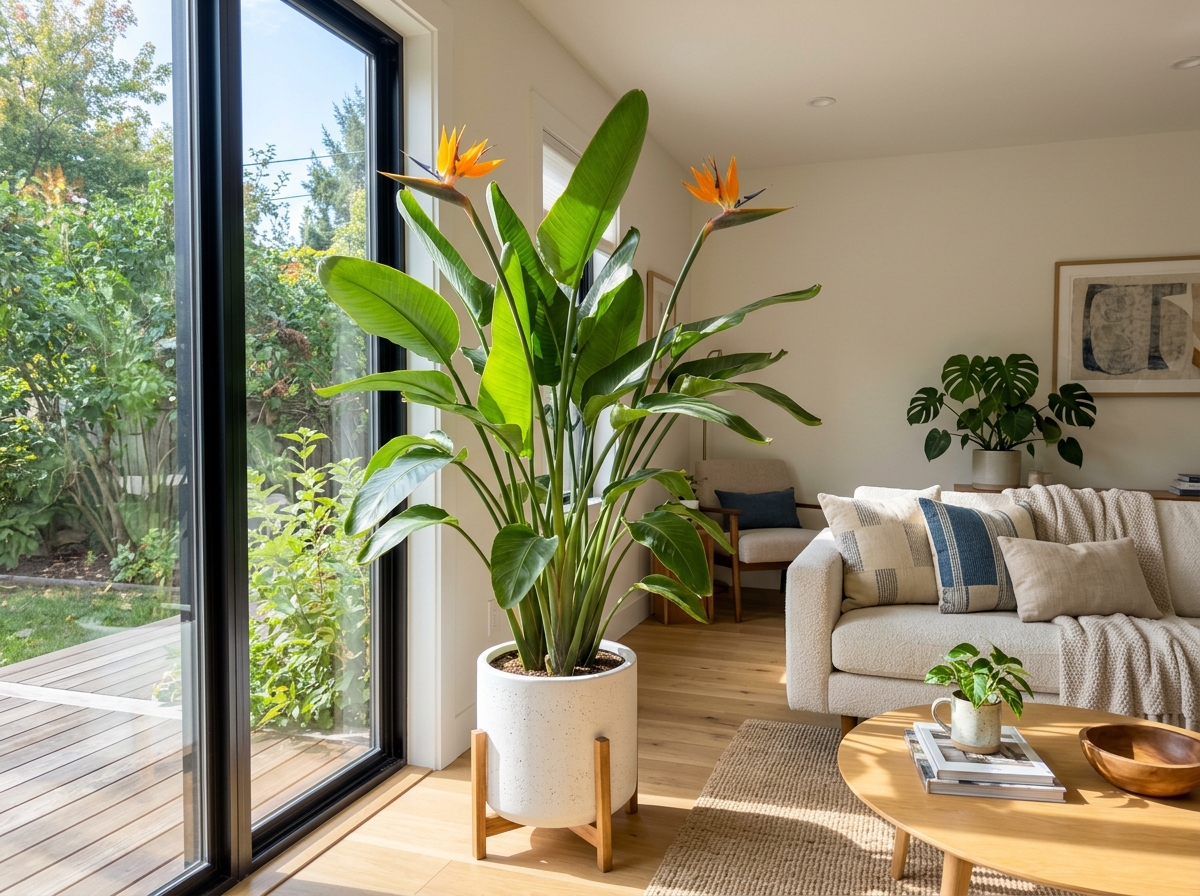
Sunlight: The Engine of Growth
Sunlight is the most critical factor for a healthy Bird of Paradise. These plants thrive in bright indirect to direct light. While they can survive in medium light, they will grow much slower and are unlikely to ever produce their signature bird-like blooms.
If you aren’t sure about your home’s light levels, we recommend checking our indoor lighting guide. Ideally, your plant should receive at least 4-6 hours of strong light daily.
Temperature and Humidity
These plants are surprisingly hardy, but they prefer a “sweet spot” of 65-80°F. While they can tolerate temperatures as low as 24°F (-4°C) for very short periods, prolonged cold will damage the foliage and kill any developing flower buds.
Regarding humidity, they are quite flexible. They thrive in humidity levels of 30-50%, which is standard for most homes. However, if you notice the edges of the leaves becoming “crispy” or brown, they might appreciate a boost to 60-70% via a humidifier or a pebble tray. This is especially common in Indoor Plants for Office Spaces where industrial HVAC systems can dry out the air.
Watering Your Bird of Paradise Plant Indoor
Watering is where many beginners get nervous, but it’s simpler than you think. The goal is to keep the soil moist but never soggy.
The Golden Rule: Allow the top 2 inches of soil to dry out between waterings. We usually find this happens every 1-2 weeks, depending on the season and the amount of light the plant receives.
- Water Quality: These plants can be sensitive to hard tap water. If you have “hard” water (high mineral content), you might see salt buildup on the leaves or browning tips. We suggest using filtered water or letting tap water sit out overnight to allow chlorine to dissipate.
- The Technique: Water slowly for about 2 minutes until water drains from the bottom holes. Always empty the drainage saucer; standing water is a one-way ticket to root rot.
- Seasonal Changes: In the winter, your plant will grow more slowly and require less water. You can often stretch your watering schedule to every 2-3 weeks during the colder months.
For more tips on keeping your home greenery simple, see our guide on Easy Care Plants for Home Air Quality.
Light and Placement for a Bird of Paradise Plant Indoor
Where you put your plant matters! Because of their high light requirements, south-facing or west-facing windows are the “prime real estate” for a Bird of Paradise.
- Rotation: Every few weeks, give your pot a quarter-turn. Plants naturally grow toward the light; rotating them ensures they don’t become “leaners” and maintain a balanced, upright shape.
- Drafts: Keep your plant away from air conditioning vents or drafty windows in the winter. Rapid temperature fluctuations can cause the leaves to curl or yellow.
- Supplemental Light: If your apartment doesn’t get much sun, don’t worry. You can use a quality grow light, like this one from Amazon, to give your foliage the 8 hours of “sun” it craves.
Placing a large Bird of Paradise in a bedroom can also help with air quality. Check out other Top Air-Purifying Plants for Bedrooms to create a complete sleep sanctuary.
Advanced Maintenance and Troubleshooting
Once your bird of paradise plant indoor is settled, a little bit of “pro” maintenance goes a long way in keeping it looking like a magazine cover.
The Mystery of the Splitting Leaf
One of the most common questions we hear is: “Why are my leaves ripping?” Don’t panic! Leaf splitting is a normal adaptive feature. In South Africa, these plants grow in windy coastal areas. The slits in the leaves act like the slats in a fence, allowing wind to pass through without snapping the entire stem. Indoors, even low humidity or a pet brushing past can trigger these splits. It’s part of the plant’s “rugged-chic” aesthetic.
Feeding and Soil
To keep those massive leaves vibrant, your plant needs fuel.
- Soil: Use a well-draining potting mix. A good DIY recipe is 60% potting soil, 20% perlite, and 20% bark chips.
- Fertilizer: During the growing season (spring and summer), use a balanced, water-soluble fertilizer (1:1:1 ratio). Applying this every 6-8 weeks will promote healthy growth and, eventually, blooms. Skip the fertilizer in the winter when the plant is resting.
Repotting and Pruning
Birds of Paradise actually enjoy being a little bit root-bound; it often encourages them to bloom. However, you should still repot every 2-3 years into a container that is about 2 inches wider than the current one.
When it comes to pruning, use clean, sharp scissors to snip off any yellow or brown leaves at the base of the stem. This redirects the plant’s energy to producing new, healthy foliage. We also recommend wiping the leaves with a damp cloth every few weeks. This removes dust, which allows the plant to photosynthesize more efficiently and helps you spot any pests early.
Speaking of pests, keep an eye out for mealybugs and scale. If you see sticky residue or small white “cottony” spots, a quick wipe with an alcohol-soaked swab or a spray of neem oil usually does the trick. For those looking for the Best Leafy Plants for Air Purification, keeping the leaves clean is the best way to ensure the plant is doing its job of filtering your air.
Frequently Asked Questions about Bird of Paradise
Why are my Bird of Paradise leaves splitting?
As we mentioned, this is a natural adaptation for wind resistance. However, if the splitting seems excessive or the leaves are curling tightly, it might be a sign of low humidity. Try misting your plant daily or placing it in a more humid room like a bright bathroom.
Will my indoor Bird of Paradise ever bloom?
It is rare for a bird of paradise plant indoor to bloom, but it is possible! To encourage flowers, your plant needs:
- Maturity: Most plants won’t bloom until they are 3-6 years old.
- Intense Light: You need at least 4-6 hours of direct sunlight.
- Root Restriction: Don’t rush to repot; they bloom better when snug in their pots. Even if it never blooms, the majestic foliage is a showstopper on its own.
Is the Bird of Paradise toxic to pets?
Yes, unfortunately, the Bird of Paradise is NOT pet-friendly. If ingested by cats or dogs, it can cause gastrointestinal distress, including vomiting and drowsiness. If you have curious pets, we recommend keeping this plant in a room they cannot access or choosing from our list of Indoor Plants Safe for Pets.
Conclusion
The Bird of Paradise is truly the royalty of the indoor plant world. Whether you choose the orange reginae for its classic look or the white nicolai for its massive, tree-like presence, you are adding a piece of living art to your home.
At Mount Pilchuck, we believe that the best homes are those that breathe. By bringing in a bird of paradise plant indoor, you aren’t just decorating; you are investing in expert-backed, health-boosting greenery that improves air circulation and mental well-being.
Ready to expand your indoor jungle? Explore more Indoor Plants or learn about other Plants that Filter Toxins from the Air to keep your environment fresh and vibrant. Happy planting!
