
The Dark Beauty That Makes Every Garden More Dramatic
Black mondo grass is one of the most visually striking groundcovers you can grow — a low-maintenance evergreen perennial with deep purple-black foliage that looks almost unreal.
Here’s a quick summary of what you need to know:
| Feature | Details |
|---|---|
| Scientific name | Ophiopogon planiscapus ‘Nigrescens’ |
| Mature size | 6-12 inches tall, up to 12 inches wide |
| Hardiness zones | USDA 5-10 |
| Light needs | Full sun to partial shade |
| Soil | Humus-rich, moist, well-drained, slightly acidic (pH 5.5-6.7) |
| Growth rate | Slow |
| Bloom time | Summer (lavender flowers, purple-black berries in fall) |
| Deer & rabbit resistant | Yes |
| Pet safe | Yes — non-toxic to cats and dogs |
Despite its name, it is not a true grass. It’s a tuberous-rooted perennial in the Asparagaceae (asparagus) family, native to Asia. The genus name Ophiopogon comes from the Greek words for “snake” and “beard” — a nod to its narrow, arching leaves.
What makes it special is the foliage. It has the darkest leaves of almost any perennial plant, creating a bold contrast against green, gold, or silver plants in the garden. It’s equally at home as a container plant indoors, where it can help improve air quality in tight spaces.
Whether you’re designing a moody modern border or looking for a low-fuss groundcover that actually looks interesting year-round, black mondo grass delivers.
Botanical Profile and Key Characteristics
To truly appreciate black mondo grass, we have to look past its “goth” exterior and understand its biology. Scientifically known as Ophiopogon planiscapus ‘Nigrescens’, this plant is a tuberous-rooted perennial. Unlike turf grass, which spreads via seeds and aggressive surface runners, this beauty grows in dense, elegant tufts.
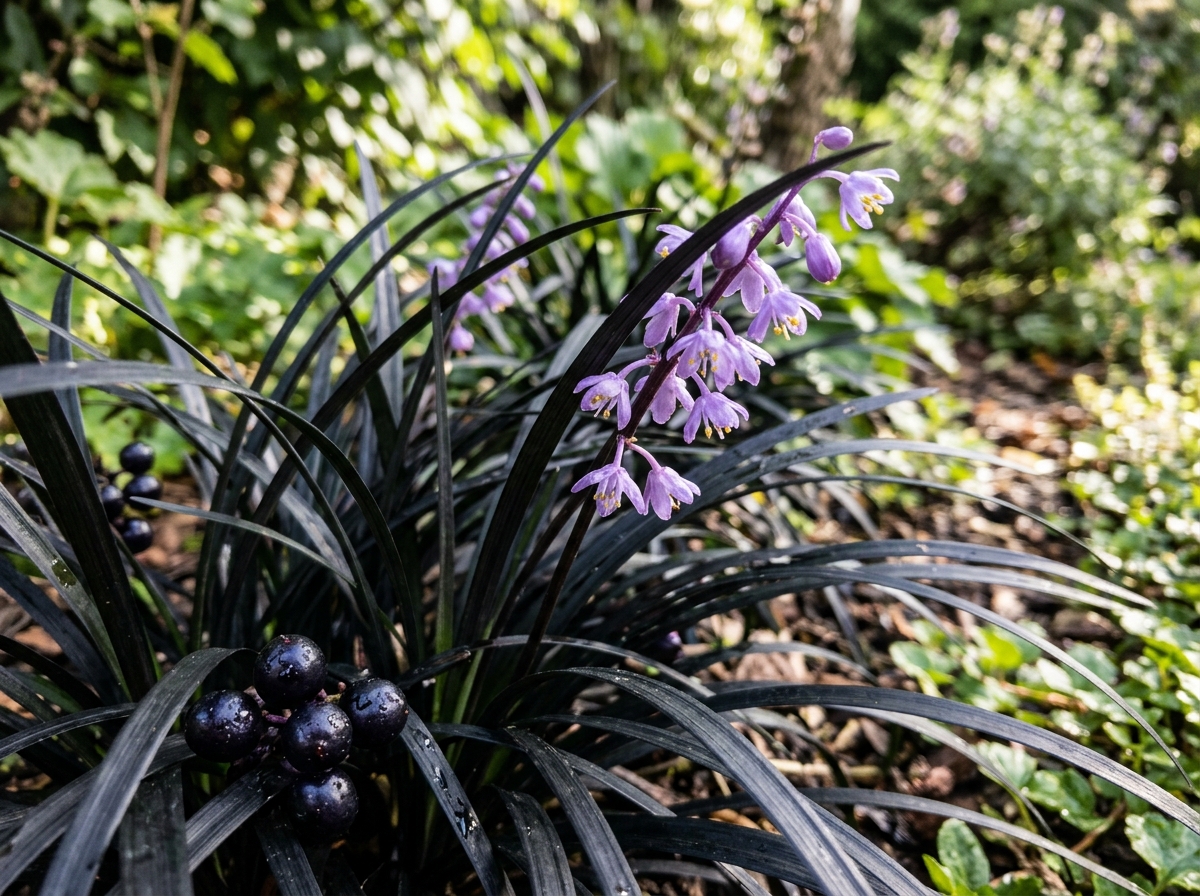
The foliage is the star of the show. The leaves are leathery, strap-shaped, and can reach lengths of 8 to 12 inches. While many plants claim to be “black,” most are actually a very deep burgundy or purple. Black mondo grass comes the closest to a true jet-black, especially when grown in the right light. It typically matures to a height of 6–12 inches and a width of about 12 inches, making it a perfect choice for the front of a garden bed.
Identifying Black Mondo Grass
If you are walking through a garden center, you might mistake it for a dark version of Liriope (Monkey Grass). However, black mondo grass has a more refined, arching habit. Its stems are stoloniferous, meaning it spreads slowly via underground runners.
The name Ophiopogon is a bit of a tongue-twister, but it has a cool origin story. Derived from the Greek words ophis (snake) and pogon (beard), it literally translates to “snake’s beard.” Whether the ancient Greeks thought the roots looked like beards or the leaves looked like snakes is up for debate, but it certainly adds to the plant’s mystique! You may also see it sold under names like ‘Ebony Knight,’ ‘Black Dragon,’ or ‘Arabicus’—don’t worry, these are almost always the same striking cultivar.
Bloom and Fruit Cycle
While we love it for the leaves, black mondo grass does have a hidden talent: it blooms! In the mid-to-late summer (usually July and August), small racemes of bell-shaped flowers emerge. These flowers range from pale pink to a soft, dark lavender. They sit low among the dark foliage, providing a delicate, sparkling contrast.
Once the flowers fade, they are replaced by glossy, globose berries. These fruits start green and ripen into a deep, dark purple or blue-black by autumn. These berries aren’t just for show; they are a great way to attract birds to your garden, providing a late-season snack for our feathered friends.
Ideal Growing Conditions for Black Mondo Grass
One of the reasons we recommend black mondo grass so highly at Mount Pilchuck is its versatility. It is hardy across a wide range of climates, specifically USDA Zones 5 through 10. However, like any “noir” icon, it has some specific preferences regarding its environment.
The ideal soil for this plant is humus-rich and consistently moist but well-drained. It prefers a slightly acidic to neutral pH, ideally between 5.5 and 6.7. If you have heavy clay or very sandy soil, we suggest amending it with plenty of organic compost to give the roots the loamy texture they crave.
Light and Temperature Requirements
Light is the most important factor in determining the color of your black mondo grass. There is a bit of a balancing act involved here, and it depends largely on where you live.
| Region | Recommended Light | Why? |
|---|---|---|
| Northern Climates | Full Sun to Light Shade | More sun brings out the deepest black pigment. |
| Southern/Hot Climates | Partial Shade | Afternoon shade prevents heat stress and foliage scorch. |
In hotter zones (Zones 8-10), the intense afternoon sun can actually bleach the leaves or cause them to turn a dusty brown. In these areas, “bright shade” or “cool sun” (morning sun only) is best.
Temperature-wise, it is quite resilient. It can handle humidity and even some salt spray, making it a candidate for coastal gardens. While it is hardy to Zone 5, we recommend applying a 2-inch layer of compost or mulch in late fall to protect the crown from extreme winter freezes.
Planting, Care, and Maintenance
Growing black mondo grass doesn’t require a degree in botany. It is a slow grower, which is actually a blessing—it won’t take over your garden like some more aggressive groundcovers.
When to Plant: Spring is the best time to get your plants in the ground. This gives them an entire growing season to establish their root systems before the winter dormant period.
Watering: During the first year, keep the soil evenly moist. Once established, the plant is surprisingly drought-tolerant, but it will always look its best with regular hydration. Avoid overhead watering if possible; watering at the base helps prevent issues with slugs and root rot.
Fertilizing: We suggest a balanced, natural fertilizer (like an NPK 5-10-5) once a year in early spring. This provides the nutrients needed for that lush, dark growth without forcing the plant to grow too fast, which can lead to weak foliage.
Cleanup: Unlike turf grass, you don’t “mow” mondo grass. Instead, do a quick spring cleanup. Before the new growth starts to poke through, remove any tattered or winter-damaged leaves to keep the clump looking tidy.
Propagating Black Mondo Grass
If you want more plants (and you will!), the easiest method is root division. Because the plant grows in tufts, you can easily divide a mature clump every 2 to 3 years.
- Use a garden fork to gently lift the clump in early spring.
- Tease the roots apart or use a sharp knife to cut the clump into sections, ensuring each section has a healthy set of roots and leaves.
- Replant the sections about 4 to 9 inches apart.
You can grow black mondo grass from seed, but be warned: it requires the patience of a saint. The seeds can take up to a year to germinate! If you’re up for the challenge, harvest the berries in the fall, extract the seeds, and keep them in a moist seed-starting mix.
Common Pests and Troubleshooting
For the most part, black mondo grass is “tough as nails.” It is virtually disease-free, but there are a few things to watch for:
- Slugs and Snails: They love the moist, shady spots where mondo grass thrives. Keep an eye out for tell-tale slime trails.
- Fern Scale: This insect can occasionally appear as small white bumps on the leaves.
- Root Rot: This only happens in soggy, poorly drained soil. If your plant is turning yellow or mushy at the base, check your drainage.
- Reversion: Occasionally, a “daughter plant” might sprout green leaves. This is a genetic throwback. Simply dig up the green section to keep your black patch pure.
Landscape Design and Companion Planting
The design possibilities for black mondo grass are endless. Its dark color makes it a “neutral” that makes every other color pop. It is frequently used in modern, minimalist gardens, but it also fits perfectly into woodland or Asian-inspired landscapes.
Top Landscape Uses:
- Edging: Use it to define the edge of a path or a lawn.
- Groundcover: Plant it en masse to create a “black carpet” effect.
- Rock Gardens: Its slow growth and small size make it perfect for tucking between stones.
- Erosion Control: The tuberous roots help hold soil on gentle slopes.
One of the biggest selling points? It is both deer resistant and rabbit resistant. Most critters find the leathery leaves unappealing, which is great news for those of us living near wooded areas.
Best Companion Plants for Black Mondo Grass
To get that “wow” factor, you want to pair black mondo grass with plants that offer high contrast.
- Chartreuse and Gold: Pair it with Sedum rupestre ‘Angelina’ (Golden Stonecrop) or golden Hostas. The bright yellow against the black is breathtaking.
- Silver and Blue: Japanese Painted Ferns (Athyrium niponicum) or ‘Jack Frost’ Brunnera provide a cool, sophisticated look.
- Texture Play: Pair the strap-like leaves with the feathery texture of Scotch Moss or the broad leaves of Coral Bells (Heuchera).
Growing Black Mondo Grass Indoors
At Mount Pilchuck, we are passionate about the benefits of indoor greenery. While often thought of as an outdoor plant, black mondo grass actually makes a fantastic houseplant! It acts as a natural air purifier, helping to improve indoor air quality and circulation.
Indoor Care Tips:
- Light: Place it near a southern or western window where it can get bright, indirect light.
- Temperature: It prefers cooler indoor temperatures, ideally between 45°F and 75°F.
- Humidity: Indoor air can be dry. Place the pot on a tray of pebbles and water or use a humidifier to keep the tips from browning.
- Potting: Use a well-draining potting mix and a container with drainage holes. An inch of stones at the bottom of the pot can help prevent the roots from sitting in water.
If you want to learn more about how to use greenery to refresh your home, check out our guide to indoor plants for better air circulation.
Frequently Asked Questions
Is black mondo grass safe for pets?
Yes! One of the best things about black mondo grass is that it is non-toxic. It is safe for humans, cats, and dogs. While we don’t recommend letting your cat use it as a salad bar (it’s for looking, not eating!), you don’t have to worry if they take a curious nibble.
Why is my black mondo grass turning green?
If your black grass is looking a bit “verdant,” it’s usually due to one of two things: light or reversion. If the plant isn’t getting enough light, it may produce more chlorophyll to compensate, causing the leaves to lighten. Secondly, because ‘Nigrescens’ is a cultivar, it can occasionally “revert” to its natural green state. If you see green shoots, simply prune them out at the root.
How fast does black mondo grass spread?
“Slow and steady” is the motto here. It is not an invasive plant. You can expect a single clump to reach its mature width of 12 inches in about 2 to 3 years. This slow growth rate is why it is often more expensive at nurseries than standard green mondo grass—it takes longer to produce!
Conclusion
Black mondo grass is more than just a plant; it’s a design statement. Whether you are using it to create a dramatic border in your backyard or as a hardy, air-purifying accent in your living room, it offers a unique beauty that few other plants can match.
At Mount Pilchuck, we believe that the best gardens are those that balance aesthetics with health-boosting benefits. By choosing low-maintenance, resilient plants like Ophiopogon planiscapus ‘Nigrescens’, you spend less time fussing over chores and more time enjoying your modern sanctuary.
Ready to bring some “noir” drama into your life? Explore our curated selection of indoor plants to find the perfect companion for your new black mondo grass!
