
Your Indoor Air Is More Polluted Than You Think
The golden pothos toxin absorbing plant is one of the best natural solutions for cleaner indoor air — here’s a quick look at what it removes and why it matters:
Top toxins golden pothos removes:
| Toxin | Common Source |
|---|---|
| Formaldehyde | Furniture, flooring, cleaning products |
| Benzene | Paint, adhesives, synthetic fibers |
| Toluene | Varnishes, nail polish, ink |
| Xylene | Paints, gasoline fumes |
| Trichloroethylene | Dry-cleaned clothes, adhesives |
According to NASA’s Clean Air Study, golden pothos (Epipremnum aureum) ranks among the top houseplants for removing these harmful compounds from indoor air.
Here’s the thing most people don’t realize: the air inside your home can be more polluted than the air outside, according to the EPA. Everyday items — furniture, flooring, cleaning sprays — constantly release invisible chemicals called Volatile Organic Compounds (VOCs). You breathe them in all day without knowing it.
Golden pothos works on two levels. Its roots and leaves absorb chemical toxins. Its small, waxy leaves also physically trap dust particles — giving it more surface area than most houseplants.
It’s also nearly impossible to kill, which makes it ideal if you don’t have a green thumb.

The Science Behind the Golden Pothos Toxin Absorbing Plant
When we talk about the golden pothos toxin absorbing plant, we aren’t just repeating “plant parent” folklore. There is significant scientific weight behind the claim that Epipremnum aureum—its formal botanical name—is a powerhouse of purification.
The most famous validation comes from the NASA Clean Air Study, which sought ways to clean the air in space stations. NASA researchers found that certain plants are remarkably efficient at scrubbing Volatile Organic Compounds (VOCs) from the atmosphere. The golden pothos was highlighted for its ability to tackle a “rogue’s gallery” of indoor pollutants.
How It Works: The Biological Vacuum
So, how does a plant “eat” poison? It’s a multi-stage process. First, the plant respires. Much like humans breathe, plants take in air through tiny pores in their leaves called stomata. During this process, they don’t just take in CO2; they also pull in airborne toxins. Once inside, the plant’s internal chemistry breaks these toxins down into harmless components that the plant can actually use for food.
But the leaves don’t do all the work. A fascinating insight from the research shows that the roots and the soil bacteria surrounding them play a massive role. The roots draw in air, and specialized soil microbes neutralize the toxins. This is why a healthy, well-established pothos is such an effective air purifying plant.
Toxin Removal: Pothos vs. The Competition
While many plants offer benefits, the golden pothos is often compared to the Spider Plant. Both are legends in indoor wellness, but they have different strengths.
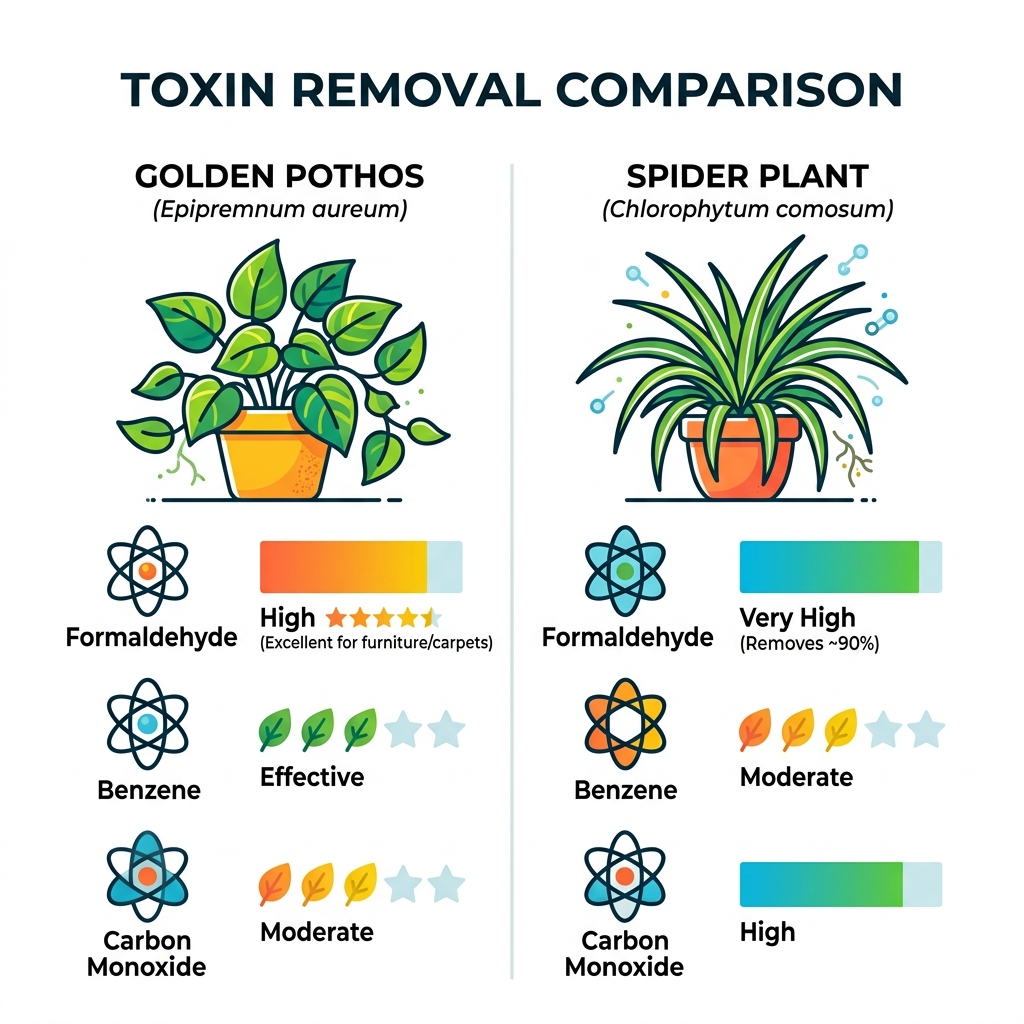
| Feature | Golden Pothos | Spider Plant |
|---|---|---|
| Formaldehyde Removal | High (Excellent for furniture/carpets) | Very High (Removes ~90%) |
| Benzene Removal | Effective | Moderate |
| Carbon Monoxide | Moderate | High |
| Dust Capture | Excellent (due to waxy leaf surface) | Moderate |
| Ease of Care | Nearly indestructible | Very easy |
As we can see, while the Spider Plant is a formaldehyde-fighting champion, the golden pothos toxin absorbing plant offers a more rounded profile, particularly when it comes to physical dust capture. Its numerous small, waxy leaves provide a massive surface area to act as a physical filter for your home.
Top Varieties and Care for Maximum Air Quality
Not all pothos look the same, and part of the fun of building an indoor jungle is choosing the aesthetic that fits your space. While they all share the same basic “toxin-absorbing” DNA, different varieties offer different visual vibes.
- Marble Queen: This is the elegant cousin. It features heavy white variegation, making the leaves look like they’ve been splashed with milk. Because it has less chlorophyll, it grows a bit slower than the standard golden variety.
- Neon: If you want a pop of color, the Neon Pothos is your best friend. Its leaves are a bright, electric lime green. It’s a fantastic way to brighten up a dark corner.
- Jade Pothos: This variety is solid dark green. Because it’s packed with chlorophyll, it is perhaps the most resilient of all, thriving in very low-light conditions where others might struggle.
- N’Joy: A smaller, more compact variety with distinct white and green patches. It’s perfect for bookshelves or small desks.
If you are looking for a budget-friendly way to clean your air, the standard Golden Pothos is usually the most affordable and widely available. Once you have one, you can learn how to grow a stunning golden cascade and eventually have a plant in every room!
Why the Golden Pothos Toxin Absorbing Plant is a Beginner Favorite
There’s a reason this plant is nicknamed “Devil’s Ivy”—it is notoriously difficult to kill. It stays green even when kept in near-darkness and can survive significant neglect. For those of us who occasionally forget our watering duties, this is a lifesaver (literally).
Beyond its toughness, the golden pothos toxin absorbing plant provides several “hidden” benefits:
- Humidity Boost: Like the Spider Plant, which can increase room humidity by about 5%, the pothos releases moisture into the air through transpiration. This is great for your skin and respiratory system during dry winter months.
- Dust Magnet: Those waxy leaves aren’t just for show. They catch dust that would otherwise be floating into your lungs. Just remember to wipe the leaves down with a damp cloth every now and then so the “filter” doesn’t get clogged!
- Versatility: Whether you want it to climb a moss pole or trail down from a high shelf, the pothos is happy to oblige. This makes it one of the most versatile low-maintenance plants available today.
Essential Care for Your Golden Pothos Toxin Absorbing Plant
While it’s hard to kill, a little love goes a long way in maximizing its air-cleaning potential. Here is our expert guide to keeping your pothos happy:
- Light: They prefer bright, indirect light. While they can survive in low light, the “golden” variegation will fade to solid green as the plant tries to produce more chlorophyll to compensate for the lack of sun.
- Water: We recommend watering every 7–10 days. The best rule of thumb? Wait until the top inch of soil is dry. If the leaves start to wilt slightly, it’s telling you it’s thirsty.
- Soil: Use a standard, well-draining potting mix. Pothos don’t like “wet feet,” so ensure your pot has drainage holes.
- Propagation: This is the best part! You can easily create new plants by taking a stem cutting and placing it in a jar of water. Within a few weeks, you’ll see roots, and you’ll have a brand-new health-boosting houseplant to gift or keep.
A Note on Safety: It is important to mention that the pothos contains insoluble calcium oxalate crystals. If chewed or ingested, these crystals can cause intense oral irritation, drooling, and vomiting. According to the ASPCA pet toxicity guide, it is toxic to both cats and dogs. Always keep your pothos on high shelves or in hanging baskets out of reach of curious nibblers.
Beyond Natural Filtration: Genetically Modified Pothos
We live in an era of incredible scientific advancement, and the humble houseplant hasn’t been left behind. Researchers have actually developed a genetically modified (GM) version of the golden pothos to supercharge its toxin-absorbing abilities.
By inserting a synthetic version of a rabbit gene called CYP2E1, scientists created a plant that produces an enzyme capable of breaking down volatile gases like benzene and chloroform much faster than a standard plant. In laboratory tests, these modified plants were able to destroy toxins rather than just storing them.
While these GM plants are a fascinating glimpse into the future of bio-filtration, the natural golden pothos toxin absorbing plant remains a highly effective and much more accessible option for the average homeowner. Whether natural or “super-powered,” having these plants in your home is a major win for your lungs.
Frequently Asked Questions about Air-Purifying Plants
How many plants are needed to clean a standard room?
This is a common question! While one plant is a great start, skeptics of the NASA study point out that home environments aren’t sealed labs. To see a significant reduction in VOCs, experts suggest having at least one medium-sized plant for every 100 square feet of living space. The more, the merrier!
Is the Golden Pothos safe for homes with cats and dogs?
As mentioned, no. If your pet decides to have a snack, they may experience distressing symptoms like pawing at the mouth, swelling, and decreased appetite. If you suspect your pet has eaten any part of a pothos, contact your vet immediately. For a completely pet-safe home, check out our list of 9 plants for a toxic-free home.
Can Golden Pothos survive in windowless offices?
Almost! They are incredibly light-tolerant, but they do need some light to photosynthesize. If your office has no windows but keeps the overhead fluorescent lights on for 8–10 hours a day, a pothos will likely survive, though it will grow much slower than it would in a sunny room.
Conclusion
At Mount Pilchuck, we believe that your home should be a sanctuary. Improving your indoor air quality doesn’t always require expensive machinery or noisy filters. Sometimes, the best solution is the one nature provided thousands of years ago.
The golden pothos toxin absorbing plant is a triple threat: it’s beautiful, it’s incredibly easy to care for, and it actively works to remove harmful chemicals from your environment. By incorporating these lush vines into your decor, you aren’t just following a trend—you’re investing in your long-term health and wellness.
Ready to transform your living space into a breathable oasis? Start your indoor garden today and breathe a little easier tonight.
