
Your Indoor Air Is Probably Dirtier Than You Think
Drought tolerant air cleaning houseplants are the simplest way to improve indoor air quality without constant watering or upkeep. Here are the top options:
| Plant | Key Toxins Removed | Watering Frequency |
|---|---|---|
| Snake Plant (Dracaena trifasciata) | Formaldehyde, benzene, trichloroethylene, xylene, toluene | Every 2-6 weeks |
| Dracaena Reflexa | Formaldehyde, benzene, trichloroethylene | Every 1-2 weeks (summer), monthly (winter) |
| Spider Plant | Formaldehyde, xylene | Every 1-2 weeks, less in winter |
| Areca Palm | All major indoor toxins | When top inch of soil dries |
| Chinese Evergreen | Benzene, formaldehyde | Every 1-2 weeks |
Most people don’t realize how polluted the air inside their home actually is. Stoves, paint, furniture, and everyday cleaning products all release invisible chemicals — called Volatile Organic Compounds (VOCs) — into the air you breathe every day.
This is serious enough that researchers have a name for it: Sick Building Syndrome. And Americans spend up to 90% of their time indoors, according to data cited in multiple air quality studies.
The good news? Certain houseplants can absorb these toxins through their leaves and roots — and some of them barely need watering at all.
That’s the sweet spot: plants that pull harmful chemicals out of your air and survive if you forget about them for weeks at a time.

Why Drought Tolerant Air Cleaning Houseplants are Perfect for Modern Homes
In today’s world, we don’t always have the time to be “plant parents” who mist and prune every afternoon. This is especially true for those of us living in dry climates like Denver or Southern California, where low humidity can turn a thirsty plant into a crispy brown mess in mere days.
Choosing plants that filter toxins from the air while requiring minimal water is a win-win for water conservation and our own health. In arid regions, the air inside our homes is often even drier due to air conditioning and heating systems. Many high-maintenance “air purifiers” (like some ferns) struggle in these conditions. However, drought tolerant air cleaning houseplants have evolved to thrive in exactly these environments.
The gold standard for this research is the NASA Clean Air Study. Back in 1989, NASA researchers were looking for ways to detoxify the air in sealed space stations. They discovered that certain plants could remove up to 87% of volatile organic compounds (VOCs) in just 24 hours. These toxins include:
- Formaldehyde: Found in carpets, upholstery, and particleboard.
- Benzene: Found in plastics, synthetic fibers, and detergents.
- Trichloroethylene: Found in printing inks, paints, and lacquers.
By selecting plants that are both NASA-approved and drought-hardy, we create a self-sustaining “filtration system” that guards our respiratory health without adding to our weekly chores.
The Best Varieties of Drought Tolerant Air Cleaning Houseplants
Not all “easy-care” plants are created equal when it comes to scrubbing the air. Some are champions at removing xylene, while others excel at nighttime oxygen production. Scientific research on indoor air quality has shown that having a variety of species is the most effective way to target a broad spectrum of pollutants.
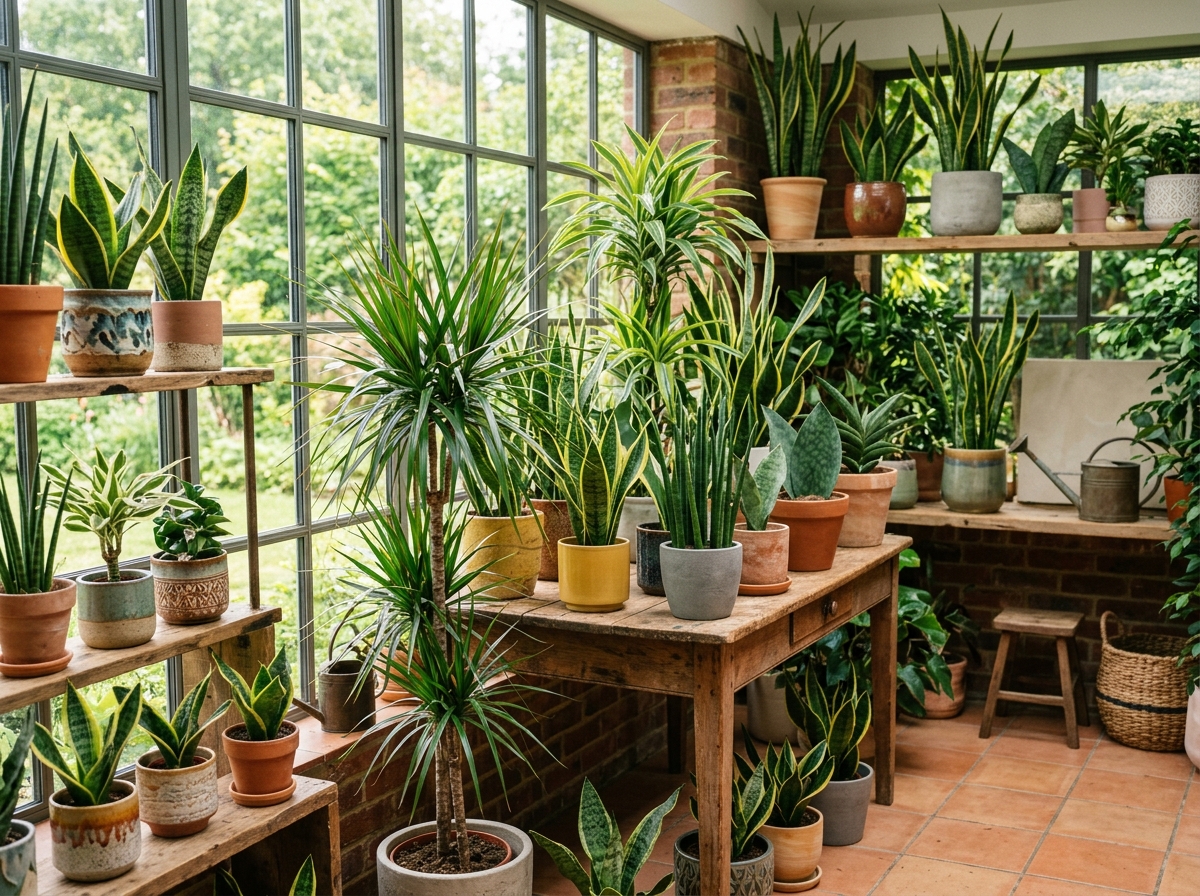
The Indestructible Snake Plant (Dracaena trifasciata)
If there were a hall of fame for drought tolerant air cleaning houseplants, the Snake Plant (formerly Sansevieria) would be the undisputed MVP. Often called “Mother-in-Law’s Tongue” because of its sharp, pointed leaves, this plant is nearly impossible to kill.
What makes it truly special is its unique biology. Most plants take in CO2 and release oxygen during the day. However, the Snake Plant uses Crassulacean Acid Metabolism (CAM). It keeps its stomata (pores) closed during the heat of the day to prevent water loss and opens them only at night. This makes it one of the top air-purifying plants for bedrooms, as it continues to refresh your air while you sleep.
Popular varieties include:
- Sansevieria Zeylanica: The classic dark green, sword-like leaves with silver wavy stripes.
- Bantel’s Sensation: Features elegant white vertical striping and thinner leaves.
- Golden Hahni: A “bird’s nest” variety that stays small, perfect for desks.
Resilient Dracaena Reflexa (Song of India)
The Dracaena Reflexa is a stunning, tree-like plant that brings a tropical vibe to any room. It ranks fifth on NASA’s list of top air purifiers because of its incredible ability to remove formaldehyde, benzene, and trichloroethylene.
We love this plant for its adaptability. It is highly resistant to pests and can survive for weeks without water. While it prefers bright, indirect light, it is well-known for being one of the best indoor plants for office spaces because it can handle the lower light levels often found in professional environments. If you’re a “forgetful” waterer, this is the plant for you—it actually prefers to dry out between sessions.
Versatile Spider Plants for Arid Environments
The Spider Plant (Chlorophytum comosum) is a classic for a reason. It’s a workhorse at removing xylene and formaldehyde. While it appreciates a bit more humidity than a cactus, it is surprisingly resilient in dry climates.
One of its best features is how easily it produces “pups”—tiny baby plants that hang down from the mother plant like spiders on a web. This makes it one of the most easy-care plants for home air quality because you can propagate your own collection for free. Simply snip a pup and place it in water or soil, and you’ve got a new air purifier ready to go.
Essential Care Guide for Drought Tolerant Air Cleaning Houseplants
The secret to success with these plants is “benign neglect.” More houseplants die from over-enthusiastic watering than from being left alone.
- Soil: Always use a well-draining potting mix. A succulent or cactus mix is usually best because it contains sand or perlite to prevent water from sitting around the roots.
- Watering: The “finger test” is your best friend. Stick your finger an inch into the soil; if it feels dry, it’s time to water. For Snake Plants, you can often wait until the soil is dry all the way to the bottom.
- Light: Most drought tolerant air cleaning houseplants thrive in indirect light. While they can survive as indoor plants for low-light rooms, their growth will slow down significantly.
- Root Bound Preference: Many of these plants, especially Dracaenas and Snake Plants, actually prefer being slightly root-bound. Don’t rush to repot them; they are often happier in a snug container.
- Fertilizer: Feed them sparingly. A slow-release granule once a year or a diluted liquid fertilizer during the spring and summer is plenty.
Avoiding Common Mistakes with Drought Tolerant Air Cleaning Houseplants
Even “indestructible” plants have their limits. The number one killer is root rot. If the leaves start to feel mushy or turn yellow at the base, you are likely overwatering. Ensure your pot has drainage holes—this is non-negotiable!
Another common issue is fluoride sensitivity. Some plants, like Dracaena and Spider Plants, are sensitive to the fluoride found in tap water, which can cause brown tips on the leaves. If you see this, try switching to rainwater or distilled water.
Lastly, watch out for temperature fluctuations. While these plants are tough, they are tropical at heart. Keep them away from drafty windows in the winter and out of the direct path of air conditioning vents. If you have furry friends, always check if your selection is among the indoor plants safe for pets. For example, Snake Plants contain saponins which can cause tummy upset in cats and dogs.
Maximizing the Benefits of Your Indoor Greenery
Adding drought tolerant air cleaning houseplants to your home does more than just scrub the air; it changes the way you feel. Research has shown that workers in plant-filled offices experienced 24% fewer headaches and 52% less eye irritation.
Beyond the physical health benefits, plants are powerful tools for stress reduction. A 2008 study showed that people in environments with greenery had a 12% higher lung capacity and reported feeling significantly more relaxed. Whether you’re looking for a concentration boost during work hours or a way to improve indoor air circulation, a few strategically placed plants can make a world of difference.
Frequently Asked Questions About Drought Tolerant Air Cleaning Houseplants
How many plants do I need for noticeable air purification?
This is a great question with a bit of a “reality check” answer. While the NASA study showed amazing results in small, sealed chambers, a typical home has much more air exchange. A study on plant effectiveness limitations suggested that to match the power of a high-end HEPA filter, you might need between 100 and 1,000 plants per 10 square feet.
However, don’t let that discourage you! Every single plant contributes to lowering VOC levels. While you might not turn your living room into a literal forest, having 5 to 10 large, healthy plants in a room can provide a measurable improvement in air quality and humidity.
Can these plants survive in low-light indoor environments?
Yes, particularly the Snake Plant and certain Dracaena varieties. They are masters of survival. However, there is a difference between “surviving” and “thriving.” In low light, a plant’s growth will be very slow, and its air-purifying metabolism will also slow down. If you want the maximum air-cleaning benefit, try to place them where they get at least some bright, indirect sun during the day.
Are these air-purifying plants safe for pets and children?
Safety is our top priority. Many effective air purifiers, like the Snake Plant and Dracaena, contain saponins. If a pet or child chews on the leaves, it can cause gastrointestinal upset, drooling, or vomiting.
If you have curious pets, consider placing these plants on high shelves or in hanging baskets. Alternatively, look for non-toxic options like the Areca Palm or the Spider Plant, which are generally considered safe by ASPCA guidelines.
Conclusion
At Mount Pilchuck, we believe that your home should be a sanctuary. By incorporating drought tolerant air cleaning houseplants, you aren’t just decorating—you’re investing in your long-term health. These resilient green companions offer a sustainable, low-effort way to combat the toxins of modern life while bringing a touch of nature’s calm into your space.
Whether you’re looking for indoor plants for better air circulation or simply want a plant that won’t die if you take a two-week vacation, the varieties we’ve discussed today are the perfect place to start. Start small, perhaps with a single Snake Plant in your bedroom, and feel the difference that cleaner air and a little bit of greenery can make.
