
Why the Right Bedroom Plants for Oxygen Can Transform Your Sleep
Bedroom plants for oxygen are one of the simplest, most natural upgrades you can make to your sleep environment. Here are the top options, ranked by oxygen output and air-purifying power:
| Plant | Oxygen Output | Key Benefit |
|---|---|---|
| Areca Palm | 18.3 ml/hr | Highest output + humidity boost |
| Snake Plant | 12.5 ml/hr | Produces oxygen at night |
| Peace Lily | 9.7 ml/hr | Removes 60% of formaldehyde |
| Spider Plant | 7.2 ml/hr | Low maintenance, pet-friendly |
| Pothos | 6.8 ml/hr | Removes 73% of formaldehyde |
| Aloe Vera | Low | Nighttime oxygen via CAM process |
Here’s a problem most people don’t think about: indoor air is often more polluted than outdoor air. The EPA estimates indoor air pollution affects 90% of homes — from off-gassing furniture, synthetic fabrics, and everyday cleaning products.
You spend roughly a third of your life in your bedroom. That’s a long time breathing stagnant, toxin-laced air.
The good news? A few well-chosen plants can make a real difference — not just by producing oxygen, but by actively filtering out the harmful compounds that build up while you sleep.
This guide compares the best bedroom plants for oxygen, air purification, and overall sleep quality, so you can pick the right ones for your space.
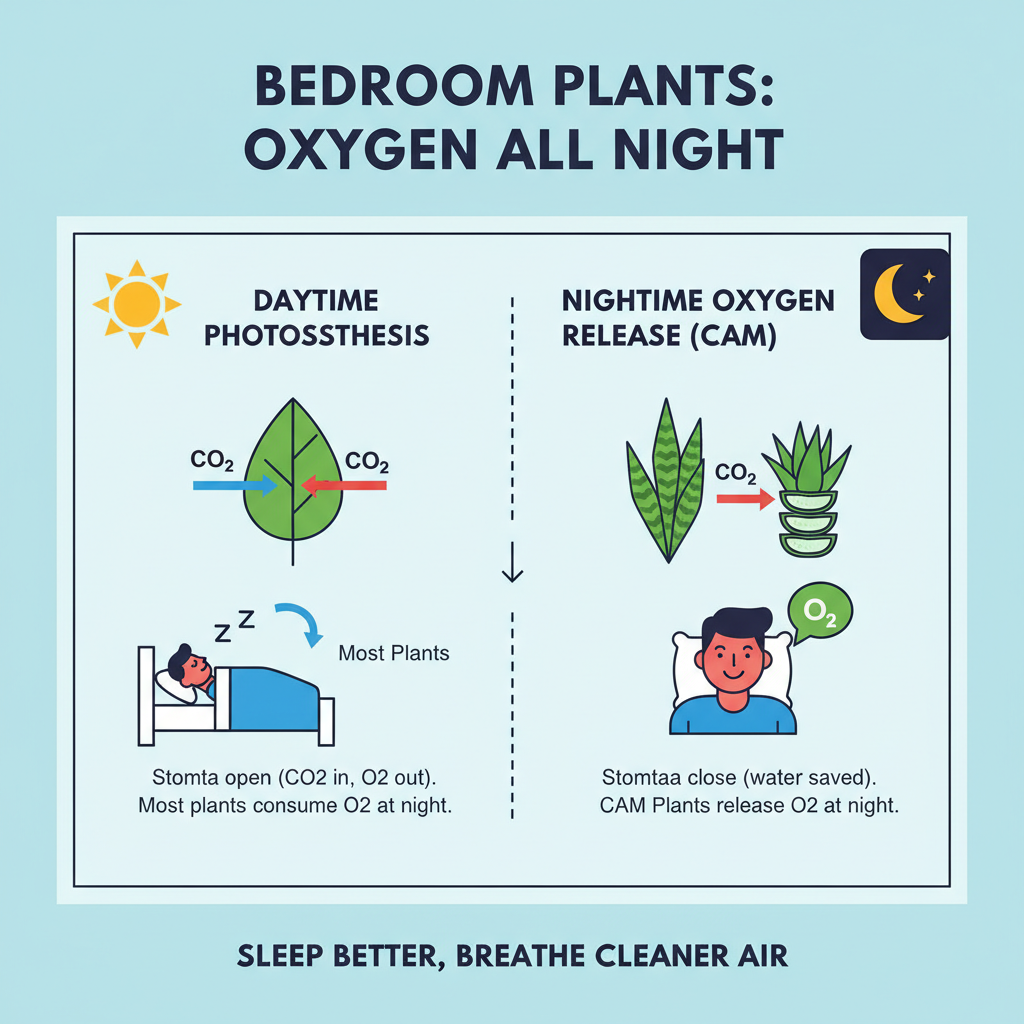
The Science of Nighttime Oxygen: How CAM Plants Work
We all learned the basics of photosynthesis in grade school: plants take in carbon dioxide and sunlight during the day to create energy, releasing oxygen as a byproduct. However, there is a common misconception that all plants “shut down” or only consume oxygen at night. While most plants do switch to respiration (taking in oxygen and releasing tiny amounts of CO2) when the sun goes down, a special group of plants has evolved a “night shift” strategy.
This process is called Crassulacean Acid Metabolism (CAM). CAM plants are typically native to arid, desert-like regions or live as epiphytes (plants that grow on other plants, like some orchids). To survive in hot, dry environments, these plants keep their “pores”—known as stomata—tightly closed during the day to prevent water loss. When the air cools down at night, they open these stomata to take in carbon dioxide and release oxygen.
This is why certain bedroom plants for oxygen are so highly prized for sleep environments. By releasing oxygen while you are actually in the room, they help maintain a fresher atmosphere. It is important to note that the amount of CO2 released by non-CAM plants at night is negligible—nowhere near enough to be harmful—but choosing CAM-capable plants gives you that extra boost of nighttime refreshment.
Scientific research, most notably the NASA Clean Air Study, highlights how these plants do more than just manage gases; they are biological filters. When we look at indoor plants that improve breathing, we are looking at a combination of nighttime oxygen production and the removal of Volatile Organic Compounds (VOCs).
Top Performers: Comparing the Best Bedroom Plants for Oxygen
When selecting the best bedroom plants for oxygen, we have to look at two main factors: how much oxygen they produce (measured in milliliters per hour) and how efficiently they scrub toxins like formaldehyde, benzene, and trichloroethylene from the air.
Below is a breakdown of how the most popular bedroom choices stack up based on experimental data:
| Plant Species | Oxygen Output (ml/hr) | Formaldehyde Removal Efficiency | Best Placement |
|---|---|---|---|
| Areca Palm | 18.3 | 38% | Bright, indirect light |
| Snake Plant | 12.5 | 52% (up to 94% in lab) | Bedside / Low light |
| Peace Lily | 9.7 | 60% | Moderate light / Humid spots |
| Spider Plant | 7.2 | 42% | Hanging baskets |
| Pothos | 6.8 | 73% | Shelves / High ledges |
For a deeper dive into these varieties, check out our guide on top air purifying plants for bedrooms.
Snake Plant: The Ultimate Bedroom Plant for Oxygen
If there were a “MVP” award for bedroom greenery, it would go to the Snake Plant (botanically known as Dracaena trifasciata). This plant is a CAM powerhouse. It produces approximately 12.5 ml of oxygen per hour, and incredibly, it maintains about 85% of its daytime oxygen output throughout the night.
Beyond its breathing benefits, the Snake Plant is a toxin-crushing machine. NASA research showed it can remove formaldehyde and trichloroethylene with up to 94% efficiency. Because it is incredibly hardy and thrives in low-light conditions, it is one of the most low-maintenance air purifying plants available. Whether you have a green thumb or a “black thumb,” the Snake Plant is likely to survive and keep cleaning your air.
Areca Palm: High-Output Bedroom Plants for Oxygen and Humidity
If you have a bit more space, the Areca Palm is the heavy hitter of the plant world. Producing a massive 18.3 ml of oxygen per hour, it is the highest-output plant on our list. But its benefits don’t stop at oxygen.
The Areca Palm is a natural humidifier. Through a process called transpiration, a single 6-7 foot palm can release enough moisture to increase room humidity by up to 5%. This is a lifesaver during winter months when heaters dry out our sinuses and skin. One large Areca Palm can effectively oxygenate a space up to 200 square feet. If you love a tropical aesthetic, these are the best leafy plants for air purification you can buy.
Peace Lily and Pothos: Dual-Action Air Refreshers
While the Peace Lily and Pothos have slightly lower oxygen output numbers (9.7 ml/hr and 6.8 ml/hr respectively), they excel at chemical filtration. In one experiment, Pothos was shown to decrease carbon dioxide levels by 6.5%, bringing levels down from 454PPM to 425PPM.
The Peace Lily is particularly famous for its ability to remove 60% of formaldehyde from the air, while Pothos can remove a staggering 73%. These are excellent choices if you are looking for plants that filter toxins from the air that might be off-gassing from new carpets or particle-board furniture.
Maximizing Air Quality: Placement, Quantity, and Care Strategies
Simply buying a plant and sticking it in a dark corner isn’t enough to turn your room into an oxygen bar. To get the most out of your bedroom plants for oxygen, you need a strategy.
The NASA Ratio NASA research suggests that for measurable air quality benefits, you should aim for at least one medium-sized plant (in a 10-12 inch pot) for every 100 square feet of living space. In a standard 12×12 bedroom, two well-placed plants are usually sufficient.
Potting for Power Believe it or not, the pot matters. Using terracotta pots can boost overall plant oxygen production by 15-20% because the porous material allows for better root oxygenation. Additionally, plants in 6-8 inch pots have been shown to produce 30% more oxygen than those in smaller containers.
The “Dusting” Secret Dust is the enemy of photosynthesis. If your plant’s leaves are covered in a layer of bedroom dust, they can’t “breathe” or process light efficiently. Wiping the leaves with a damp cloth weekly can increase photosynthetic efficiency by up to 30%.

Strategic Grouping While you should avoid overcrowding (which can reduce efficiency by 20-30% due to lack of light), grouping 3-5 plants in a 3-foot radius can increase local humidity by 15%. Position these clusters near “pollutant sources”—like a new mattress or a desk with a computer—to see up to 3x greater VOC removal efficiency. For more tips on keeping your green friends happy, see our guide on easy care plants for home air quality.
Beyond Oxygen: Holistic Health Benefits of Bedroom Greenery
The benefits of bedroom plants for oxygen extend far beyond just the chemistry of the air. Having life in your room changes the entire “vibe” and biological makeup of the space.
- Mold Reduction: English Ivy is a superstar here. Research from the University of Georgia found that English Ivy can remove up to 58% of airborne mold particles in just 6 hours. This is vital for allergy sufferers.
- Deep Sleep Phases: A fascinating follow-up to the NASA studies suggests that improved air quality can increase deep sleep phases by up to 37%. When the brain isn’t busy processing toxins or struggling with low oxygen levels, it can stay in restorative sleep cycles longer.
- Stress Management: Simply looking at greenery has been shown to lower cortisol levels and reduce blood pressure.
If you find that plants aren’t enough for your specific needs, you might also consider portable air purifiers for bedroom a pocket friendly choice to work alongside your greenery. For the ultimate setup, you can check out how to turn your home into a literal oxygen bar.
A Note on Pet Safety Before you fill your room with plants, check the toxicity profile. According to the ASPCA, while the Areca Palm and Spider Plant are non-toxic to cats and dogs, the Snake Plant and Peace Lily can cause mild to moderate irritation if ingested. Always place toxic plants on high shelves or in areas where pets can’t reach them.
Frequently Asked Questions about Bedroom Plants for Oxygen
Do plants release dangerous levels of CO2 at night?
This is a common myth. While most plants do release small amounts of carbon dioxide at night through respiration, the amount is absolutely negligible. A single human (or even a small dog) exhales significantly more CO2 than a room full of plants. Furthermore, CAM plants like the Snake Plant and Aloe Vera are net oxygen producers at night, making them perfectly safe bedside companions.
How many plants are needed for a standard 12×12 bedroom?
Based on the NASA ratio of one plant per 100 square feet, a 12×12 bedroom (144 sq. ft.) would ideally have two medium-sized plants. If you choose high-output plants like the Areca Palm, one large specimen may be enough. If you prefer smaller plants, a cluster of three 6-inch pots will provide a similar benefit.
Which plants are safest for bedrooms with pets?
If you have a curious cat or a nibbling dog, the Areca Palm and Spider Plant are your best bets, as they are non-toxic. The Snake Plant and Pothos should be kept out of reach, as they contain calcium oxalate crystals which can cause mouth irritation and tummy upset in pets. You can find more information on the ASPCA website.
Conclusion
Creating a restorative sleep environment is about more than just a good mattress; it’s about the air you breathe for eight hours every night. By strategically choosing bedroom plants for oxygen—like the nighttime-producing Snake Plant or the high-output Areca Palm—you can naturally lower toxin levels, boost humidity, and potentially increase your deep sleep phases.
At Mount Pilchuck, we believe that a few green additions can transform your bedroom into a true sanctuary. Start with one or two hardy varieties, keep their leaves clean, and enjoy the literal breath of fresh air. For more expert advice on enhancing your home with health-boosting greenery, visit our main site at https://www.mountpilchuck.com/. Sweet dreams!
