
Your Darkest Corners Deserve Greenery Too
Philodendron low light care is more achievable than most people think — and the right variety can genuinely thrive in the dimly lit corners, north-facing rooms, and windowless offices where most plants give up.
Here’s a quick answer for getting started:
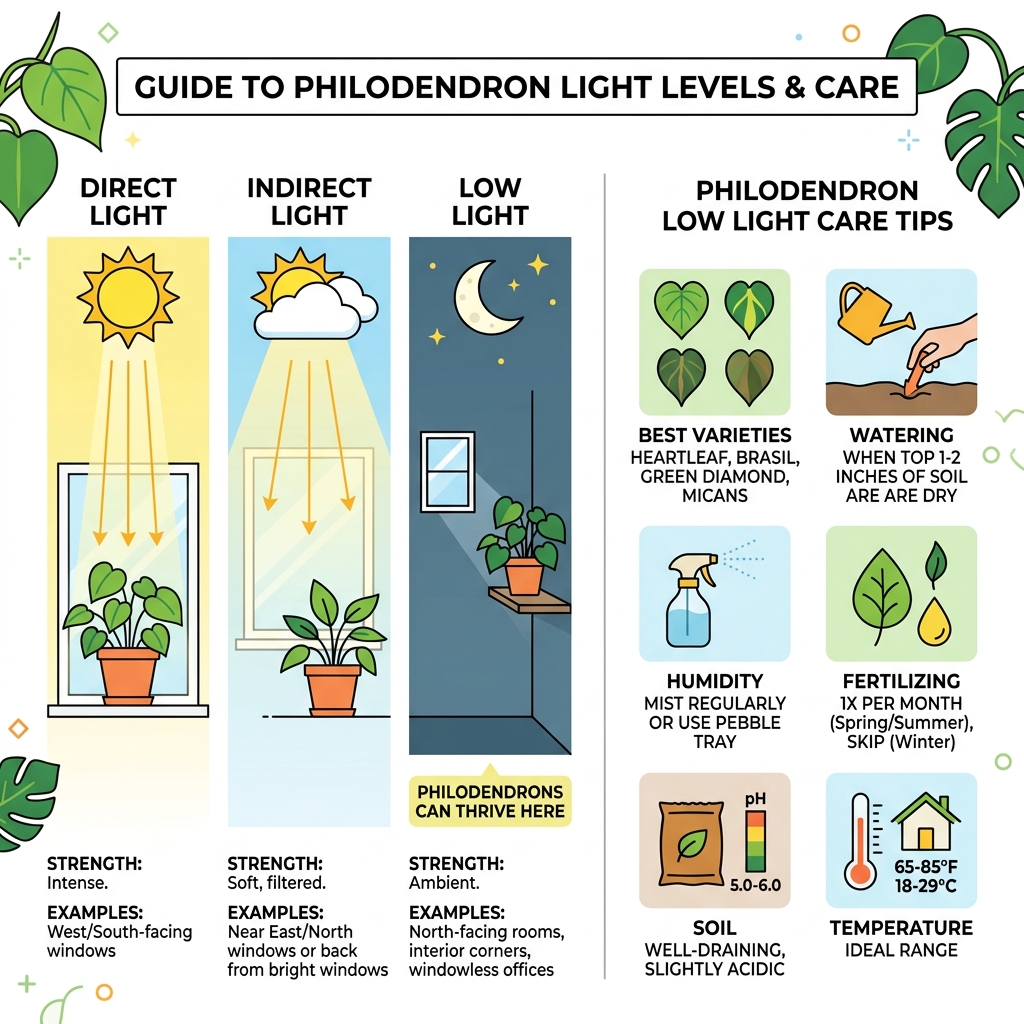
| Care Factor | Low Light Recommendation |
|---|---|
| Best varieties | Heartleaf, Brasil, Green Diamond, Micans |
| Light level | Ambient or indirect light; avoid total darkness |
| Watering | When top 1-2 inches of soil are dry |
| Humidity | Mist regularly or use a pebble tray |
| Fertilizing | Once a month in spring/summer; skip in winter |
| Soil | Well-draining, slightly acidic (pH 5.0-6.0) |
| Temperature | 65-85°F (18-29°C) |
Philodendrons are native to the floor of tropical rainforests in Central and South America. Under dense canopies, they evolved to capture whatever light filters through — which is exactly why they handle low-light indoor spaces so well.
That said, “low light” doesn’t mean “no light.” It means soft, ambient, or indirect light — like what you’d find near a north-facing window or several feet back from a bright one. A truly dark room will still stress any philodendron over time.
For urban dwellers dealing with small apartments, limited windows, or stuffy interior rooms, philodendrons offer something rare: lush, tropical greenery that actually works with your space — and as a bonus, they help freshen stagnant indoor air.
This guide covers everything you need to keep them healthy in low-light conditions, from variety selection to watering, pruning, and troubleshooting.
Top Varieties for Philodendron Low Light Care
When we talk about philodendron low light care, the first step is choosing the right athlete for the race. Not all philodendrons are created equal; some crave the spotlight, while others are perfectly content in the wings.
The Araceae family characteristics and history tell us that these plants are the second-largest member of their family, known for their diverse growth habits. One fascinating trait some species exhibit is “skototropism”—a fancy word meaning they actually grow toward darkness when they are young. In the wild, this helps them find the dark silhouette of a tree trunk to climb. Once they reach the light of the canopy, they switch gears. This natural resilience makes them champions of the “darkest corners” in our homes.
| Variety | Growth Habit | Leaf Shape | Low Light Tolerance |
|---|---|---|---|
| Heartleaf (P. hederaceum) | Vining/Trailing | Classic Heart | Excellent |
| Philodendron Brasil | Vining/Trailing | Heart with Yellow Variegation | High |
| Green Diamond | Upright/Bushy | Elongated Spear | Very High |
| Philodendron Micans | Vining/Trailing | Velvety Heart | Moderate-High |
| Silver Sword | Climbing | Sword-shaped | Moderate |
Why Green Varieties Excel in Philodendron Low Light Care
You might notice that solid green varieties often perform better in dim spaces than their highly variegated cousins. This comes down to biology. Chlorophyll is the engine that turns light into food. In variegated plants (like the ‘Pink Princess’ or ‘White Knight’), the white or pink patches lack chlorophyll. This means the remaining green parts have to work double-time.
In a low-light environment, a solid green plant like the ‘Green Diamond’ has a higher density of chlorophyll across its entire leaf surface. This makes it more energy-efficient. Scientific research on epiphytic and hemiepiphytic growth shows that many philodendrons are adapted to life under a thick canopy where they must maximize every stray photon. By choosing solid green foliage, you are giving your plant a head start in the photosynthetic adaptation game.
Best Placement Strategies for Low Light
Finding the “sweet spot” for your plant is an art. We recommend these specific locations to maximize health without scorching leaves:
- North-Facing Windows: These provide the most consistent, weak light throughout the day—perfect for philodendron low light care.
- Office Corners: If your office has overhead fluorescent lights but no windows, a Heartleaf Philodendron can often survive, though it may grow slowly.
- Bathroom Humidity: Bathrooms with small frosted windows are ideal. The humidity mimics their tropical origins, while the low light keeps them comfortable.
- Distance from Glass: If you have a bright South-facing window, place your philodendron 5-8 feet back. This ensures they get ambient light without the heat of direct rays.
- Supplemental LED Grow Lights: If your room is truly “cave-like,” we suggest using a small LED grow light positioned 12-18 inches above the plant for 6-8 hours a day.
Mastering the Environment: Water, Soil, and Humidity
In lower light, your plant’s metabolism slows down. It’s like the plant is in “power-save mode.” Because of this, the environmental factors like soil and water must be adjusted. You can’t treat a low-light plant the same way you treat one sitting in a sunny window.

A common mistake is using heavy, garden-style soil. We always recommend a well-draining potting mix. A mix of two parts orchid bark or perlite to one part peat-free compost works wonders. You want a soil pH between 5.0 and 6.0. Using a slightly acidic mix helps the plant absorb nutrients more effectively. For more ideas on managing dim spaces, check out our guide on indoor-plants-for-low-light-rooms.
Watering Schedules for Philodendron Low Light Care
The number one killer of philodendrons in the shade is overwatering. Because there is less light, there is less evaporation. The soil stays wet much longer than you’d expect.
- The Finger Test: Never water on a set schedule (like “every Monday”). Stick your finger into the soil. If the top 2 inches feel dry, it’s time to water.
- Seasonal Adjustments: In winter, your plant may only need water once every 10-14 days. In summer, it might be once a week.
- Drainage Importance: Always use a pot with drainage holes. If you love a decorative “cachepot” without holes, keep the plant in its plastic nursery liner and lift it out to water in the sink.
- Signs of Overwatering: Yellowing leaves (starting at the base), a musty smell from the soil, or stems that feel mushy.
- Underwatering Symptoms: Drooping leaves that look “thin” or “limp,” and soil that has pulled away from the edges of the pot.
Humidity Hacks for Dry Rooms
Philodendrons love humidity between 60% and 80%, but most homes sit around 30-40%. While they are tough enough to tolerate dry air, they won’t look their “lush tropical best” without a little help.
- Pebble Trays: Fill a shallow tray with pebbles and water. Sit the pot on the pebbles (not in the water). As the water evaporates, it creates a humid microclimate around the leaves.
- Misting: We recommend misting the leaves a few times a week, especially in winter when the heater is running.
- Grouping Plants: Plants “breathe” out moisture (transpiration). By grouping several plants together, they create their own humid “mini-jungle.”
- Humidifiers: If you have a large collection, a small humidifier is the most effective way to keep edges from turning brown and crispy.
Troubleshooting Growth and Maintenance in Dim Spaces
Maintenance is key when growth is slow. In a low-light setting, every leaf is precious. If a leaf is covered in dust, it can’t photosynthesize. We suggest wiping the leaves with a damp cloth every month to keep the “solar panels” clean.
Pruning and Training for Fullness
In low light, vining philodendrons can become “leggy.” This means the stem grows long, but the leaves are spaced far apart as the plant “stretches” to find light.
- Node Identification: Look for the small bumps on the stem where leaves grow. These are nodes.
- Pruning for Bushiness: To encourage a fuller look, snip the vines just above a node in the spring. This signals the plant to grow new stems from the base.
- Support Structures: For climbing varieties like the ‘Silver Sword,’ provide a moss pole. When the aerial roots can grip a moist support, the leaves often grow larger and more vibrant.
Repotting and Soil Refreshing
Philodendrons are relatively fast growers and generally need repotting every 2-3 years. However, in low light, they might take longer to become root-bound.
- Signs it’s Time: Roots growing out of the drainage holes, water sitting on top of the soil without soaking in, or growth that has completely stalled for over a year.
- Pot Size Selection: Only go up one pot size (about 1-2 inches wider). A pot that is too large holds too much water, which leads to root rot in low-light conditions.
- Timing: Always repot in spring or early summer when the plant has the most energy to recover from the move.
Frequently Asked Questions about Low Light Philodendrons
Are philodendrons toxic to pets and children?
Yes, they are. Philodendrons contain calcium oxalate crystals. If chewed or swallowed, these crystals can cause intense burning and swelling of the mouth, tongue, and throat. To keep everyone safe, we recommend placing your plants on high shelves or using hanging baskets. If you are pruning, wear gloves, as the sap can be a skin irritant for some people.
Can I propagate philodendrons in a dark room?
You can, but be prepared for a wait! Propagation is the process of growing a new plant from a stem cutting.
- Cut a 4-6 inch piece of stem with at least two nodes.
- Place the bottom node in a jar of clean water.
- Keep it in the brightest spot you have available—even a low-light room needs a little help here.
- Roots usually appear in 2-4 weeks, but in low light, it might take 6-8 weeks.
How do I know if my philodendron is getting too little light?
Plants are great communicators if you know what to look for. Signs of light starvation include:
- Yellowing Leaves: If the plant is losing more leaves than it’s growing.
- Stretching Stems: Extremely long gaps between leaves (legginess).
- Lack of New Growth: If the plant hasn’t produced a single leaf in an entire growing season.
- Loss of Variegation: If a ‘Brasil’ or ‘Birkin’ starts turning solid green, it’s trying to create more chlorophyll to survive the dimness.
- Soil Staying Wet: If the soil is still soggy two weeks after watering, the plant isn’t “drinking” because it lacks the light energy to do so.
Conclusion
At Mount Pilchuck, we believe every home—no matter how many windows it has—deserves the vibrant energy of living plants. Mastering philodendron low light care allows you to bring health-boosting greenery into the most neglected corners of your life. These plants don’t just sit there; they work for you, improving air circulation and providing a tropical vibe that lowers stress.
By choosing the right variety, adjusting your watering habits, and keeping those leaves clean, you can enjoy a lush indoor jungle year-round. Ready to expand your collection? Find the best indoor plants for your home and start transforming your space today.
