
Why the Right Plants for Narrow Spaces Make All the Difference
Plants for narrow spaces are the smart solution for any tight strip, skinny bed, or confined corner in your garden or home.
Here are the best options at a glance:
| Plant | Type | Height | Width | Zones |
|---|---|---|---|---|
| ‘Sky Pencil’ Japanese Holly | Evergreen shrub | 8-10 ft | 2-3 ft | 6-9 |
| ‘Graham Blandy’ Boxwood | Evergreen shrub | 8-10 ft | 2 ft | 5-9 |
| STING® Arborvitae | Evergreen tree | 15-20 ft | 1-1.5 ft | 4-8 |
| ‘Purple Pillar’ Rose of Sharon | Deciduous shrub | 10 ft | 2-3 ft | 5-9 |
| Karl Foerster Feather Reed Grass | Ornamental grass | 5-6 ft | 2 ft | 4-9 |
| Hoya linearis | Indoor trailing vine | 1-1.5 m | 0.1-0.5 m | Indoor |
Almost every yard — and many homes — has at least one “skinny” spot. Maybe it’s the strip between your sidewalk and the house. Maybe it’s the gap along a garage wall or fence. Or perhaps it’s a narrow windowsill or hallway corner indoors where you want a touch of green.
The problem? Most common plants grow too wide. Plant the wrong shrub or tree and you’ll spend years fighting it with pruning shears — or worse, ripping it out entirely.
The good news is that horticulturists have specifically bred hundreds of columnar and narrow-growing plants to solve exactly this problem. The principle is simple: right plant, right place. Choose a plant whose natural shape fits your space, and maintenance drops dramatically.
This guide covers the best narrow-space plants for both outdoor beds and indoor environments — including options that can also improve your home’s air quality and circulation.
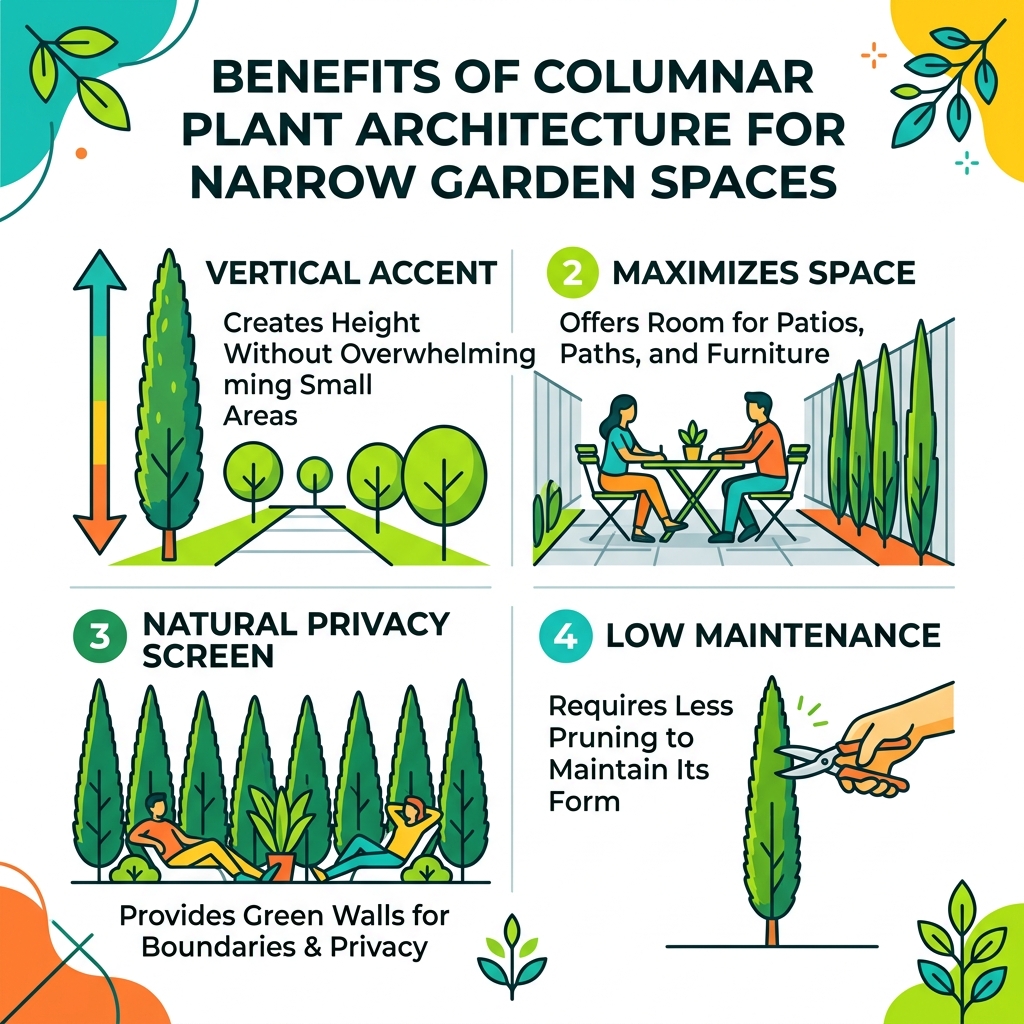
Top Evergreen and Deciduous Plants for Narrow Spaces
When we talk about plants for narrow spaces, evergreens are often the first choice because they provide year-round structure and privacy. However, deciduous shrubs offer seasonal interest—like flowers and fall color—without necessarily taking up more room.
‘Sky Pencil’ Japanese Holly (Ilex crenata)
This is perhaps the most famous of all columnar shrubs. It grows naturally in a pencil-thin shape, reaching 8 to 10 feet tall while staying only 2 to 3 feet wide. It is a female cultivar, meaning it can produce small black berries if a male pollinator is nearby. It’s perfect for framing a doorway or lining a narrow path.
‘Graham Blandy’ Boxwood
If you want a formal look, ‘Graham Blandy’ is a veteran “pole-type” boxwood. It is incredibly narrow, often staying around 2 feet wide even after 20 years of growth. It is hardy in Zones 5-9 and maintains a dense, upright habit with very little pruning required.
STING® Arborvitae
For those who need height but have almost zero width to spare, STING® Arborvitae is a game-changer. It can reach 15 to 20 feet in height while maintaining a width of just 1 to 1.5 feet. This makes it one of the most efficient “living fences” available for tight property lines.
‘Purple Pillar’ Rose of Sharon
Not all narrow plants have to be green columns. The ‘Purple Pillar’ (and its sibling ‘White Pillar’) Rose of Sharon brings a Mediterranean feel to tight spots. Unlike traditional Hibiscus syriacus, which can become quite bushy, these cultivars grow straight up to 10 feet with a 2-3 foot spread, covered in beautiful summer blooms.
Fine Line® Buckthorn
This deciduous shrub offers a unique, feathery texture. It stays narrow (2-3 feet) and reaches about 5-7 feet tall. In the fall, the foliage turns a lovely yellow, providing seasonal variety in a footprint that won’t encroach on your walkway.
For more detailed guidance on choosing and installing these varieties, we recommend checking out this scientific research on 22 shrubs for small spaces.
Comparison Table: Columnar Plant Dimensions
| Plant Name | Mature Height | Mature Width | Hardiness Zone | Best Use |
|---|---|---|---|---|
| ‘Sky Pencil’ Holly | 8-10′ | 2-3′ | 6-9 | Entryways |
| ‘Graham Blandy’ Boxwood | 8-10′ | 2′ | 5-9 | Formal Borders |
| STING® Arborvitae | 15-20′ | 1-1.5′ | 4-8 | Privacy Screens |
| ‘Purple Pillar’ Rose of Sharon | 10-16′ | 2-3′ | 5-9 | Flowering Accent |
| Weeping White Spruce | 20-30′ | 5-8′ | 2-8 | Cold Climates |
| ‘Dee Runk’ Boxwood | 8-10′ | 2′ | 6-8 | Low Maintenance |

Maximizing Verticality with Vines and Espalier Techniques
When ground space is at a premium—sometimes as little as 6 to 12 inches—vines and espalier techniques become your best friends. These methods allow you to grow “flat” against a wall or fence.
Clematis and Flowering Vines
Vines like the ‘Jolly Good’ Clematis are excellent for narrow garden beds. They use tendrils to climb upward rather than spreading outward. By providing a simple trellis or wire system, you can turn a bare wall into a vertical garden of blooms.
Self-Climbing Vines
If you don’t want to install a trellis, self-climbing vines like Boston Ivy use small “suckers” to attach directly to brick or stone. They require zero horizontal space at the base but can cover a massive vertical area, providing cooling shade for the building.
Espalier Training
Espalier is the ancient art of training a woody plant—often a fruit tree like an apple or pear, or a flowering shrub like Camellia—to grow in a two-dimensional plane. By tying branches to a frame and pruning away any growth that moves forward or backward, you can keep a tree only 1 foot deep. This is a fantastic way to grow your own fruit in a narrow side yard.
To see these techniques in action, you can view more info on planting narrow garden beds with vines.
Perennials and Grasses for Tight Garden Borders
Perennials and ornamental grasses add movement and color to plants for narrow spaces. The key is to look for “clump-forming” varieties rather than “running” varieties that spread via underground rhizomes.
Karl Foerster Feather Reed Grass
This is the gold standard for narrow ornamental grasses. It stays strictly upright, reaching 5 to 6 feet tall but only about 2 feet wide. It provides a vertical “wheat-like” texture that looks stunning when planted in groups to hide utility boxes or soften the edges of a garage.
Pyromania® Red Hot Pokers
For a splash of tropical color, Kniphofia (Red Hot Pokers) are excellent. They grow in tight clumps with tall, narrow flower spikes that attract pollinators. They are drought-tolerant and love the reflected heat often found in narrow passages between buildings. You can find more info on growing Pyromania red hot pokers to help them thrive.
Heuchera (Coral Bells)
For the very front of a narrow bed, Heuchera cultivars like Heuchera pulchella or Heuchera hallii are perfect. These are compact, evergreen perennials that stay under 12 inches wide. They are ideal for “crevice gardening” or edging a path where you don’t want foliage spilling over and causing a tripping hazard.
If you are working with pots, you might want to explore perennials for containers to see how these plants behave in restricted root zones.
Best Perennials and Grasses for Narrow Spaces
- Vertical Texture: Use grasses to add height without bulk.
- Pollinator Support: Many narrow perennials, like Veronica pinguifolia, provide vital nectar for bees.
- Drought Tolerance: Tight spaces against walls often stay dry; choose plants that can handle less water.
- Clump-forming habit: Avoid invasive spreaders to keep your borders tidy.
Indoor Solutions: Plants for Narrow Spaces and Better Airflow
At Mount Pilchuck, we believe that gardening shouldn’t stop at the doorstep. Many of the same principles for outdoor plants for narrow spaces apply to indoor environments, especially in small apartments or offices where air circulation is crucial for health.
Hoya linearis: The Perfect Narrow Trailer
Hoya linearis is an award-winning trailing houseplant that is practically made for narrow spaces. It has slender, wax-like foliage that hangs straight down, reaching lengths of up to 1.5 meters while staying only 0.5 meters wide. Because it grows vertically downward, it’s perfect for a high shelf or a hanging basket in a narrow hallway. Plus, it produces fragrant, star-shaped flowers in late summer!
Air Circulation and Health-Boosting Greenery
Indoor plants do more than just look good; they help move air and can improve air quality. In tight indoor spaces, choosing plants with compact habits ensures that the plants don’t block pathways or become “dust collectors.”
- Snake Plants (Sansevieria): These are the ultimate “upright” indoor plants. They grow strictly vertical and can survive in low-light corners of a narrow office.
- Wheeler’s Dwarf Pittosporum: While often used outdoors in Zones 8-11, this compact evergreen can be grown indoors in bright light. It stays in a neat, 2-3 foot mound and is excellent for improving indoor aesthetics.
For those living in urban environments, we have gathered more info about indoor plants for small apartments and more info about indoor plants for office spaces.
Indoor Plants for Narrow Spaces and Air Quality
When selecting plants for indoor air, look for those that are low-maintenance and thrive in the specific light levels of your room. For rooms with limited windows, check out more info about indoor plants for low-light rooms.
If your goal is health-focused, you can find more info about low-maintenance air-purifying plants to help create a cleaner breathing environment in your home. Interestingly, even some outdoor-leaning species have been studied for their resilience; for instance, see this scientific research on Veronica pinguifolia, which highlights its compact, hardy nature.
Essential Care and Maintenance for Tight Spots
Even the most perfect plants for narrow spaces require a little bit of help to stay in their lane. Because these plants are often placed in “high-traffic” areas or against structures, their care needs are unique.
Sunlight and Reflected Heat
Narrow spaces between buildings often suffer from “all or nothing” light. They might be in deep shade for most of the day and then get blasted by intense, reflected heat from a wall for two hours.
- Tip: For hot, reflected light, choose succulents like Aptenia cordifolia (Baby Sunrose) or heat-tolerant junipers.
- Tip: For deep, narrow shadows, stick with Yews or Boxwoods.
Soil Drainage and Watering
Tight spots near foundations often have poor soil—think construction debris or heavy clay. Furthermore, eaves and roof overhangs can create “rain shadows” where the ground stays bone-dry even during a storm.
- Action: Always check soil moisture manually. Don’t assume rain reached the plants near the house wall.
Pruning and Spacing
While columnar plants are bred to stay narrow, an annual “haircut” helps maintain their density.
- Evergreens: Shear lightly in early spring to encourage thick growth.
- Perennials: For plants like Heuchera, the rootstock can sometimes “lift” out of the ground. Annual mulching or replanting helps keep the crown at the right level.
Common Maintenance Tools
- Hand Pruners: For precise shaping of boxwoods and hollies.
- Hedge Shears: For maintaining the flat face of an arborvitae screen.
- Soaker Hoses: The best way to ensure deep watering in narrow, hard-to-reach beds.
Common Mistakes When Choosing Plants for Narrow Spaces
- Overcrowding: Planting too many “skinny” plants too close together can lead to poor air circulation and fungal diseases.
- Ignoring Mature Width: A plant that is 2 feet wide today might be 4 feet wide in ten years. Always plan for the mature size.
- Zone Mismatch: Don’t fall in love with a Mediterranean cypress if you live in Zone 4. Always check your USDA Hardiness Zone.
- Neglecting Pruning: Even “low-maintenance” plants need a quick check-up once a year to remove dead wood.
Frequently Asked Questions about Narrow Gardening
Which plants for narrow spaces are deer-resistant?
Many narrow evergreens are unfortunately “deer candy,” but there are exceptions. Boxwoods (like ‘Graham Blandy’ or ‘Dee Runk’) are generally avoided by deer because of the taste of their leaves. Junipers (like ‘Skyrocket’) and Japanese Plum Yews are also excellent deer-resistant choices for tight spots.
How do I choose plants for a narrow space in Zone 2?
In extremely cold climates, your options are more limited but still beautiful. The Weeping White Spruce is a standout for Zone 2. It grows tall and narrow with a pendulous, “Dr. Seuss-like” appearance. Siberian Cypress is another hardy option that works well as a low-growing ground cover for narrow borders in cold regions.
What are the best low-maintenance plants for tight areas?
If you want to “plant it and forget it,” Karl Foerster Grass and ‘Sky Pencil’ Holly are your best bets. They require almost no pruning to maintain their shape. For indoors, Snake Plants are the champions of low maintenance, requiring very little water and tolerating almost any light condition.
Conclusion
Finding the right plants for narrow spaces doesn’t have to be a struggle. By selecting species with a natural columnar habit, utilizing vertical gardening techniques like espalier, and choosing the right indoor greenery, you can turn even the most cramped corner into a lush, vibrant sanctuary.
At Mount Pilchuck, we are dedicated to helping you breathe easier by providing expert advice on health-boosting plants. Whether you are looking to soften a concrete walkway or improve the air circulation in your home office, the right plant is out there.
Ready to transform your space? Check out more info about our indoor plant guides for more tips on creating a healthy, green environment indoors and out. In gardening, “skinny” is often the secret to success!
