
Why Oxygen Plants in Your Bedroom Actually Matter
Oxygen plants for bedroom spaces are one of the simplest upgrades you can make for better sleep and cleaner air. If you’re short on time, here’s what you need to know:
Best oxygen-producing plants for your bedroom:
- Snake Plant – releases oxygen at night, extremely low maintenance
- Aloe Vera – nighttime oxygen producer, also filters benzene and formaldehyde
- Areca Palm – two plants can oxygenate 100 sq ft
- Peace Lily – can increase oxygen levels up to 25% in a well-ventilated room
- Pothos – shown to reduce CO2 levels by 6.5%
- Spider Plant – great for low light, filters toxins
- Orchids – nighttime oxygen release, compact and elegant
- ZZ Plant – nearly indestructible, good for low-light bedrooms
Most of us spend 7-9 hours a night breathing the same stagnant bedroom air. That air can contain formaldehyde from furniture, benzene from cleaning products, and a slow buildup of CO2 as we sleep.
The good news? Certain houseplants actively work against all of this.
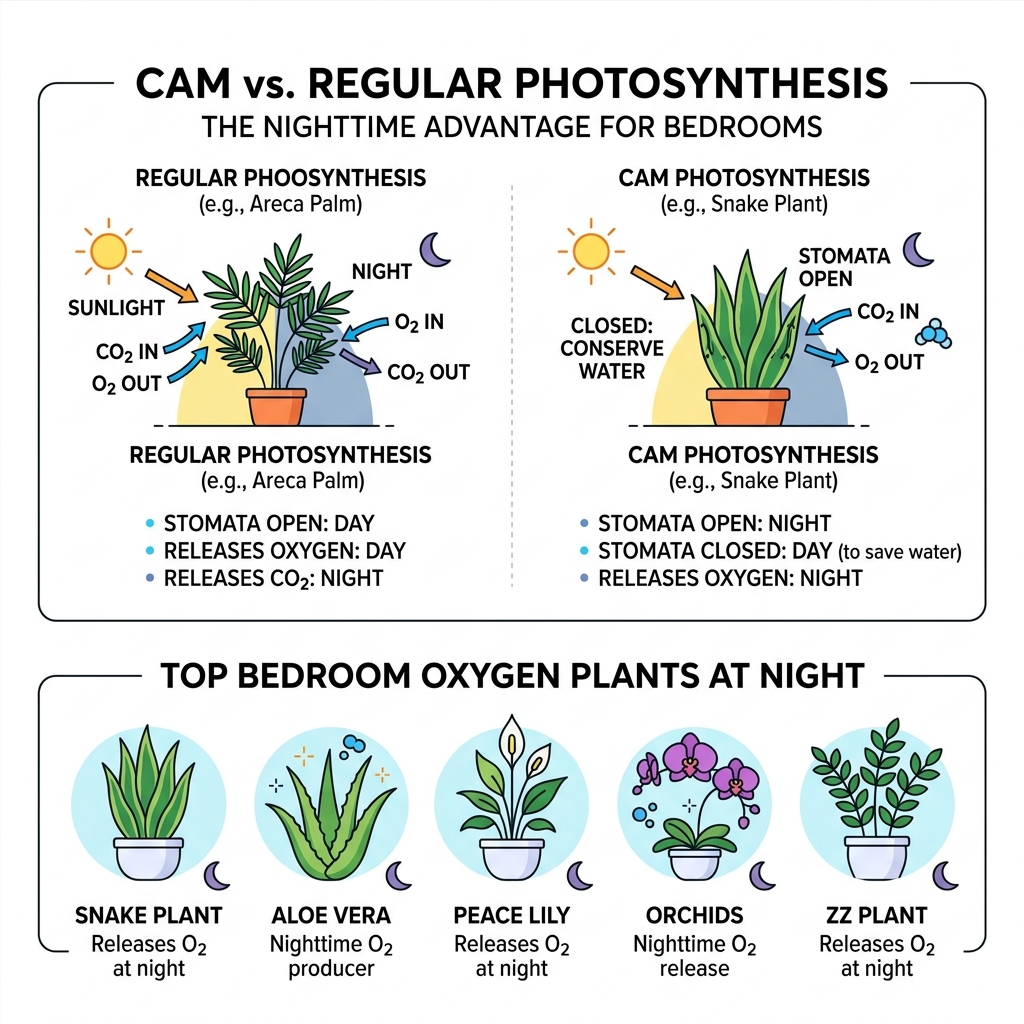
Unlike most plants, a special group uses a process called Crassulacean Acid Metabolism (CAM) to produce oxygen at night — right when you need it most. About 5-10% of plant species work this way, including several that are easy to find and even easier to care for.
This isn’t just feel-good advice. NASA-funded research has confirmed that specific indoor plants remove harmful airborne toxins from enclosed spaces. And for urban dwellers dealing with poor ventilation and sealed windows, that matters a lot.
The Science of Nighttime Oxygen Production
To understand why certain oxygen plants for bedroom use are so special, we have to look at how they breathe. Most plants follow a standard schedule: they take in carbon dioxide and release oxygen during the day (photosynthesis) and then flip the script at night, taking in a tiny bit of oxygen and releasing CO2 (respiration).
However, nature has a clever workaround for plants that evolved in hot, arid climates. About 5% to 10% of plant species use a process called Crassulacean Acid Metabolism, or CAM photosynthesis. In the desert, opening your “pores” (stomata) during the heat of the day would mean losing all your precious water to evaporation. To survive, these plants keep their stomata tightly shut during the day and only open them at night when it’s cool.
When these CAM plants open their stomata at night, they absorb carbon dioxide and release oxygen. This means while you are dreaming, your Snake Plant or Aloe Vera is actively refreshing the air. It’s like having a silent, natural air purifier running on your nightstand.
It is important to note that while most plants do release a small amount of CO2 at night through respiration, the levels are incredibly low—far less than what a human or even a small pet exhales. Having greenery in your room is entirely safe and provides a net benefit for air quality. For a deeper dive into how greenery transforms your home, check out our guide on air refreshing plants.
Top 10 Oxygen Plants for Bedroom Air Quality
Choosing the right oxygen plants for bedroom environments depends on your light levels and how much time you want to spend on maintenance. Here are our top picks for a literal breath of fresh air.

1. Snake Plant (Sansevieria)
Often called “Mother-in-Law’s Tongue,” this is the undisputed champion of bedroom plants. It is a CAM plant that specifically releases oxygen at night. It’s also incredibly hardy; it can survive in low light and doesn’t mind if you forget to water it for a few weeks. NASA studies highlight it as one of the best plants for removing toxins like formaldehyde and nitrogen oxides.
2. Aloe Vera
Known for its medicinal sap, Aloe Vera is also a nighttime oxygen powerhouse. It’s a succulent, meaning it stores water in its leaves and uses CAM photosynthesis. It’s excellent at filtering out benzene (found in detergents) and formaldehyde (found in floor finishes). Plus, if you get a minor burn or scrape, the remedy is right there on your windowsill!
3. Areca Palm
If you want to feel like you’re sleeping in a tropical resort, the Areca Palm is for you. Research suggests that just two Areca Palms in a 100-square-foot area can significantly increase oxygen levels. They also act as natural humidifiers, releasing moisture into the air through transpiration—perfect if you suffer from dry sinuses in the winter.
4. Peace Lily
The Peace Lily is a multi-tasker. While it isn’t a CAM plant, it is exceptionally efficient at air purification. Studies from the University of Technology Sydney found that Peace Lilies can increase oxygen levels by up to 25% in well-ventilated rooms. They are also famous for filtering out ammonia and trichloroethylene. To learn more about these powerhouses, see our list of air purifying plants for bedrooms.
5. Spider Plant
Spider plants are the “easy button” of the plant world. They are fantastic at battling carbon monoxide and xylene. They produce plenty of “babies” or spiderettes, which you can easily propagate to fill every room in your house with oxygen-producing greenery.
6. Pothos (Devil’s Ivy)
Pothos is a leafy vine that looks beautiful trailing from a high shelf. Tests have shown that Pothos can cause a 6.5% decrease in carbon dioxide levels. It’s one of the best options for beginners because it can tolerate almost any light condition and will “wilt” slightly to tell you exactly when it needs water.
7. Gerbera Daisy
While most bedroom plants are green and leafy, the Gerbera Daisy brings a pop of color. Surprisingly, these flowers are also nighttime oxygen producers. They are particularly effective at removing benzene that can come from ink or tobacco smoke.
8. Money Plant (Epipremnum aureum)
In many cultures, the Money Plant is believed to bring prosperity, but its real wealth is the oxygen it provides at night. Like the Pothos, it is a vigorous grower and works hard to scrub the air of synthetic chemicals.
9. Orchids
Orchids (specifically epiphytic varieties like Dendrobium and Phalaenopsis) are CAM plants. They absorb CO2 at night to conserve water, making them elegant additions to a bedside table. Unlike many other plants, they absorb nutrients and water from the air and rain rather than soil.
10. ZZ Plant (Zamioculcas zamiifolia)
The ZZ plant is nearly indestructible. It has waxy, deep green leaves that reflect light and brighten up dark corners. It’s a slow grower but a steady air purifier, making it a “set it and forget it” choice for a healthy bedroom.
Comparison Table: Oxygen and Light Needs
| Plant Name | Nighttime Oxygen? | Light Requirement | Maintenance Level |
|---|---|---|---|
| Snake Plant | Yes (CAM) | Low to Bright Indirect | Very Low |
| Aloe Vera | Yes (CAM) | Bright Indirect | Low |
| Areca Palm | No (Daytime) | Bright Indirect | Medium |
| Peace Lily | No (Daytime) | Low to Medium | Medium |
| Spider Plant | No (Daytime) | Medium | Low |
| Orchids | Yes (CAM) | Medium | Medium |
Proven Health Benefits of Bedroom Greenery
Beyond just looking pretty, having oxygen plants for bedroom use provides tangible health benefits backed by science.
NASA-Approved Toxin Removal
In the late 1980s, NASA conducted the Clean Air Study to find ways to detoxify the air in space stations. They discovered that common houseplants are surprisingly good at filtering “Volatile Organic Compounds” (VOCs). These include:
- Formaldehyde: Found in carpets, upholstery, and plywood.
- Benzene: Found in plastics, synthetic fibers, and some detergents.
- Trichloroethylene: Found in printing inks, paints, and lacquers.
Plants like the Snake Plant and Peace Lily act as living filters, pulling these chemicals into their leaves and roots. For more on this, read about plants that filter toxins.
Anxiety and Stress Reduction
Studies have consistently shown that being around greenery lowers cortisol levels (the stress hormone) and heart rates. The simple act of caring for a plant—watering it, wiping its leaves—can be a grounding ritual that signals to your brain it’s time to wind down for sleep.
Natural Humidity Boost
Plants release about 97% of the water they take in back into the air through transpiration. This is a game-changer for people living in dry climates or those who use heaters that dry out the air. Increased humidity can reduce the incidence of respiratory issues, dry skin, and sore throats.
Mold Spore and Particle Reduction
Believe it or not, plants can help keep your room cleaner. Some studies suggest that rooms with plants have up to 50-60% fewer airborne mold spores and bacteria than rooms without them. The plants essentially “clean” the air of biological pollutants.
How to Care for Your Oxygen-Producing Greenery
You don’t need a green thumb to keep these plants alive, but a few basic tips will ensure they produce the maximum amount of oxygen for you.
Light is Fuel
Even for “low-light” plants, light is the energy source for photosynthesis. If a plant doesn’t get enough light during the day, it can’t “charge up” to produce oxygen at night. Try to give your plants at least some indirect sunlight. If your bedroom is truly dark, consider rotating your plants to a sunnier room every few days. You can find more tips on low light rooms on our site.
The Role of Soil Microorganisms
The air purification doesn’t just happen in the leaves. Microorganisms in the potting soil play a massive role in breaking down pollutants like benzene. Using a high-quality, well-draining indoor plant soil mix helps these “good” bacteria thrive.
Don’t Overwater
The number one killer of indoor plants is “kindness”—specifically, too much water. Most oxygen plants for bedroom use, like Snake Plants and Aloe, are drought-tolerant. Wait until the top inch of soil is dry before watering again. Using pots with drainage holes is essential to prevent root rot.
Keep Leaves Clean
Dust is the enemy of oxygen production. A layer of dust on a leaf blocks the stomata, making it harder for the plant to “breathe” and filter toxins. Every few weeks, take a damp cloth and gently wipe the leaves of your larger plants like the Peace Lily or Snake Plant. This keeps them efficient and looking shiny! For more maintenance advice, see our guide on easy care plants.
Frequently Asked Questions about Oxygen Plants for Bedroom
Do plants release harmful CO2 at night?
This is one of the most common myths in the plant world! While it is true that most plants release a small amount of carbon dioxide at night during respiration, the amount is negligible. To put it in perspective, a human roommate or a dog releases significantly more CO2 than a dozen plants combined. There is absolutely no danger of “suffocating” from plants in your room. In fact, by choosing CAM plants, you are actually reducing the CO2 levels while you sleep.
Which oxygen plants for bedroom are best for low light?
If your bedroom doesn’t get much sun, go for the Snake Plant, ZZ Plant, or Pothos. These species have adapted to survive on the forest floor or in shaded areas, meaning they can still perform their air-purifying duties with very little light. For more hardy options, check out our section on low maintenance air purifying plants.
How many oxygen plants for bedroom do I need for a 100 sq ft space?
While one plant is better than none, studies suggest that for a noticeable impact on air quality, you should have multiple plants. For a standard 100-square-foot bedroom, two Areca Palms or a combination of 3-5 medium-sized plants (like a Snake Plant, a Pothos, and a Peace Lily) will provide a significant boost in oxygen and toxin removal. If you love the look of greenery, don’t be afraid to add more! You can find inspiration in our article on the best leafy plants for air purification.
Conclusion
At Mount Pilchuck, we believe that your bedroom should be a sanctuary—a place where the air is fresh, the mind is calm, and sleep comes easily. Integrating oxygen plants for bedroom decor isn’t just an aesthetic choice; it’s a lifestyle shift toward better respiratory health and improved mental well-being.
While these plants do incredible work, they are most effective when part of a broader sleep hygiene routine. Try to keep your bedroom temperature cool, declutter your nightstands to reduce dust, and ensure there is at least some ventilation during the day.
Whether you start with a single, nearly-indestructible Snake Plant or turn your room into a lush indoor jungle, your body will thank you for the extra oxygen. Ready to start your indoor garden? Explore our indoor plants category for more expert advice and plant recommendations.
For more tips on optimizing your home environment, visit us at https://www.mountpilchuck.com/. Happy planting and sweet dreams!
